---
title: "Adoption Assistance on Your Paycheck: Reimbursement and Tax Checks"
description: "Reconcile adoption assistance, employee reimbursements, payroll taxes and W-2 code T with an original cash example and a separate expense-allocation checklist."
url: "https://blog.checkstubsonline.com/adoption-assistance-paycheck"
datePublished: "2026-11-27"
---
# Adoption Assistance on Your Paycheck: Reimbursement and Tax Checks
Reconcile adoption assistance, employee reimbursements, payroll taxes and W-2 code T with an original cash example and a separate expense-allocation checklist.
Published: 2026-11-27
By [Check Stubs Online Editorial Team](https://blog.checkstubsonline.com/editorial-policy#editorial-team)
**A qualifying employer adoption reimbursement can avoid federal income-tax withholding while still increasing Social Security and Medicare wages.** First identify who received the payment, then compare the correct wage bases and cash deposit. W-2 Box 12 code T reports adoption benefits; the employee’s permitted income exclusion and any adoption credit require a separate tax-return review.
Reviewed November 27, 2026 · U.S. federal 2026 adoption-benefit payroll. The worked records are fictional and assume a qualifying written program, substantiated eligible expenses and ordinary employee status. State rules, adoption timing, income limits, ownership cases and the actual return can change the result.
A reimbursement can make the deposit much larger without making every dollar federal income-tax withholding wages. A payment sent to an agency can have the opposite cash pattern. Reconcile the benefit approval, payment recipient and tax treatment as three separate questions before interpreting an unfamiliar pay-stub label.
## In this guide
1. [Identify the payment route](#adopt-payment)
2. [Check the written program and expenses](#adopt-program)
3. [Compare the federal wage bases](#adopt-wages)
4. [Reconcile an original employee reimbursement](#adopt-example)
5. [Separate code T from return eligibility](#adopt-return)
6. [Allocate expenses without double counting](#adopt-allocation)
7. [Request the right record or correction](#adopt-correct)
8. [Adoption payroll questions](#adopt-faq)
## Start with the person or organization that received the money
Find the actual payment reference. A $4,200 benefit approval does not tell you whether $4,200 was reimbursed to the employee, paid to an agency, scheduled for later, or never transmitted. Those arrangements can share a benefit label but produce different deposits.
**Three adoption-payment routes and the cash record to check**
| Arrangement | Cash tracing | Important distinction |
| --- | --- | --- |
| Employee reimbursement | Match the employer transfer to the employee’s bank or payroll deposit. | The reimbursed amount is part of cash paid; do not subtract an agency-payment offset. |
| Direct agency payment | Match the employer transaction to the agency receipt. | A taxable payroll value may appear without that benefit being paid into the employee’s bank. |
| Ordinary unrestricted bonus | Match the cash earnings and normal payroll treatment. | An adoption-related personal purpose does not establish a qualifying employer program. |
If the transfer is separate from the normal paycheck, reconcile both payments. Do not assume that a line in an informational benefits section was deducted from wages or included in the bank transfer. The [guide to employer-paid benefits](https://blog.checkstubsonline.com/employer-paid-benefits-pay-stub) explains how to distinguish displayed values from actual cash movements.
## A plan approval and a qualified expense are both necessary checks
The adoption section of [2026 IRS Publication 15-B](https://www.irs.gov/publications/p15b) describes a separate written employer program, eligibility and nondiscrimination conditions, reasonable notice and substantiation. It also limits benefits for specified owners and their families. A more-than-2% S-corporation shareholder does not receive the ordinary employee exclusion treatment described here.
Request the current plan terms, your eligibility confirmation, the approved expense category and amount, and the required receipts. The employer’s allowance can be smaller than the federal exclusion ceiling. Neither a favorable payroll code nor a plan’s advertised maximum guarantees reimbursement of a particular invoice.
The [IRS adoption-benefits page](https://www.irs.gov/credits-deductions/individuals/adoption-credit) identifies eligible children and qualifying costs, such as adoption fees and appropriate legal, court and travel expenses. Surrogacy costs and adopting a spouse’s child are excluded from these adoption-tax rules. Other reimbursements and prior benefits must also be considered. Special-needs adoption has its own conditions and cannot be established solely by a medical description.
Keep sensitive adoption records in the administrator’s approved submission channel. A payroll clarification normally needs an amount, benefit reference and payment date; it does not require circulating a child’s full identity or unredacted case file.
## Why can adoption assistance be subject to FICA but not income-tax withholding?
Publication 15-B separates these taxes. Payments for qualifying expenses under the employer program are excluded from federal income-tax withholding wages, but remain subject to Social Security, Medicare and FUTA under the applicable rules. FUTA is paid by the employer; it is not another employee deduction.
The [2026 W-2 instructions](https://www.irs.gov/instructions/iw2w3) direct qualifying program benefits to code T in Box 12, including benefits above the exclusion amount. They exclude those benefits from Box 1 while requiring the applicable Social Security and Medicare wage reporting. That reporting rule does not resolve the employee’s final permitted exclusion.
For the cash example below, assume the employee remains below the Social Security wage ceiling and no Additional Medicare withholding is triggered. [2026 Publication 15](https://www.irs.gov/publications/p15) specifies a 1.45% employee Medicare rate; the employee Social Security rate is 6.2%. Actual wage limits, exemptions, other benefits and year-to-date earnings must be checked before using those assumptions.
## Original example: $4,200 reimbursed directly to an employee
Assume a fictional employee receives $3,850 ordinary cash salary and a $4,200 reimbursement in the same payroll. The employee previously paid the supported adoption expenses personally. The reimbursement meets the written-program rules, and the employee qualifies to exclude it on the return. Federal income-tax withholding on the salary is supplied as $410. No pre-tax reductions, state/local taxes or other employee deductions are modeled.
**Original cash-reimbursement payroll with separate withholding and FICA bases**
| Payroll line | Reason or calculation | Amount |
| --- | --- | --- |
| Cash salary | Ordinary period earnings | $3,850.00 |
| Adoption reimbursement | Cash also paid to the employee | $4,200.00 |
| Federal withholding wage base | Qualifying adoption payment excluded | $3,850.00 |
| Social Security and Medicare wages | Salary plus reimbursement | $8,050.00 |
| Employee Social Security | $8,050 × 6.2% | −$499.10 |
| Employee Medicare | $8,050 × 1.45%, rounded | −$116.73 |
| Federal income tax withheld | Supplied salary withholding | −$410.00 |
| Combined cash deposit | $8,050 − $499.10 − $116.73 − $410 | $7,024.17 |
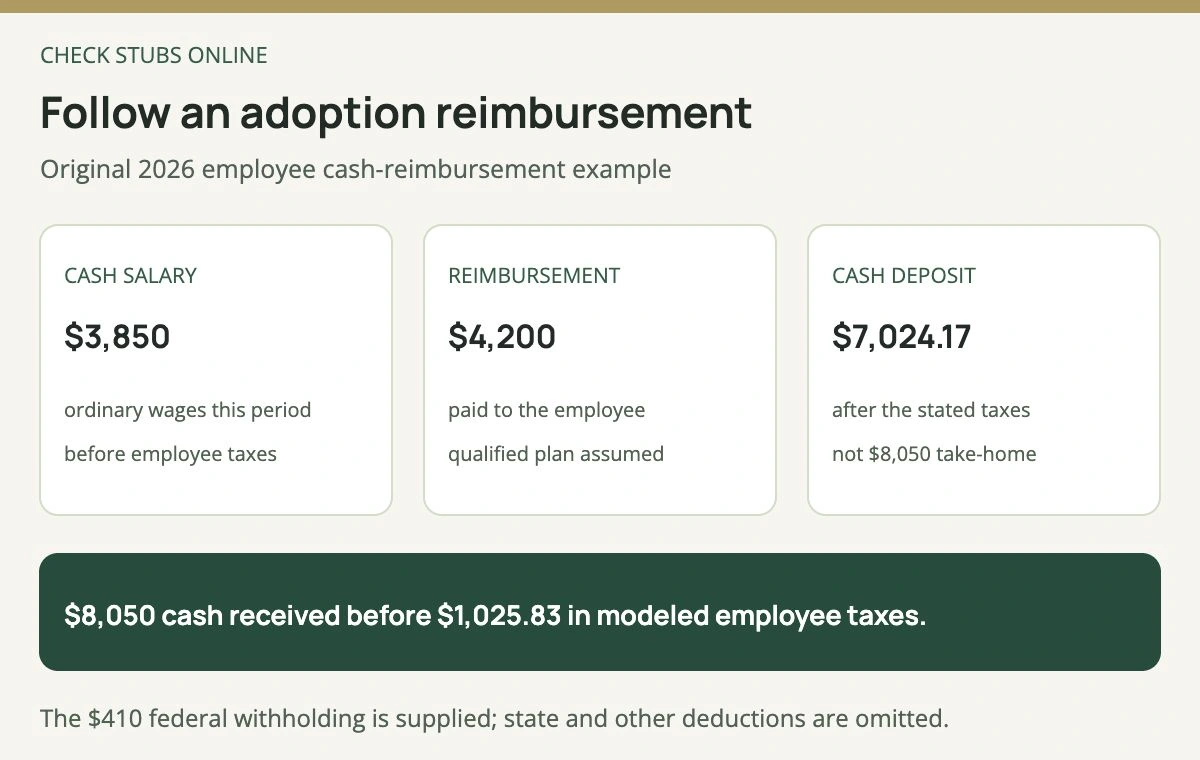
This reimbursement goes to the employee. A direct-to-agency benefit would require a different cash bridge.
The reimbursement is not a $4,200 tax-free increase in take-home pay under these assumptions. At the same $410 supplied withholding, salary alone produces $3,145.47 after ordinary employee FICA. Adding the reimbursement increases the modeled deposit by $3,878.70: $4,200 less $321.30 of additional FICA. Each tax line is rounded independently to cents.
Do not subtract $4,200 as a noncash offset in this example: the employee actually receives it. If the employer instead sends $4,200 to an agency, cash wages remain $3,850 before the stated employee taxes, producing $2,824.17 in this otherwise identical model. The agency payment and employee deposit would then be separate. Neither illustration predicts an individual paycheck.
A useful [gross-to-net reconciliation](https://blog.checkstubsonline.com/gross-vs-net-pay) starts with the correct cash route. The amount appearing in Social Security wages is not automatically the amount paid into the employee’s bank.
## Code T identifies the benefit; it does not approve the final exclusion
Publication 15-B identifies a potential $17,670 exclusion for 2026. Treat that as an applicable per-child limit subject to the rules, rather than a new annual cash entitlement. Previous benefits for the same adoption, household income, filing status and adoption type or timing need separate review. A payroll withholding exemption does not guarantee that no additional income belongs on the return.
The IRS adoption page distinguishes the exclusion from the Adoption Credit and directs the taxpayer to Form 8839. Its current page contains 2026 information, while its linked detailed Form 8839 instructions are still labeled 2025. Use the form and final instructions applicable to the return being filed; do not transplant a prior-year threshold or timing example without checking it.
Domestic, foreign and qualifying special-needs adoptions have different timing and expense rules. If a foreign adoption is not finalized, or benefits span several years, retain the prior-year amounts and obtain the appropriate return-year treatment. An employer’s correct code T entry should not be changed to Box 1 merely because a personal return limitation reduces the exclusion.
## Use a separate expense allocation for the exclusion and credit
Assume $14,760 of otherwise qualifying costs for one adoption, including the same $4,200 reimbursed above. Assume that $4,200 is fully excludable and no other reimbursement or prior-year benefit affects this limited example. The remaining expense pool is $14,760 − $4,200 = $10,560.
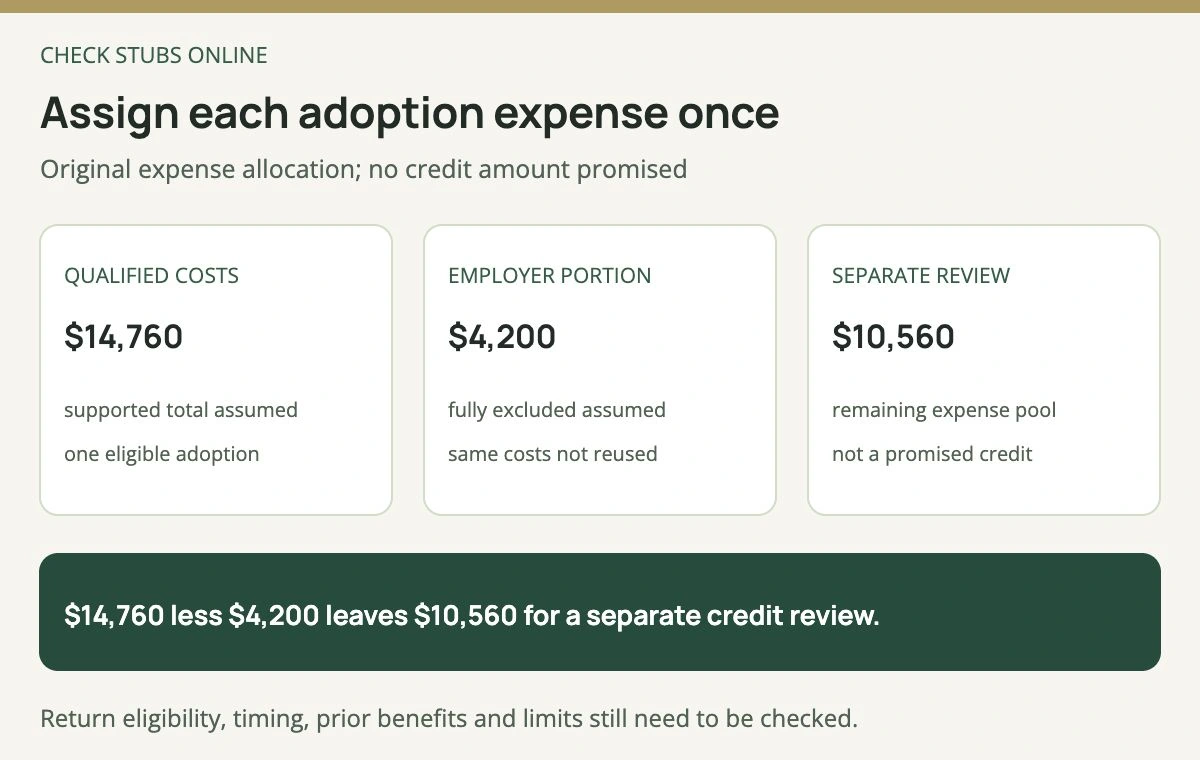
The $10,560 is a pool of remaining expenses to evaluate. It is not an approved credit, refund or cash benefit.
The IRS says the same qualifying expense cannot support both the employer exclusion and the credit. Maintain invoice-level records showing the cost, payer, reimbursement and benefit allocation. Then review the remaining costs under the credit’s own income, timing, per-child and prior-claim limits. The employer exclusion is considered before the credit.
Neither a $4,200 code T entry nor a $10,560 remaining balance establishes the credit’s refundable portion. A refund calculation involves the actual return and current filing instructions, not just subtraction on a benefit worksheet.
## A practical payroll and tax-record checklist
1. **Match the approval to a completed payment.** Record the benefit year, approved costs, transfer date and actual recipient.
2. **Identify the wage bases separately.** Ask whether the adoption amount was included in Social Security and Medicare wages and excluded from income-tax withholding wages under the proper rules.
3. **Rebuild the cash total.** Include a reimbursement actually paid to the employee, or separate a payment already sent to an agency.
4. **Reconcile annual reporting.** Compare the employer’s qualifying program total with code T and applicable annual wage boxes.
5. **Review the return independently.** Check eligibility, prior amounts and expense allocation before determining the exclusion or credit.
For example: “My approved $4,200 adoption reimbursement was paid to me on this payroll. Please confirm its withholding and FICA bases and the corresponding code T total.” Use your supported figures and a secure transaction reference.
If an issued record is incorrect, ask the employer to explain and correct it. Follow the [pay-stub correction process](https://blog.checkstubsonline.com/pay-stub-errors-correction); a separately created statement cannot change the employer’s benefit classification or establish adoption eligibility. A later W-2 reporting error may require the issuer’s correction process as well.
## Adoption assistance paycheck questions
### Why was Social Security tax taken from an adoption reimbursement?
Qualifying program benefits can be excluded from federal income-tax withholding while remaining FICA wages. Check the actual benefit rules and wage-base limits rather than assuming all taxes share one exemption.
### Does code T mean the entire amount is excluded from my income?
No. It identifies reported employer adoption benefits. The allowable exclusion depends on the applicable return rules and household facts.
### Should I subtract a noncash benefit offset from a cash reimbursement?
Not merely because another example uses one. Trace who received the money. A reimbursement actually paid to the employee differs from an employer payment directly to an agency.
### Can I use the reimbursed invoice again for the adoption credit?
The portion allocated to excluded employer assistance cannot also support the credit. Review remaining costs separately and retain their payment and benefit records.
Check Stubs Online’s editorial review used current IRS adoption, fringe-benefit, payroll-rate and W-2 guidance. The employee reimbursement and expense-allocation ledgers were independently constructed and checked for this guide.
## Relevant document tool
Review the IRS adoption-benefits guidance
Check the qualified program, payment route and expense allocation before interpreting payroll or the annual code T amount.
[Review adoption assistance rules](https://www.irs.gov/publications/p15b)
A payroll entry does not determine a child’s eligibility, a household’s exclusion or a tax refund.
## Related guides
- [Pay Stub Errors: How to Request and Track a Correction](https://blog.checkstubsonline.com/pay-stub-errors-correction)
- [Employer-Paid Benefits on a Pay Stub: What Changes Your Pay?](https://blog.checkstubsonline.com/employer-paid-benefits-pay-stub)
- [Gross vs. Net Pay: Reconcile Your Paycheck](https://blog.checkstubsonline.com/gross-vs-net-pay)