---
title: "Nondiscretionary Bonuses and Overtime: Check Your Regular Rate"
description: "See how an included bonus changes overtime pay, with an original weekly calculation, a later-payment true-up and practical payroll record checks."
url: "https://blog.checkstubsonline.com/bonus-overtime-regular-rate"
datePublished: "2026-11-22"
---
# Nondiscretionary Bonuses and Overtime: Check Your Regular Rate
See how an included bonus changes overtime pay, with an original weekly calculation, a later-payment true-up and practical payroll record checks.
Published: 2026-11-22
By [Check Stubs Online Editorial Team](https://blog.checkstubsonline.com/editorial-policy#editorial-team)
**A nondiscretionary bonus can increase the regular rate used to calculate overtime for a covered, nonexempt employee.** Include the bonus in the workweek in which it was earned, subject to the applicable allocation rules and statutory exclusions. If payroll pays the bonus later, an additional overtime adjustment may be due for the affected weeks. The award’s label and its payment date do not settle that calculation.
Reviewed November 22, 2026 · Ordinary federal FLSA overtime for nonexempt employees. Fictional examples assume one hourly rate, actual worked hours and no other earnings or exclusions. State law, contracts, exemptions and special pay arrangements require separate review.
A performance award can create two payroll questions: how much bonus was earned, and whether the original overtime premium needs to rise. A statement showing the bonus alone may not answer the second question. Start with the plan, the earning period and the employee’s weekly time records.
This guide explains compensation before deductions. For the amount withheld after earnings are calculated, use our separate [bonus tax-withholding guide](https://blog.checkstubsonline.com/bonus-tax-withholding). A payroll-tax method does not decide which earnings belong in an overtime rate.
## In this guide
1. [Identify the bonus terms](#bonus-status)
2. [Base pay versus regular rate](#bonus-rate)
3. [Calculate an original weekly example](#bonus-worked-example)
4. [Reconcile a later payment](#bonus-later-payment)
5. [Handle a bonus covering several weeks](#bonus-longer-period)
6. [Build a practical review file](#bonus-records)
7. [Request an explained correction](#bonus-next-step)
8. [Common bonus and overtime questions](#bonus-questions)
## Does the plan make the bonus nondiscretionary?
The [Department of Labor’s bonus guidance](https://www.dol.gov/agencies/whd/fact-sheets/56c-bonuses) distinguishes an unexpected award under the employer’s retained discretion from promised incentives. A genuinely discretionary bonus requires the employer to retain the decision about both payment and amount until near the end of the relevant period, without an earlier promise or agreement creating an expectation. Calling a plan “discretionary” does not by itself meet that test.
Previously announced production, attendance or quality incentives commonly belong in the regular rate. A separate statutory exclusion can change the treatment, so “nondiscretionary” is not a substitute for reviewing the actual payment. Keep the announcement, formula, eligibility rules and any later amendment. An employee’s memory of an informal promise is a reason to locate the relevant communication, not to reconstruct a different plan.
**Questions to identify before classifying a bonus**
| Record | Question it answers | What it does not establish alone |
| --- | --- | --- |
| Plan or announcement | Was an incentive promised before the work? | The title “discretionary” is not the complete test |
| Calculation schedule | Which performance and dates generated the amount? | The bank-payment date does not identify every earning week |
| Payroll explanation | Was the payment included or excluded, and why? | A code such as BONUS does not show the legal analysis |
## Your base hourly rate and regular rate can differ
The [DOL regular-rate overview](https://www.dol.gov/agencies/whd/fact-sheets/56a-regular-rate) explains that the overtime base generally uses included compensation and actual hours worked in each workweek. The contractual hourly rate is one input. Included incentives or differentials can make the regular rate higher. A pay-period total is not a reason to average separate workweeks together.
For the simple hourly case below, all worked hours first receive straight-time pay. The extra overtime component is then one-half of the regular rate for each overtime hour. That half-rate step works because the straight-time component for those hours has already been paid. It does not mean an employee’s entire overtime compensation is only half of an hourly rate.
Different arrangements need their own calculations. Multiple rates, commissions, piecework, daily overtime and special statutory arrangements can require more detail. Our [weekend differential guide](https://blog.checkstubsonline.com/weekend-differential-pay) addresses another kind of added compensation; this example intentionally isolates a single bonus.
## Original example: a $90 bonus raises gross pay to $1,235
Assume a covered, nonexempt hourly employee works 45 hours in one established workweek at $24 per hour. A promised $90 production incentive is earned entirely in that week and must be included. There is no leave pay, other bonus, shift premium, commission, special exemption or additional state calculation in this teaching case.
**Fictional one-week bonus and overtime calculation**
| Step | Calculation | Result |
| --- | --- | --- |
| Pay straight time for all 45 hours | 45 × $24 | $1,080.00 |
| Add included weekly bonus | $1,080 + $90 | $1,170.00 |
| Calculate regular rate | $1,170 ÷ 45 | $26.00/hour |
| Find weekly overtime hours | 45 − 40 | 5 hours |
| Add the overtime premium | 5 × $26 × 0.5 | $65.00 |
| Total gross compensation | $1,170 + $65 | $1,235.00 |
The $65 premium contains $60 attributable to the $24 base rate and another $5 attributable to the bonus. One useful independent check is $90 ÷ 45 = $2 of added regular rate; $2 × 0.5 × 5 = $5 additional premium. Both routes produce the same result.
Do not add 45 hours of straight-time pay and five full hours at $39 without removing the straight time already included for those five hours. That would count part of the same compensation twice. Alternatively, a correctly structured record can show 40 hours at $24, five at $36, the $90 bonus and a $5 bonus-related adjustment: $960 + $180 + $90 + $5 = $1,235.
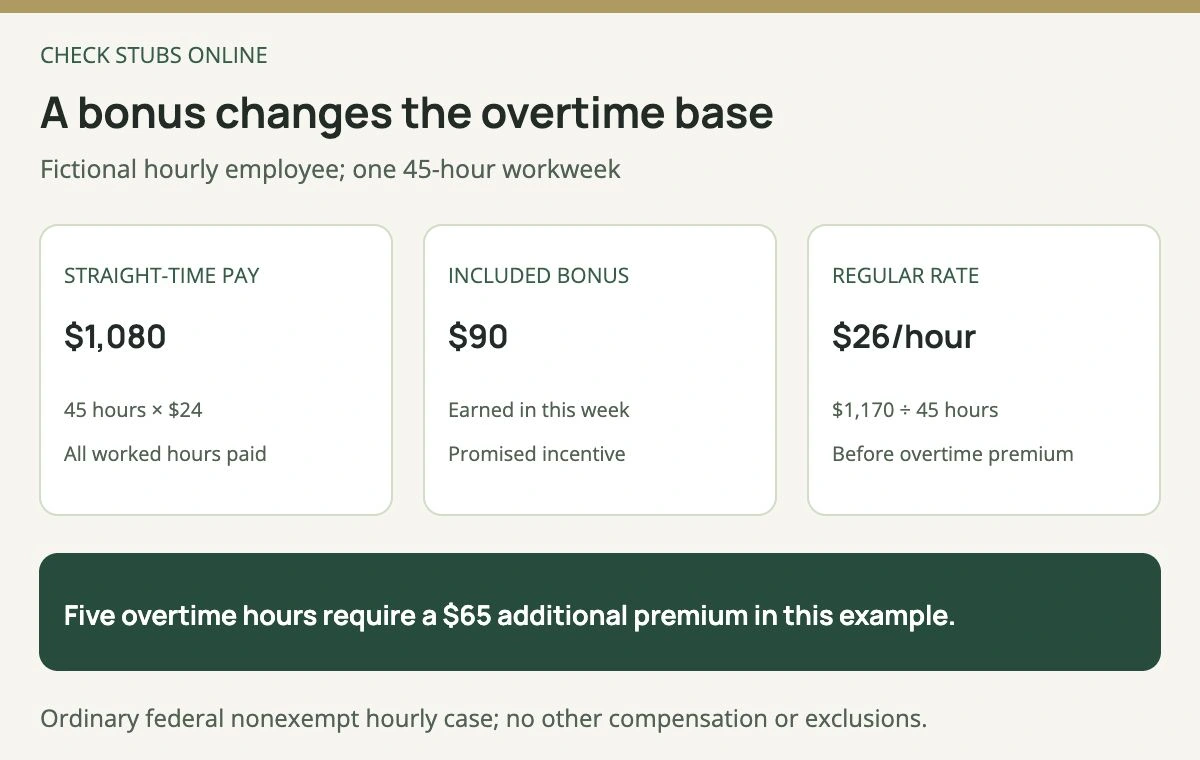
The example separates straight-time compensation, the included bonus and the additional overtime premium. It does not estimate take-home pay.
## What if the bonus is paid after the original paycheck?
Continue the same example. Before the award could be calculated, assume payroll correctly paid $1,080 straight time plus a $60 base-rate overtime premium, for $1,140 gross. Once the $90 bonus becomes ascertainable, paying only $90 would leave the bonus-related overtime component missing. The additional gross payment in this scenario is $95: the bonus plus the $5 true-up.
The reconciliation is $1,140 already paid + $90 bonus + $5 adjustment = $1,235. It is not another full $65 premium, because $60 of that premium was already paid. Nor is it another $1,235 payment. Compare the original statement and the later adjustment together.
The current [29 CFR Part 778, sections 778.106 and 778.209](https://www.ecfr.gov/current/title-29/subtitle-B/chapter-V/subchapter-B/part-778), addresses delayed calculations and allocation. A later determination is not an unlimited permission to postpone compensation after it can be computed. Ask which earning weeks and overtime amounts the later payment corrects.
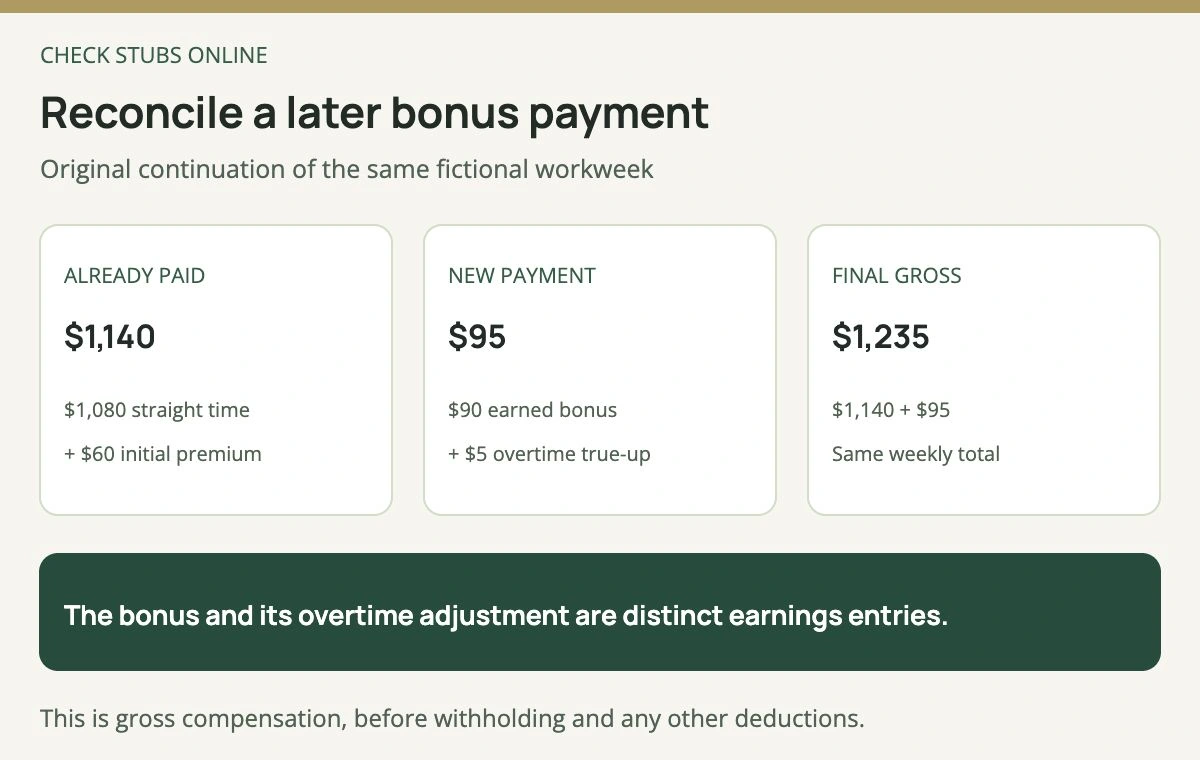
A later statement may contain both the earned award and an overtime reconciliation for the earlier week.
## A monthly or quarterly bonus needs a workweek allocation
For an included bonus spanning several weeks, section 778.209 calls for attributing it to the weeks in which it was earned and checking the affected overtime. When actual weekly earnings cannot be identified, the regulation permits an appropriate reasonable allocation supported by the facts. Do not move an entire quarter’s incentive into the payment week merely because that is when it appears on a statement.
Build a worksheet with the earning dates, weekly hours, each week’s allocated bonus and overtime already paid. A week with no overtime and a week with several overtime hours can have different adjustment results even when their allocated bonus amounts are equal. Dividing everything by a quarterly average can hide those differences.
Some bonuses structured as a percentage of total straight-time and overtime earnings are addressed differently under section 778.210. A percentage plan should be reviewed before adding a second adjustment that the plan has already covered. The $90 example here is a fixed included incentive, not that percentage arrangement.
## Keep the evidence at the level of the calculation
1. **Save the original promise.** Keep the announced rules and the version applicable to the work.
2. **Identify the earning window.** Separate performance dates from award approval and payment dates.
3. **Retain weekly time.** Use actual worked hours rather than a pay-period average or leave balance.
4. **List included compensation.** Record the bonus and any other pay components separately.
5. **Reconcile prior payments.** Identify the overtime already paid before calculating an additional amount.
6. **Link the correction.** Keep the later statement with the weeks it adjusts.
For the fictional employee, a compact file has four items: the $90 production plan, the 45-hour time record, the original $1,140 statement and the $95 adjustment statement. That file answers both “what changed?” and “was part of this paid before?” A deposit screenshot alone cannot show the full gross calculation.
## Ask payroll for an explained calculation
A focused request could say: “The production award relates to the week in which I worked 45 hours at $24. Please explain its regular-rate treatment and any overtime true-up. My illustrative reconciliation is a $26 regular rate, $65 total premium and $5 above the $60 premium already paid.” Replace the assumptions with the real facts rather than presenting this article as an employer-specific determination.
If records disagree, request an issuer correction using our [pay-stub error workflow](https://blog.checkstubsonline.com/pay-stub-errors-correction). A [retroactive wage increase](https://blog.checkstubsonline.com/retroactive-pay-raise-overtime) can also require earlier-week recalculation, but a changed base rate and a performance bonus are distinct inputs. Preserve both original and corrected records.
When preparing an authorized record, the [Enhanced pay stub builder](https://www.checkstubsonline.com/enhanced-pay-stub) supports regular, overtime and additional earnings entries. Enter the verified payroll figures and inspect the totals. The tool does not classify a bonus, allocate it across prior weeks, determine legal entitlement or pay the employee.
## Bonus and overtime questions
### Does every bonus increase overtime pay?
No. Coverage, exemption status, the bonus terms and applicable exclusions matter. This guide’s calculation assumes a bonus that must be included for a nonexempt employee.
### Can an employer exclude it by naming it discretionary?
The name alone does not decide. Review who retained control of the payment and amount, when that decision was made, and any earlier promise.
### Do I divide the bonus by 40 hours?
In the stated 45-hour example, included compensation is divided by all 45 actual worked hours. Using 40 would produce a different, unsupported regular rate for this case.
### Does the payment week determine all overtime adjustments?
No. An included deferred award must be considered for its earning period under the allocation rules. Keep those dates separate from its payment date.
### Is the overtime adjustment tax-free?
This is a wage-compensation calculation, not a conclusion about tax exclusions or deductions. Review payroll withholding and any tax-return treatment separately under the applicable tax rules.
Check Stubs Online’s editorial review used the linked DOL guidance and current federal overtime regulations. The 45-hour scenario was constructed for this guide and checked through two independent arithmetic paths; no employer-specific legal conclusion is implied.
## Relevant document tool
Keep the bonus and overtime adjustment clear
Enter approved earnings and checked overtime amounts, then review the full statement and its totals.
[Open the Enhanced builder](https://www.checkstubsonline.com/enhanced-pay-stub)
Record preparation does not determine bonus classification, allocate prior-week pay or make a wage payment.
## Related guides
- [Retroactive Pay After a Raise: Check Hours and Overtime](https://blog.checkstubsonline.com/retroactive-pay-raise-overtime)
- [Weekend Differential Pay: Rates, Hours and Overtime](https://blog.checkstubsonline.com/weekend-differential-pay)
- [Bonus Tax Withholding: Why Your Bonus Check Is Smaller](https://blog.checkstubsonline.com/bonus-tax-withholding)