---
title: "Cannot Pay Your Federal Tax Balance? Filing and Payment Steps"
description: "Cannot pay your federal tax bill in full? Separate filing, partial payments, IRS plans and hardship review, with a checked example and a practical record checklist."
url: "https://blog.checkstubsonline.com/cannot-pay-tax-balance"
datePublished: "2026-11-11"
---
# Cannot Pay Your Federal Tax Balance? Filing and Payment Steps
Cannot pay your federal tax bill in full? Separate filing, partial payments, IRS plans and hardship review, with a checked example and a practical record checklist.
Published: 2026-11-11
By [Check Stubs Online Editorial Team](https://blog.checkstubsonline.com/editorial-policy#editorial-team)
**If you cannot pay your full federal tax balance, do not wait to address a required return: verify the amount, pay what you can through an official channel and review the IRS options for the remainder.** Filing and payment have separate consequences. A filing extension, a payment-plan application and an approved installment agreement are different actions; none should be assumed to erase the debt or all additional charges.
Reviewed November 11, 2026 · U.S. federal individual tax balances. Original examples reconcile fictional principal and a proposed budget only. They do not calculate penalties, interest, payment allocation, relief eligibility or an approved repayment term. State tax accounts require separate review.
A useful first session should leave you with three concrete records: the return or notice you are addressing, evidence of any actual payment, and the status of the next action. Having those records is more reliable than remembering that you clicked a payment link or discussed a plan.
## In this guide
1. [Separate filing from payment](#balance-file)
2. [Confirm the year and balance](#balance-confirm)
3. [Reconcile a partial payment](#balance-example)
4. [Compare payment-plan routes](#balance-plan)
5. [Test a proposed monthly budget](#balance-budget)
6. [Address hardship and notices](#balance-hardship)
7. [Keep future withholding separate](#balance-future)
8. [Unpaid-tax questions](#balance-faq)
## File and pay as separate tasks
The [IRS payment-plan overview](https://www.irs.gov/payments/payment-plans-installment-agreements) advises timely filing even when full payment is not possible and paying as much as you can. Waiting until you can afford everything can leave the filing obligation unresolved as well as the payment obligation.
The [failure-to-file penalty](https://www.irs.gov/payments/failure-to-file-penalty) concerns an untimely required return, including the applicable extension. The separate [failure-to-pay guidance](https://www.irs.gov/payments/failure-to-pay-penalty) concerns unpaid tax and explains that circumstances such as an approved agreement can affect the calculation. Do not combine simplified percentages from different situations into a personal bill.
If there is still time to request a valid extension, review the [IRS filing-extension instructions](https://www.irs.gov/filing/get-an-extension-to-file-your-tax-return). More time to file generally does not extend the payment deadline. Check the actual tax year and any applicable relief; an expired filing window cannot be reopened merely by reading an extension guide.
Our [Form 4868 preparation guide](https://blog.checkstubsonline.com/form-4868-online-tax-extension-guide) explains that document separately. A prepared PDF, a submitted extension request and confirmation of an accepted filing action should not be treated as the same record.
## Confirm which balance you are trying to resolve
Write the tax year, return type, notice number if any, and the date of the amount shown. A return balance at filing may differ from a later notice or current account because of payments, adjustments and charges. Start by explaining the difference instead of choosing whichever number is lower.
The [IRS individual account](https://www.irs.gov/payments/online-account-for-individuals) provides balances by year, payment history and pending or scheduled payments. Match those records to your confirmations. A payment scheduled for next week has a different status from one already completed and credited.
If the underlying calculation is unclear, use [our federal balance reconciliation guide](https://blog.checkstubsonline.com/why-owe-federal-income-tax) first. An inability to pay and a disagreement about whether the amount is correct require different evidence, although a person may need to address both.
**A focused federal balance action sheet**
| Item | Record to keep | Question to resolve |
| --- | --- | --- |
| Return or notice | Copy, tax year, amount and date | Does the current account agree? |
| Payment | Confirmation, tax type, year and status | Has it completed and been credited? |
| Plan request | Application and decision or pending status | What action or response is still required? |
| Notice deadline | Actual notice instructions and due date | What must happen before that date? |
| Future tax review | Separate current-year withholding or estimated-payment file | Will a new balance be created? |
## Original example: a partial payment changes principal
Assume a fictional account has $3,460 confirmed tax principal and a $900 payment is completed and credited entirely against it. For this limited illustration, there are no existing charges or allocation questions. The remaining principal is $2,560.
That subtraction does not produce a payoff quote. A real account can include charges or apply payments according to rules that require a more detailed reconciliation. Save the payment evidence and obtain the actual remaining amount rather than treating this example as an account calculation.
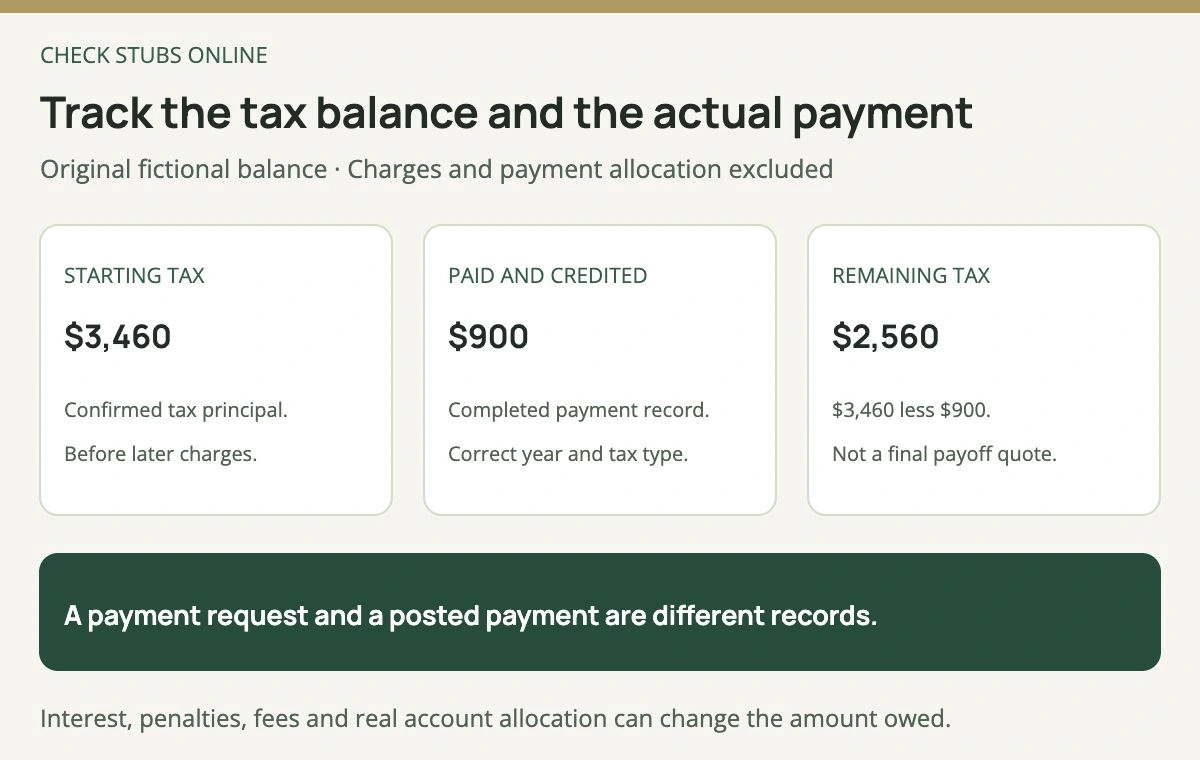
The $2,560 is the example’s remaining tax principal, not a promise about the amount required to close a real account.
Also record where the payment went. Sending money for the wrong year, a state account or a future estimated installment does not establish that this federal balance was credited. Resolve a mismatch through the relevant official account or notice channel instead of sending the same amount again without checking.
The [official IRS payment page](https://www.irs.gov/payments) lists payment methods and their conditions. Review any method-specific fees and confirmation instructions. A receipt should identify an actual payment action; a downloaded tax document is not a remittance.
## Use the current payment-plan application rules
The [IRS online agreement page](https://www.irs.gov/payments/online-payment-agreement-application), reviewed for this article, describes a short-term option of 180 days or less and monthly installment arrangements. It currently lists online individual application thresholds of less than $100,000 combined tax, penalties and interest for the short-term option, and $50,000 or less for the Simple payment plan, with all required returns filed for the latter.
Those are application criteria, not a promise that your chosen amount or term will be accepted. Review the current page when applying, including the applicable fees and any low-income provisions. Different application or payment methods can affect costs. If online application is unavailable, follow the official alternatives.
Keep the request and its outcome separate in your folder. Note whether it was saved, submitted, approved, rejected or requires more information. If an existing arrangement is already in place, review its terms before changing payment behavior. A new draft budget does not amend an agreement.
Before confirming anything, compare the proposed payment date with actual income dates and essential expenses. A monthly amount that looks manageable in an annual average may be difficult in a particular week. Our [biweekly budgeting guide](https://blog.checkstubsonline.com/biweekly-paycheck-budget) explains why the bank calendar matters alongside monthly totals.
## Original budget test: division is not a repayment agreement
Suppose the fictional person proposes $320 per month toward the $2,560 principal. Dividing principal by that proposed amount gives eight. That is only a principal-only planning result; it assumes no additional charges and does not establish an approved installment amount.
The [IRS interest guidance](https://www.irs.gov/payments/interest) explains that interest can continue on unpaid amounts and that rates may change quarterly. Approved plans can also carry applicable charges. Consequently, eight payments cannot be presented as the real account’s final term or cost.
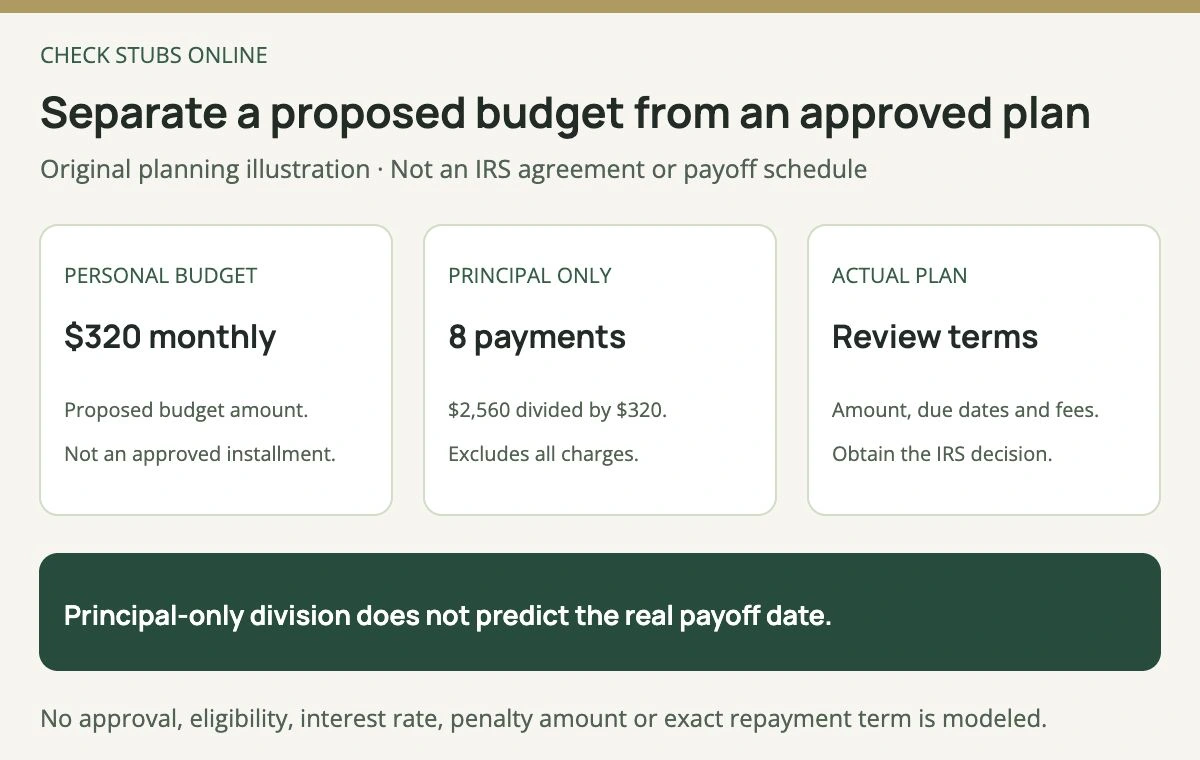
A personal budget entry, an IRS application and approved agreement terms each need their own evidence.
Use two worksheets if necessary: a household cash-flow sheet and an account-resolution sheet. The first shows what you believe you can sustain. The second records what the IRS has actually agreed to, what has been paid and what remains due. Connecting the two prevents an intended payment from being mistaken for a completed obligation.
## If basic living expenses make payment impossible
The [IRS hardship collection guidance](https://www.irs.gov/businesses/small-businesses-self-employed/temporarily-delay-the-collection-process) describes requesting currently not collectible status when financial hardship prevents payment. The IRS may request income, expenses, bank and asset information to evaluate the situation.
That status is a temporary collection determination, not cancellation. Applicable penalties and interest can continue, and the IRS describes possible later review, refund offsets and a notice of federal tax lien. Do not assume that an unanswered hardship request has already changed your account status.
If you receive a notice, preserve its response date and use its official contact instructions. Keep a log of the actual conversation, documents requested and follow-up deadline. Do not manufacture supporting expenses or omit accounts to make a worksheet fit a desired result.
When a payment fails or income changes, raise the issue through the current arrangement’s procedures promptly. Keep the bank record, the failure notification and the response together. Those documents explain what happened more accurately than a spreadsheet that still marks the intended payment “paid.”
## Prevent a second problem without confusing tax years
A payment arrangement for an old balance does not automatically correct current-year withholding. Review the new year separately, including additional jobs and income without withholding. Keep estimated payments clearly labeled by the intended year and type.
The [Check Stubs Online W-4 preparation tool](https://www.checkstubsonline.com/forms/w4/create) can help prepare reviewed future payroll instructions for an available year. It does not apply for an IRS payment plan, deliver the certificate to an employer or pay the old tax balance. See [the W-4 guide](https://blog.checkstubsonline.com/w4-online-generator-guide) before completing that separate workflow.
## Unpaid-tax questions
### Should I wait to file until I have the full amount?
Address the required filing on its own timeline. The IRS distinguishes filing consequences from unpaid-tax consequences.
### Does a partial payment create an installment agreement?
No. Preserve the payment record and separately confirm whether an agreement has been approved.
### Will an approved plan remove all interest?
No. Review the actual terms and current IRS charge rules rather than assuming an interest-free arrangement.
### Can a W-4 update pay last year’s bill?
No. Future payroll instructions and an existing tax-year balance are separate tasks.
The Check Stubs Online Editorial Team reviewed current primary filing, payment and hardship guidance and independently checked the original principal and budget arithmetic.
## Relevant document tool
Prepare updated payroll instructions
After reviewing current-year income and withholding needs, prepare the supported year’s W-4 and inspect its completed preview.
[Open the W-4 builder](https://www.checkstubsonline.com/forms/w4/create)
A W-4 PDF does not apply for a payment plan, pay an existing balance or submit instructions to your employer.
## Related guides
- [Why Do I Owe Federal Income Tax? Trace the Balance Due](https://blog.checkstubsonline.com/why-owe-federal-income-tax)
- [Form 4868 Online: Review Your Extension Estimate and Tax Payment](https://blog.checkstubsonline.com/form-4868-online-tax-extension-guide)
- [W-4 Online: Review Your 2026 Withholding Certificate](https://blog.checkstubsonline.com/w4-online-generator-guide)