---
title: "Child Support on a Pay Stub: Deductions, Limits and Payment Credits"
description: "Trace child-support payroll deductions to case credits. Check disposable earnings, federal limits and an original payment ledger without confusing withholding with receipt."
url: "https://blog.checkstubsonline.com/child-support-pay-stub-deduction"
datePublished: "2026-11-25"
---
# Child Support on a Pay Stub: Deductions, Limits and Payment Credits
Trace child-support payroll deductions to case credits. Check disposable earnings, federal limits and an original payment ledger without confusing withholding with receipt.
Published: 2026-11-25
By [Check Stubs Online Editorial Team](https://blog.checkstubsonline.com/editorial-policy#editorial-team)
**A child-support deduction on a pay stub shows an amount withheld from earnings under a support process; it does not by itself prove the amount was credited to the case.** Compare the income-withholding instruction, the correct earnings base, payroll deductions and the agency’s payment history. Support limits differ from ordinary consumer-debt garnishment limits, and a withholding ceiling does not rewrite the underlying support obligation.
Reviewed November 25, 2026 · U.S. child-support payroll records and federal CCPA limits. Actual orders, state rules, priorities and case accounting control. Examples are fictional, assume identified conditions and do not determine a person’s support obligation or legal remedy.
An entry such as “CS,” “support” or “IWO” can explain a smaller deposit without explaining which order, period or case it belongs to. Ask payroll for the code’s meaning and the relevant instruction. An abbreviation alone does not establish arrears or a failure to pay voluntarily.
The [ordinary wage-garnishment guide](https://blog.checkstubsonline.com/wage-garnishment-pay-stub) concerns a different federal ceiling. This article concentrates on support withholding and the path from a wage deduction to a credited payment.
## In this guide
1. [Identify the instruction and payment period](#support-order)
2. [Separate disposable earnings from net pay](#support-base)
3. [Check the correct federal support ceiling](#support-caps)
4. [Reconcile an original payroll example](#support-example)
5. [Trace deductions to case credits](#support-credit)
6. [Handle changed pay or instructions](#support-changes)
7. [Keep tax and sharing questions separate](#support-tax)
8. [Ask the right record owner](#support-request)
9. [Support deduction questions](#support-faq)
## What does the payroll instruction actually require?
Obtain the relevant income-withholding order or notice through the authorized employer or agency channel. Confirm the employee association, issuing authority, current instruction, payment frequency, stated amounts, destination and case reference. Keep children’s details and full identifiers out of an ordinary troubleshooting message.
[Utah ORS’s income-withholding explanation](https://ors.utah.gov/child-support/collect-child-support/income-withholding/) illustrates an agency sending an instruction to the employer and tells paying parents to monitor receipt in their case account. It also explains that withholding is a normal process rather than proof of past failure to pay. That is a named program example, not a universal statement of every state’s processing steps.
**Identify each record before comparing amounts**
| Record | What to verify | What it does not settle alone |
| --- | --- | --- |
| Support order/case instruction | Obligation and applicable case terms | A specific payroll payment’s delivery |
| Employer withholding notice | Amount, frequency and routing to apply | A new legal calculation by the employee |
| Wage statement | The deduction actually recorded | Agency receipt or allocation |
| Remittance confirmation | Payment sent, reference and destination | That the case has posted it correctly |
| Case payment history | Credits and allocation shown by the agency | Every unresolved payroll timing question |
Use matching units. A monthly support amount is not automatically the same as twice a biweekly deduction. Ask how the instruction converts to the actual payroll schedule rather than selecting a multiplier yourself. Medical support, arrears and administrative fees may be separate lines requiring their own authority and treatment.
## Is disposable earnings the same as take-home pay?
Not necessarily. [DOL Fact Sheet 30](https://www.dol.gov/agencies/whd/fact-sheets/30-cppa) distinguishes earnings after legally required reductions from the later cash remaining after voluntary deductions. The federal CCPA base can therefore exceed the deposit left after insurance, voluntary retirement contributions and support itself. A “pre-tax” label alone does not make a voluntary deduction legally required for this purpose.
Ask for the actual calculation and which reductions were treated as required by law. Mandatory retirement systems and other special arrangements need their own analysis; do not treat the simple example as a rule excluding every retirement-related reduction. Our [mandatory deduction guide](https://blog.checkstubsonline.com/mandatory-paycheck-deductions) helps identify the separate questions.
## Which federal support percentage applies?
The [DOL employment-law guide](https://webapps.dol.gov/elaws/elg/garnish.htm) explains the federal support ceilings. They depend on support for another spouse or child outside the order and whether the relevant payments are more than 12 weeks overdue. Applicable state protection and the actual order still require review.
**Federal CCPA support ceilings: conditions must be established**
| Verified circumstances | Maximum share of disposable earnings |
| --- | --- |
| Spouse or child outside this order supported; no higher-arrears condition | 50% |
| No spouse or child supported outside this order; no higher-arrears condition | 60% |
| Spouse or child outside this order supported; relevant support over 12 weeks overdue | 55% |
| No spouse or child supported outside this order; relevant support over 12 weeks overdue | 65% |
These are ceilings, not a direction to withhold the maximum from every paycheck. They do not apply the ordinary consumer-debt 25% test to child support. Nor should the maximum be multiplied again for each case; multiple instructions, priorities and allocation require the applicable rules and agency guidance.
## Original example: why the cap is $950 but cash is $810
Assume a fictional pay period contains $2,400 gross earnings and $500 reductions that are legally required for the CCPA calculation. A separate $140 benefit deduction is voluntary and does not reduce the assumed disposable-earnings base. The support instruction requests $1,100 for this same pay period. Assume payroll has confirmed that the 50% federal ceiling is the governing cap: another spouse or child outside this order is supported, the higher arrears percentage does not apply, no stronger state limit applies, and there are no fees or competing orders.
**Fictional one-period support reconciliation under explicit assumptions**
| Step | Calculation | Amount |
| --- | --- | --- |
| Gross earnings | Supplied wages | $2,400 |
| Legally required reductions | Supplied total | −$500 |
| CCPA disposable earnings | $2,400 − $500 | $1,900 |
| Applicable assumed ceiling | $1,900 × 50% | $950 |
| Support withheld | Lesser of $1,100 instruction and $950 ceiling | −$950 |
| Voluntary benefit deduction | Separate cash reduction | −$140 |
| Remaining cash | $2,400 − $500 − $950 − $140 | $810 |
The $150 difference between the $1,100 instruction and $950 withheld is a limitation difference in this example, not forgiveness of support. The agency or appropriate legal process must explain the obligation and any balance. Do not privately change the case amount because payroll could not collect the requested total.
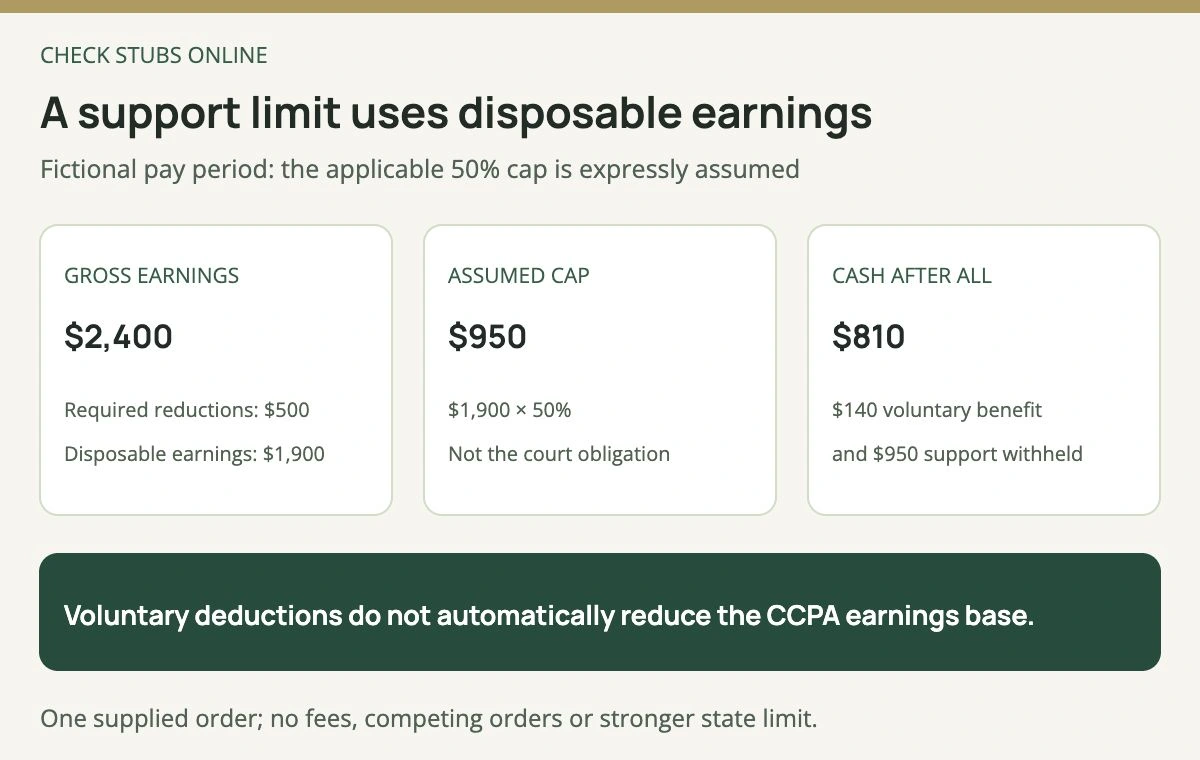
The support base and final cash amount serve different purposes. Confirm the real governing cap rather than borrowing the example’s 50% assumption.
The supplied $500 is not a tax calculation, and the $140 benefit is explicitly voluntary. If either classification is wrong in an actual case, the base and result need revision. A generic take-home-pay calculator cannot validate a support order, competing claims or state-specific priorities.
## How do you trace withholding to the case account?
List each payroll deduction with its payday and case reference. Request the employer’s remittance date and payment identifier, then match the agency’s receipt and allocation. Distinguish processing time from a returned transfer, wrong case association, reversal or combined remittance. The [ORS instruction to monitor case receipts](https://ors.utah.gov/child-support/collect-child-support/income-withholding/) is a useful example of why the wage statement is only one part of that trail.
In a separate fictional reconciliation, three deductions of $320 total $960. The case history currently shows two matching $320 credits, totaling $640. The unmatched $320 needs a trace. This arithmetic does not identify fault, establish a statutory remittance deadline or prove the recipient has been paid.
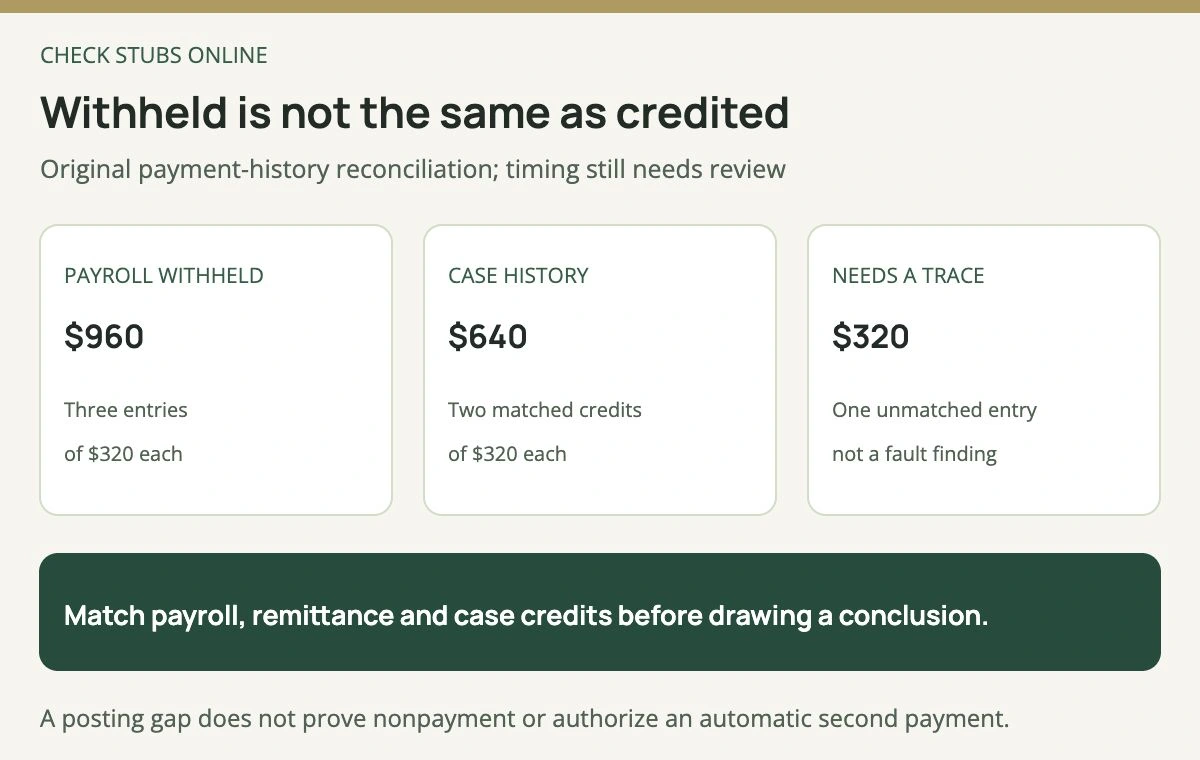
An unmatched entry is a specific investigation task. It is not automatically a reason to pay the same amount again.
Ask the employer and agency what action is appropriate while the trace is pending. Do not assume payroll withholding permits ignoring the case, or that an unposted credit requires a duplicate direct payment. Retain any advice and confirmation, because a later credit may need to be matched to an earlier deduction.
## What if pay falls, the job changes or support should stop?
Report employment and income changes through the actual case process and ask what current instructions apply. A smaller paycheck can alter available withholding without automatically changing the ordered support. A modification request and a payroll correction are different tasks with different decision makers.
At a new job, confirm the correct order association and avoid assuming a gap between employers means no obligation exists. At the old job, check final or lump-sum payment instructions with the agency rather than applying an ordinary-pay formula to every item. Special payments and multiple orders can require additional rules.
If a payroll deduction appears after an expected ending date, request the effective instruction and its receipt date. Payroll may need an authorized amended or termination notice. A personal expectation about a child’s birthday or an informal agreement is not a substitute for verifying the controlling direction.
## Does child support reduce taxable wages?
A cash deduction is not automatically a tax exclusion. [IRS Topic 452](https://www.irs.gov/taxtopics/tc452) distinguishes child support from alimony and states that child support is not deductible by its payer or taxable income to its recipient for federal income-tax purposes. Keep that tax statement separate from another program’s income-definition rules.
When reading a pay statement, reconcile wage bases and employee taxes before assuming support lowers W-2 wages. Use the [tax-base deduction guide](https://blog.checkstubsonline.com/pre-tax-vs-post-tax-deductions) for that different calculation. A case’s payment credit, a personal tax deduction and the amount deposited in checking are not interchangeable.
## What should a useful correction request contain?
1. **Identify one paycheck.** Give the pay period, payday and deduction code.
2. **Name the disputed step.** Base calculation, percentage, instruction amount, remittance or agency credit.
3. **Attach the relevant comparison.** Use the applicable notice, statement and case-history excerpt through the secure channel.
4. **Request the missing evidence.** Ask for calculation details or the remittance reference, not a broad disclosure of someone else’s family information.
5. **Track the result.** Keep any corrected payroll record and the later agency posting connected to the original entry.
For the fictional trace: “The \[date\] statement records $320 support withheld. Please confirm its remittance date, destination and payment reference. My case history through \[date\] does not yet show the matching credit.” Our [payroll contact guide](https://blog.checkstubsonline.com/who-handles-payroll-in-a-company) helps identify the employer record owner; obligation or case-credit disputes belong with the appropriate agency or legal process.
Limit shared identifiers to what that authorized channel requires. Do not publish a full order or a child’s information in an ordinary support forum. A self-prepared wage document cannot amend an order or prove an agency received funds.
## Child-support deduction questions
### Does withholding mean someone is behind on support?
Not by itself. The cited Utah program describes routine income withholding. Check the actual order and case history rather than drawing a conclusion from the payroll label.
### Is the maximum always 65%?
No. The federal table depends on specific family-support and arrears conditions, and applicable state protections matter. The example deliberately assumes a confirmed 50% cap.
### Does a cap reduce the underlying support obligation?
No automatic reduction follows from the payroll ceiling. Ask the case administrator about the obligation, allocation and any unpaid balance.
### Does the pay stub prove the receiving parent has the money?
It shows the recorded deduction. Trace employer remittance and agency receipt/allocation for the remaining steps.
The Check Stubs Online Editorial Team reviewed the linked labor, state-program and federal tax sources. The capped payroll and remittance ledgers are original fictional examples, with independently checked arithmetic and no personal support determination.
## Relevant document tool
Follow the deduction through to the case record
Utah ORS explains employer income withholding and why paying parents should monitor their case payment history.
[Review Utah income withholding](https://ors.utah.gov/child-support/collect-child-support/income-withholding/)
Use the agency and rules for your actual case. This Utah example does not calculate a support obligation or decide another state’s procedures.
## Related guides
- [Pre-Tax vs. Post-Tax Deductions: Read Your Paycheck](https://blog.checkstubsonline.com/pre-tax-vs-post-tax-deductions)
- [Mandatory Paycheck Deductions: What Is Required and How to Check It](https://blog.checkstubsonline.com/mandatory-paycheck-deductions)
- [Wage Garnishment on a Pay Stub: Why the Amount Changes](https://blog.checkstubsonline.com/wage-garnishment-pay-stub)