---
title: "Commission Draw on a Pay Stub: Earnings, Advances and Settlements"
description: "Reconcile earned commissions, prior draws and the remaining payment. Follow an original ledger example and check recovery terms, wage rules and deductions."
url: "https://blog.checkstubsonline.com/commission-draw-pay-stub"
datePublished: "2026-11-22"
---
# Commission Draw on a Pay Stub: Earnings, Advances and Settlements
Reconcile earned commissions, prior draws and the remaining payment. Follow an original ledger example and check recovery terms, wage rules and deductions.
Published: 2026-11-22
By [Check Stubs Online Editorial Team](https://blog.checkstubsonline.com/editorial-policy#editorial-team)
**A commission draw is an advance or guaranteed payment that a plan may credit against later commission earnings.** To read the pay stub, separate earned commissions, draws already paid and the remaining settlement. Whether an uncovered draw can be carried forward or recovered depends on the actual agreement and applicable wage law. A negative ledger balance alone does not establish a lawful deduction or a personal repayment duty.
Reviewed November 22, 2026 · Employee commission records, with expressly labeled federal and New York examples. Fictional calculations are gross-pay reconciliations, not tax estimates, legal findings or independent-contractor accounting advice.
If the sales report says $2,800 but the settlement statement shows only $800 in additional gross pay, the missing piece might be earlier draws. The right comparison is the entire earning period. It is equally possible that payroll used an incorrect input, so locate the agreement and prior statements before deciding what the difference means.
This guide focuses on an employee’s draw ledger. Business-to-business contractor payments have a different record trail; use our [independent-contractor payment guide](https://blog.checkstubsonline.com/independent-contractors-pay-stubs) for that separate situation.
## In this guide
1. [Identify the commission and draw terms](#draw-terms)
2. [Read the statement beside its ledger](#draw-statement)
3. [Reconcile an original settlement](#draw-example)
4. [Review a draw shortfall](#draw-shortfall)
5. [Keep wage and overtime rules in view](#draw-wage-rules)
6. [Separate gross settlement from withholding](#draw-tax)
7. [Request an explained correction](#draw-correction)
8. [Commission draw questions](#draw-questions)
## Start with the commission plan, not the code on the stub
The [U.S. Department of Labor describes commissions](https://www.dol.gov/general/topic/wages/commissions) as pay associated with completing a task, commonly sales. A draw changes payment timing or the plan’s guarantee; it does not by itself tell you when a sale qualifies, which rate applies or what happens after a cancellation.
Read how the agreement defines an earned sale, the commission base, the percentage or fixed payment, the settlement period and any draw treatment. “Booked,” “approved,” “earned” and “paid” may describe different stages. A dashboard of potential sales is not necessarily the final wage calculation.
Plans often distinguish a recoverable draw, described as offsettable under specified terms, from a nonrecoverable guarantee. Those labels are starting points, not a nationwide legal ruling. A written clause does not override wage protections. Avoid assuming that all shortfalls become loans or that every future commission can be reduced without restriction.
For a specific state example, [New York’s LS44 commission guidance](https://dol.ny.gov/system/files/documents/2023/11/ls44.pdf) requires covered commission salespersons’ agreed terms to be written and signed, including the calculation method, reconciliation frequency for a recoverable draw and relevant termination terms. Its requirements belong to that state and covered category; do not apply them as the rule for every worker nationwide.
## Read the pay stub and commission ledger together
A payroll statement may summarize a settlement while a separate sales ledger explains individual transactions. Ask payroll how the two connect. The same adjustment can be displayed as a gross earnings reconciliation or another clearly identified entry; the system’s presentation must still avoid counting compensation or withholding twice.
**A practical commission-record cross-check**
| Record | What to locate | Comparison to make |
| --- | --- | --- |
| Signed plan and amendments | Earning conditions, rate, draw and settlement rules | Use the version applicable to the sales |
| Sales or commission ledger | Eligible transactions, approvals and adjustments | Recalculate the approved earned amount |
| Earlier payroll statements | Draw amounts and dates already recorded | Separate gross advances from net deposits |
| Settlement statement | New commission amount and prior-draw credit | Explain the additional gross payment |
| Payment record | Actual net amount and payment date | Compare after taxes and other real deductions |
## Original example: $2,800 earned and $2,000 already paid
Assume a fictional employee’s lawful applicable plan credits four $500 gross draws against commissions for the same settlement period. Each draw was already recorded as payroll gross compensation. The final approved commission amount is $2,800, with no separate salary, extra incentive, reversal, minimum-wage adjustment or overtime adjustment in this limited example.
**Fictional commission settlement before withholding**
| Entry | Calculation | Gross amount |
| --- | --- | --- |
| Draw 1 | Already paid | $500.00 |
| Draw 2 | Already paid | $500.00 |
| Draw 3 | Already paid | $500.00 |
| Draw 4 | Already paid | $500.00 |
| Total draws | 4 × $500 | $2,000.00 |
| Approved earned commissions | Same settlement period | $2,800.00 |
| Additional gross settlement | $2,800 − $2,000 | $800.00 |
The independent payment check is $500 + $500 + $500 + $500 + $800 = $2,800. The original draws are part of the final commission compensation in this scenario. Adding a fresh $2,800 payment to those draws would produce $4,800, overcounting the intended compensation by $2,000.
Conversely, recording only $800 as the period’s entire earned commission would omit the $2,000 paid earlier. Describe the figures precisely: $2,800 earned, $2,000 gross already advanced and $800 additional gross due under the example’s assumptions.
The actual settlement deposit can be lower than $800 because this calculation stops before withholding and other deductions. Earlier $500 gross draws also need not have produced $500 bank credits. Do not subtract net bank deposits from a gross commission figure; that mixes two different bases.
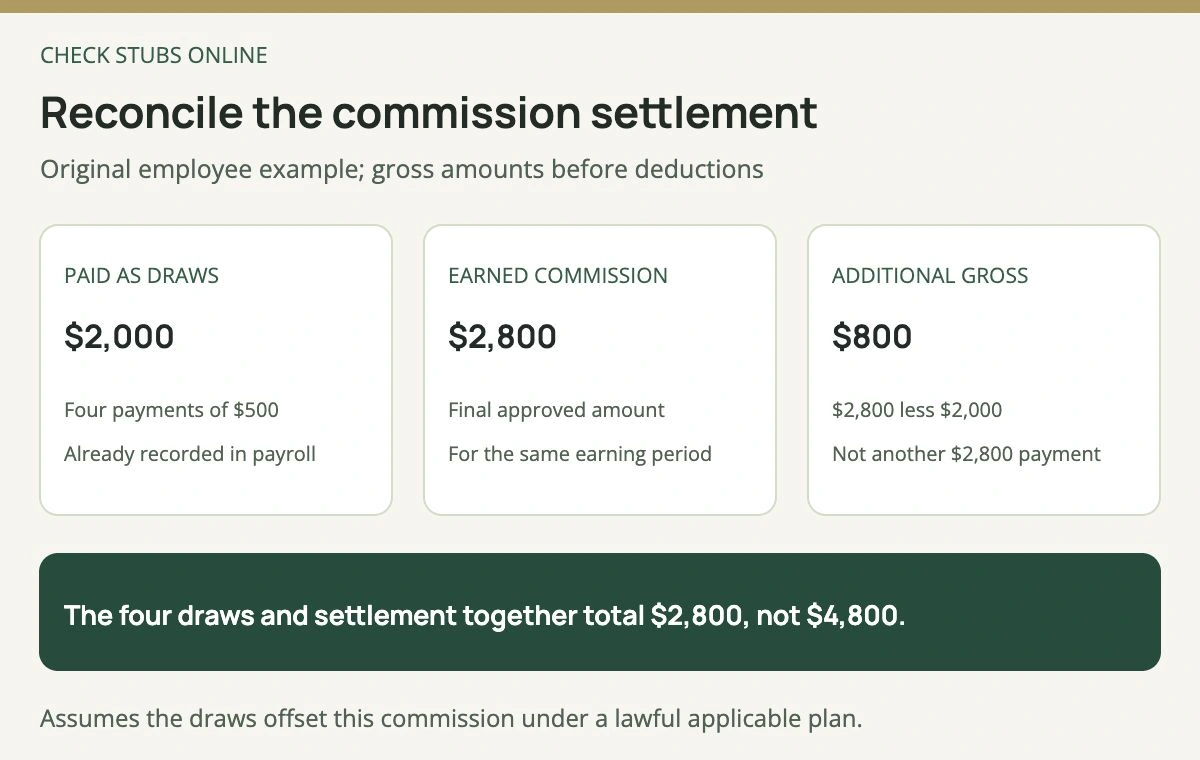
The illustration follows one earning period and treats prior draws as compensation already paid, not another source of sales earnings.
## What if commissions are lower than the draw?
Change only the final earned commission in the fictional ledger to $1,600. Draws remain $2,000, so the difference is $400. That subtraction identifies an accounting question. It does not determine whether the employer can carry the amount forward, reduce other wages, request payment after termination or treat it as a debt.
Review the plan’s guarantee, reconciliation language and the law governing the employee. [New York’s commission FAQ](https://dol.ny.gov/system/files/documents/2021/03/microsoft-word-commissions-faq.doc.pdf) discusses draw reconciliation, restrictions and the significance of specific repayment terms. It also distinguishes earned commissions from unearned amounts and discusses payment after employment ends. Those fact-dependent rules should be read together; an isolated “recoverable” label is not enough to decide an actual dispute.
Before an adjustment, obtain the beginning draw balance, the advances included, approved commissions, every offset and the proposed ending balance. Ask whether the figure is merely a running plan balance or an amount payroll proposes to take from current wages. If a real repayment demand or disputed wage deduction is involved, seek guidance from the applicable labor agency or a qualified adviser with the agreement and records.
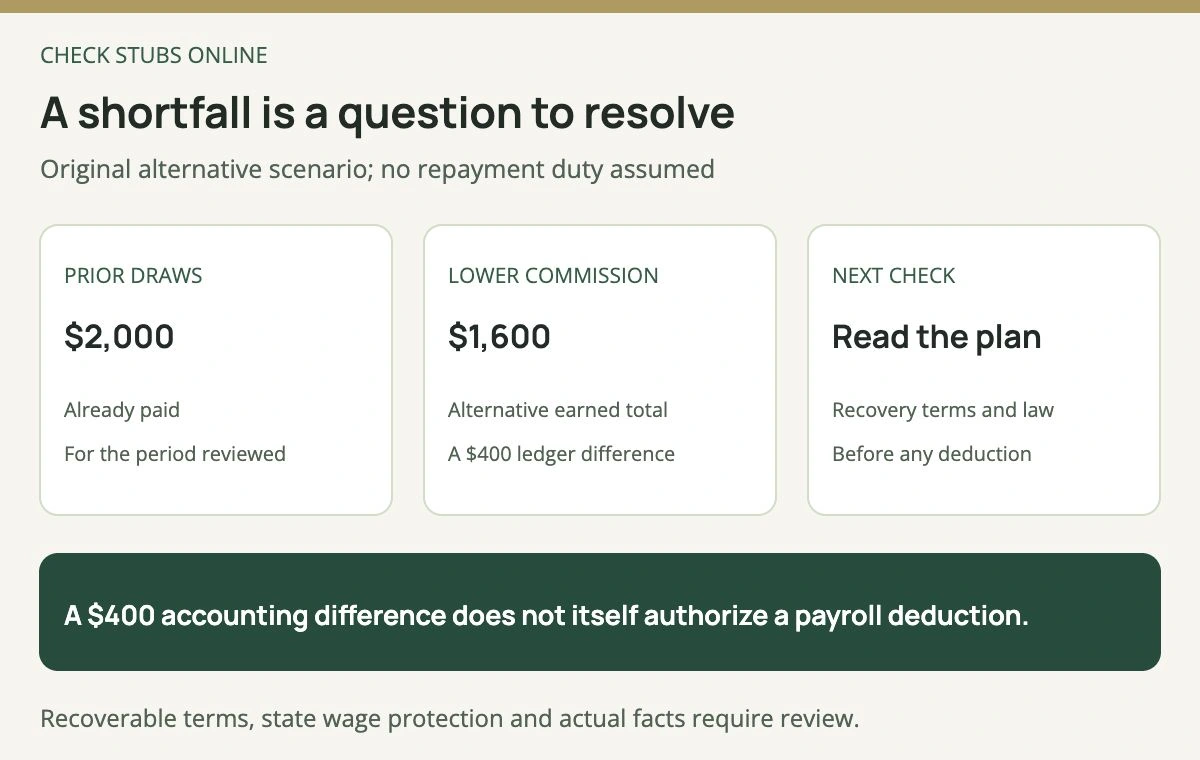
The $400 difference is deliberately shown as an unresolved plan-and-law question rather than an automatic deduction.
## Commissions do not automatically remove wage or overtime protections
For a covered nonexempt employee, commission compensation can affect the regular rate and overtime. The current [federal overtime regulations, sections 778.117–778.121](https://www.ecfr.gov/current/title-29/subtitle-B/chapter-V/subchapter-B/part-778), address commissions and deferred calculations. A large later settlement is not a substitute for reviewing the relevant workweeks and compensation already paid.
A specific retail/service overtime exemption has multiple conditions. [DOL Fact Sheet 20](https://www.dol.gov/agencies/whd/fact-sheets/20-flsa-commissions-retail) explains the qualifying establishment, regular-rate and commission-share tests. Being paid by commission alone does not establish that exemption, and state law can differ. Ask for the actual basis rather than guessing from a job title.
The sample settlement does not decide coverage, hours or entitlement. If it were applied to a real nonexempt employee, payroll would also need to demonstrate compliance with applicable minimum-wage and overtime requirements. Keep the time records even when the sales ledger is the main document used to calculate the commission.
## A gross reconciliation is different from a tax calculation
After identifying the additional gross amount, review taxes and other deductions separately. The IRS includes commissions among supplemental wages in [Publication 15, section 7](https://www.irs.gov/publications/p15); payment arrangements and the applicable conditions determine the permitted income-tax withholding method. A 22% assumption is not a universal total deduction or final income-tax rate.
Our [supplemental withholding example](https://blog.checkstubsonline.com/bonus-tax-withholding) isolates those payroll components. It does not turn every commission settlement into the same tax calculation. Ask how earlier draws were reported and withheld so that the reconciliation does not tax or record the same gross payment twice.
For year-to-date review, compare successive cumulative totals and actual transactions. Our [YTD gross-pay guide](https://blog.checkstubsonline.com/ytd-gross-pay) explains why adding cumulative balances overstates income. A sales period and a wage payment year may also differ; retain both dates.
## Request the missing bridge between sales and payroll
A useful request for the example would be: “Please provide the approved $2,800 commission calculation, the four $500 draws credited against it and the resulting $800 additional gross settlement. Please also identify withholding, any other adjustment and the related payment.” That asks for a reconcilable record rather than assuming the smaller deposit proves an underpayment.
If a sale, rate or prior advance is incorrect, identify that entry and request an issuer correction. Keep the original and revised ledger with the related statements. Our [pay-stub correction guide](https://blog.checkstubsonline.com/pay-stub-errors-correction) helps track a changed record without rewriting the employer’s PDF yourself.
For authorized record preparation, the [Enhanced pay stub builder](https://www.checkstubsonline.com/enhanced-pay-stub) supports additional earnings alongside regular pay and overtime. Use verified payroll figures. It does not run a sales commission ledger, determine when a commission is legally earned, enforce a draw agreement or independently verify income.
## Commission draw questions
### Is a draw always extra pay on top of commission?
No. In this example it is credited against the final commission, so it is part of that compensation. A different guaranteed salary-plus-commission arrangement needs its own terms and calculation.
### Does “recoverable draw” automatically mean I owe cash?
No. Read the actual terms, circumstances and applicable wage law. A ledger shortfall does not itself establish an enforceable personal debt or authorize a wage deduction.
### Why does my commission ledger exceed the settlement check?
Prior draws, deductions or different earning/payment periods may explain it. Compare gross amounts first, then reconcile withholding and net payment.
### Should an employee keep time records when paid commissions?
Yes, time records can be necessary for minimum-wage, overtime and exemption analysis. Commission pay is not a blanket exception to those rules.
### Can a statement builder resolve a disputed draw balance?
No. Obtain the issuer’s ledger and plan explanation. A document prepared from supplied figures does not decide whether those figures or recovery terms are legally correct.
This guide’s commission ledger is an original fictional teaching case. Check Stubs Online reviewed federal wage guidance, the linked New York materials and the current builder scope, and independently checked the settlement arithmetic.
## Relevant document tool
Show additional earnings clearly
Use the approved commission settlement and checked deduction figures, then review the complete pay statement.
[Open the Enhanced builder](https://www.checkstubsonline.com/enhanced-pay-stub)
The builder prepares records; it does not manage a commission ledger, resolve draw disputes or verify earnings.
## Related guides
- [Bonus Tax Withholding: Why Your Bonus Check Is Smaller](https://blog.checkstubsonline.com/bonus-tax-withholding)
- [Pay Stub Errors: How to Request and Track a Correction](https://blog.checkstubsonline.com/pay-stub-errors-correction)
- [Do Independent Contractors Get Pay Stubs? Payment Records Explained](https://blog.checkstubsonline.com/independent-contractors-pay-stubs)