---
title: "Direct Deposit vs. Paper Check: Timing, Access and Pay Records"
description: "Compare direct deposit and paper paychecks, understand bank choice and funds availability, reconcile split deposits, and keep payment evidence separate from a pay statement."
url: "https://blog.checkstubsonline.com/direct-deposit-vs-paper-check"
datePublished: "2026-11-10"
---
# Direct Deposit vs. Paper Check: Timing, Access and Pay Records
Compare direct deposit and paper paychecks, understand bank choice and funds availability, reconcile split deposits, and keep payment evidence separate from a pay statement.
Published: 2026-11-10
By [Check Stubs Online Editorial Team](https://blog.checkstubsonline.com/editorial-policy#editorial-team)
**Direct deposit sends wages electronically to an account; a paper paycheck must be delivered and then cashed or deposited.** Either method can represent the same net wages. Compare the permitted payment options, account access, delivery process, fees and actual funds availability. A pay statement explains earnings and deductions; it is separate from the payment itself.
Reviewed November 10, 2026 · U.S. employee wage-payment methods, current federal bank-choice and availability guidance, and a specifically labeled New York example. State rules and individual account terms can differ. The original payroll amounts are fictional, with deductions supplied as assumptions rather than calculated taxes.
The useful question is not which method has the most modern name. It is whether the permitted arrangement reliably delivers the correct amount, gives the employee usable access and leaves records that can be reconciled. Check those details before switching an existing payroll instruction.
## In this guide
1. [Compare the two methods](#deposit-difference)
2. [Check bank choice and state rules](#deposit-rights)
3. [Follow one original net payment](#deposit-example)
4. [Separate payday and availability](#deposit-timing)
5. [Plan a change carefully](#deposit-switch)
6. [Investigate a missing payment](#deposit-missing)
7. [Keep payment and statement records](#deposit-records)
8. [Direct-deposit and check questions](#deposit-faq)
## What changes when wages arrive electronically?
With direct deposit, the employer or its payroll provider sends the wage payment to the designated account. With a paper check, someone must arrange delivery, and the worker needs a way to cash or deposit the instrument. The pay calculation remains a separate step from either delivery route.
A digital statement can accompany a paper check, and a printed statement can describe a direct deposit. Do not use the statement’s format to infer how money was sent. Our [electronic pay-stub guide](https://blog.checkstubsonline.com/electronic-pay-stubs-access) covers access to the earnings document.
**Questions to compare before choosing a permitted wage-payment method**
| Question | Direct deposit | Paper check |
| --- | --- | --- |
| How does the worker receive it? | Electronic credit to the designated account | Physical instrument delivered under the employer’s process |
| What needs setup? | Accurate account instructions and applicable authorization | Correct payee, delivery details and cashing/deposit route |
| What can delay usable access? | Submission, receipt or account issues; check actual status | Delivery, deposit timing and applicable availability policy |
| What should be retained? | Payroll statement and matching transfer confirmation | Payroll statement, check details and deposit/cashing evidence |
| Which costs matter? | Actual account, access or service charges, if any | Any permitted cashing, deposit or access charges |
| What does it not prove alone? | Gross wages, all deductions or future earnings | That a printed check has been received, paid or cleared |
Ask about the employee’s practical access as well as the employer’s processing preferences. A person who cannot use the proposed account arrangement needs a lawful workable option. A check that cannot be conveniently deposited or cashed may create a different access problem rather than solving the first one.
## Bank choice and direct-deposit consent are different issues
The bank-choice protection in [Regulation E, section 1005.10(e)(2)](https://www.consumerfinance.gov/rules-policy/regulations/1005/10/) prevents an employer from making one specific receiving institution compulsory for electronic wages. Its official interpretation permits requiring electronic salary deposit when the worker chooses the receiving institution. That federal bank-choice rule is not a universal right to insist on a paper check.
State wage-payment requirements can add conditions. For example, [New York’s Methods of Payment guidance](https://dol.ny.gov/getpaid) describes written notice and written consent for workers covered by its direct-deposit and payroll-card requirements. It also lists exceptions tied to specified executive, administrative or professional work above its stated earnings level, and certain farm work. Check that scope before applying the example, and do not export New York’s consent process to every state.
Employers should identify the employee’s relevant jurisdiction and current requirements before changing methods. Employees can ask which options and authorization rules apply to their situation. A general payroll preference does not replace that review.
## Original example: $2,580 net, one wage payment
Assume a fictional payroll calculation has $3,400 in cash gross wages and $820 in employee taxes and benefit reductions. Those reductions are given record totals, not a rate calculation. There are no reimbursements, fees or additional adjustments in this comparison.
The net amount is $2,580. Suppose an allowed direct-deposit arrangement routes $2,180 to checking and $400 to savings. Together the two credits equal the one net wage payment. Alternatively, a paper paycheck for $2,580 can represent the same net amount.
**Original payment-route reconciliation; amounts do not change between methods**
| Item | Amount |
| --- | --- |
| Gross wages | $3,400 |
| Assumed employee reductions | −$820 |
| Net wages | $2,580 |
| Direct-deposit checking allocation | $2,180 |
| Direct-deposit savings allocation | $400 |
| Sum of the two direct-deposit allocations | $2,580 |
| Alternative single paper paycheck | $2,580 |
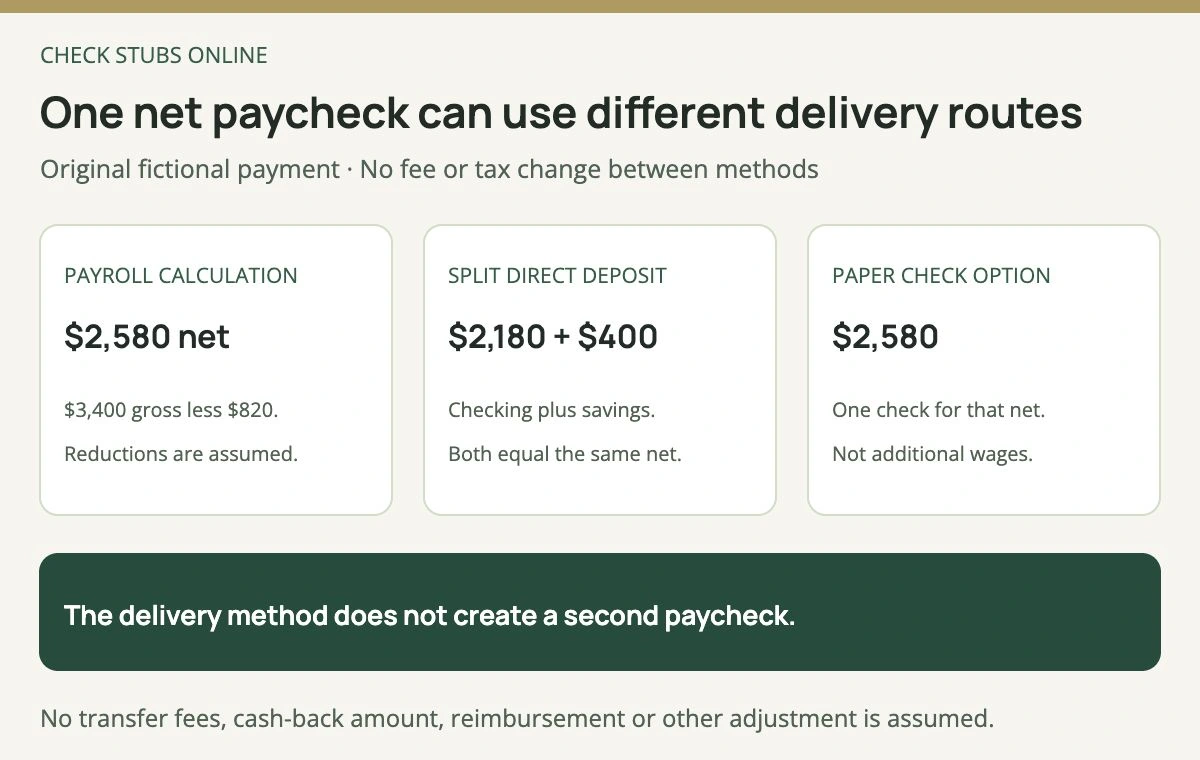
The direct-deposit and check amounts are alternatives for the same wages. They are not payments to add together.
If the checking account shows only $2,180, compare the savings allocation before concluding that $400 is missing from payroll. If a check is later issued as a replacement for a failed deposit, payroll must track that replacement against the original payment; it should not silently become a second set of wages.
The example assumes no cost difference. If the actual arrangement has a charge, identify who imposes it, whether it is permitted and where it appears. Do not describe a bank or cashing-service charge as an employee payroll tax. The [gross-to-net explanation](https://blog.checkstubsonline.com/gross-vs-net-pay) helps keep those categories separate.
## Payday, bank receipt and spendable funds are separate milestones
The scheduled payday belongs on the payroll calendar. The bank’s receipt of an electronic payment and the account’s usable funds are related but distinct facts. A preview statement or a pending transaction is not by itself confirmation that the amount is available to spend.
For the general electronic-payment rule, [12 CFR 229.10(b)](https://www.ecfr.gov/current/title-12/chapter-II/subchapter-A/part-229/subpart-B/section-229.10) connects required availability to the bank’s receipt of the payment, including collected funds and the necessary account information. The [CFPB direct-deposit explanation](https://www.consumerfinance.gov/ask-cfpb/if-i-get-paid-through-direct-deposit-when-can-i-withdraw-the-funds-en-1025/) describes an outside limit of the following business day, measured from the institution’s business-day receipt, and notes that access is often provided earlier.
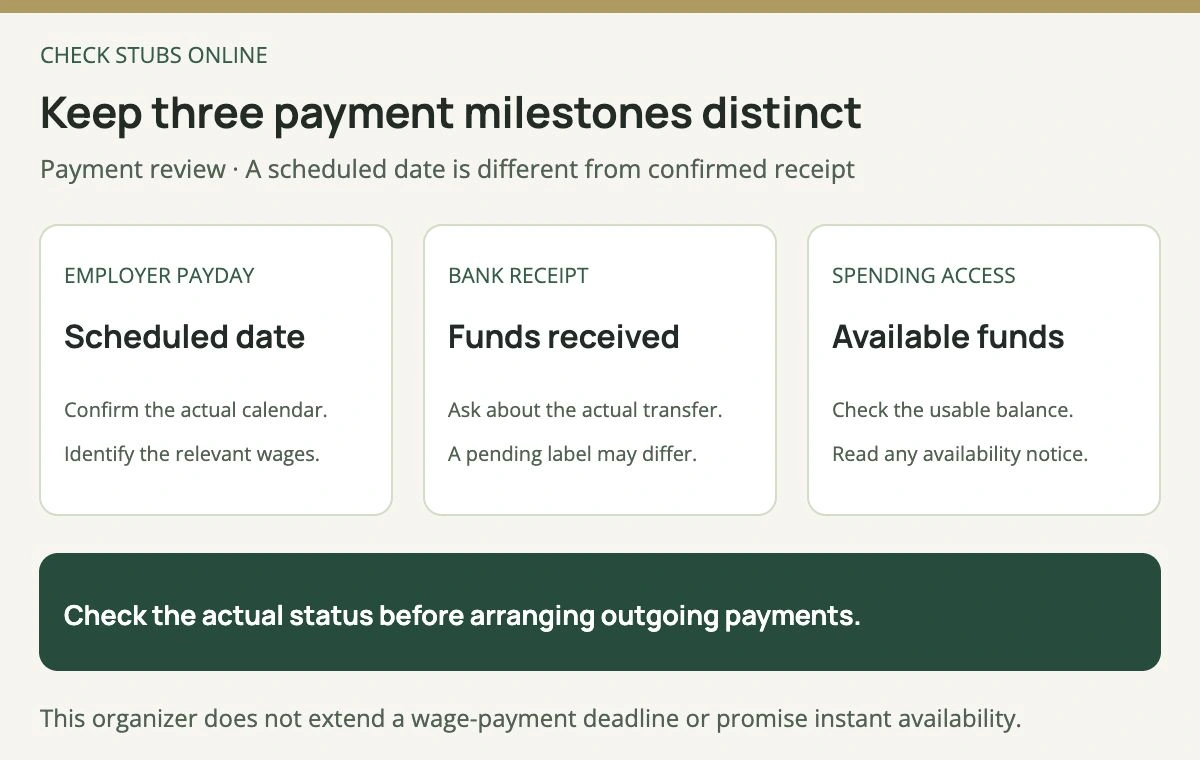
These stages help identify where to ask about a payment. They do not give an employer extra time to satisfy applicable wage-payment duties.
Do not treat an advertised early-access feature as an unconditional promise for every payroll. Confirm the institution’s policy and the actual payment status. Our [pay-period and pay-date guide](https://blog.checkstubsonline.com/pay-period-vs-pay-date) also separates the work dates from the scheduled payment date.
For paper checks, delivery and deposit are additional steps. The [CFPB check-cashing explanation](https://www.consumerfinance.gov/ask-cfpb/can-i-cash-a-check-at-any-bank-or-credit-union-en-931/) notes that a bank does not have to cash every check presented by a noncustomer. Ask about identification, any applicable charges and when deposited funds can be used. Check the institution’s current policy and applicable law rather than assuming immediate availability from a photograph of a deposited check.
## Plan the first payment after an account change
Use the employer’s authorized process to change routing instructions. Verify the account details through the actual bank and ask payroll when the new instruction takes effect. An instruction submitted today may not govern a payroll already processed.
The [CFPB account-moving checklist](https://www.consumerfinance.gov/consumer-tools/bank-accounts/moving-your-checking-account/) recommends coordinating the first new direct deposit with automatic payments and allowing for outstanding activity in the old account. Keep enough information to track both sides of the transition before closing an old account.
Confirm whether the transition payment will use the old account, the new account or another permitted route. Record who confirmed the effective date. If a verification or setup step is still pending, ask how wages due in the meantime will be delivered.
Protect account instructions through the employer’s established channel. If a message unexpectedly asks for a change, verify it using a previously known contact route. A request arriving by email is not itself evidence that payroll authorized the change.
## Investigate the specific payment before requesting a replacement
Start with the payment date, expected net amount and the account or delivery route shown by payroll. Check every authorized split destination. Ask payroll whether the payment was actually released and whether it has a trace or check reference, then ask the bank about receipt or availability as appropriate.
For a lost paper check, contact payroll promptly about its investigation and replacement process. Do not attempt to cash both an original and a replacement. Keep the cancellation or replacement reference with the wage record so the file explains why two instrument numbers may describe one payment.
For a returned electronic payment, payroll and the receiving institution need the actual status and reason. A rejected transfer does not make the underlying wage obligation disappear. Ask for a concrete resolution and delivery plan; unresolved wage-payment concerns can be taken to the relevant labor agency.
Our [payroll-contact guide](https://blog.checkstubsonline.com/who-handles-payroll-in-a-company) helps identify the right person. If this is a first paycheck, [the smaller first-paycheck guide](https://blog.checkstubsonline.com/first-paycheck-low) covers partial-period and deduction explanations separately from a delivery failure.
## Keep the earnings statement and payment evidence together
Retain the statement showing gross wages and employee reductions alongside evidence for the corresponding net payment. Bank credits, check references and payroll records serve different roles. An attractive PDF alone does not demonstrate that a transfer or check payment cleared.
The [Check Stubs Online pay stub maker](https://www.checkstubsonline.com/pay-stub-maker) arranges actual payroll information into an earnings statement. It does not transfer wages, issue a bank paycheck or verify an account. Use supported amounts and periods, then keep the separate payment trail with the finished record.
## Direct-deposit and paper-check questions
### Does direct deposit mean I no longer need a pay statement?
No. The payment and the earnings explanation serve different purposes; applicable statement rules still need review.
### Can two bank credits be one paycheck?
Yes, if they are the authorized allocations of the same net payment. Reconcile their sum with payroll.
### Does federal law let the employer choose my receiving bank?
Regulation E prohibits requiring a particular institution as a condition of employment. State payment-method rules can impose additional conditions.
### Is a replacement check extra income?
A replacement for the same unpaid wages is not a second wage entitlement. Keep the original and replacement status documented and resolve duplicate-payment issues with payroll.
The Check Stubs Online Editorial Team reviewed current primary bank-choice, payment-method and availability guidance and independently checked the original single-payment and split-deposit arithmetic.
## Relevant document tool
Prepare the earnings statement from actual payroll
Arrange the supported gross wages, deductions and net payment so they can be reconciled with the separate deposit or check record.
[Open the pay stub maker](https://www.checkstubsonline.com/pay-stub-maker)
The maker prepares a statement. It does not transfer wages, issue a bank check or verify account activity.
## Related guides
- [Electronic Pay Stubs: Access, Printing and State Rule Checks](https://blog.checkstubsonline.com/electronic-pay-stubs-access)
- [Pay Period vs. Pay Date: Read Your Payroll Calendar](https://blog.checkstubsonline.com/pay-period-vs-pay-date)
- [Why Is My First Paycheck So Small?](https://blog.checkstubsonline.com/first-paycheck-low)