---
title: "Final Paycheck After Quitting: Deadlines and Records to Check"
description: "When is your final paycheck due after quitting? Compare federal and state guidance, vacation-payout limits and a checked gross-to-payment example."
url: "https://blog.checkstubsonline.com/final-paycheck-after-quitting"
datePublished: "2026-11-14"
---
# Final Paycheck After Quitting: Deadlines and Records to Check
When is your final paycheck due after quitting? Compare federal and state guidance, vacation-payout limits and a checked gross-to-payment example.
Published: 2026-11-14
By [Check Stubs Online Editorial Team](https://blog.checkstubsonline.com/editorial-policy#editorial-team)
**When you quit, the deadline for your final paycheck depends on the applicable state rules and circumstances; there is no single immediate-payment rule for every U.S. employee.** Confirm the last day, notice given, work location and regular payday, then reconcile unpaid earnings, any required vacation payout, deductions and actual payment. A payroll statement or a pending deposit does not by itself prove that all final wages were received.
Reviewed November 14, 2026 · U.S. employee separation-pay records. California and New York illustrate different rules; they are not a 50-state deadline chart. Industry exceptions, contracts, collective bargaining agreements and the actual facts can matter. Fictional amounts do not determine anyone’s legal entitlement or taxes.
Leaving a job creates two separate tasks: establish when wages must be paid and establish what the final payment includes. A familiar Friday payroll schedule may answer neither task completely. Save the separation details and source records before your employee portal access changes.
## In this guide
1. [Find the applicable payment deadline](#final-deadline)
2. [Compare an original state timeline](#final-timeline)
3. [List the final earnings components](#final-earnings)
4. [Review vacation and other balances](#final-vacation)
5. [Reconcile gross, net and actual payment](#final-example)
6. [Request records or raise an unpaid-wage concern](#final-request)
7. [Final-paycheck questions](#final-faq)
## Start with the actual rule for the place and situation
The [U.S. Department of Labor’s final-paycheck guidance](https://www.dol.gov/general/topic/wages/lastpaycheck) says federal law does not require former employees to receive their last paycheck immediately. It also explains that some states require immediate payment. That federal statement is not permission to ignore a stricter state deadline.
Identify the state connected with the work, whether you quit or were discharged, when notice was given and when employment actually ended. If you worked across states, do not assume the employer’s headquarters alone supplies the answer. Confirm the relevant agency’s current coverage and any industry-specific exception.
Keep the difference between [the covered pay period and payday](https://blog.checkstubsonline.com/pay-period-vs-pay-date) visible. Your last day can occur inside a pay period, but a special final-wage rule may require payment sooner than the routine run. Conversely, one state’s accelerated deadline should not be presented as the rule for every employee elsewhere.
**Two state examples show why a universal answer is unreliable**
| Jurisdiction and stated circumstance | Agency guidance | Important limit |
| --- | --- | --- |
| California: employee without a definite-term written contract quits with at least 72 hours’ prior notice and leaves on the stated date | Final wages are due at quitting | Confirm coverage and any special exception; do not apply this row to every separation |
| California: employee in that stated category quits without 72 hours’ prior notice | Wages are due within 72 hours of quitting | Mailing and payment-location rules have additional details |
| New York: employment has ended | Wages are due by the regular payday for the period worked | Use the actual payday and applicable coverage, not California’s notice rule |
The California rows come from the [Labor Commissioner’s payday and final-wage guidance](https://www.dir.ca.gov/dlse/faq_paydays.htm). The New York row follows the [state Department of Labor’s wage FAQ](https://dol.ny.gov/wages-and-hours-frequently-asked-questions), which also says an employer must mail final wages if asked. Read the relevant source’s details for your own case.
## Original timeline: notice and payday answer different questions
Suppose a fictional employee gives notice at 9 a.m. on Monday, November 16, 2026 and quits at 9 a.m. on Thursday, November 19. That is exactly 72 hours of notice. Assume the employee has no written employment contract for a definite term and no special California exception applies.
Under the stated California rule, the final wages would be due at quitting on November 19. For a separate New York comparison, assume the applicable regular payday for those wages is Friday, November 20. The New York agency’s rule uses that payday. These are alternative jurisdiction examples, not two deadlines applying to the same worker.
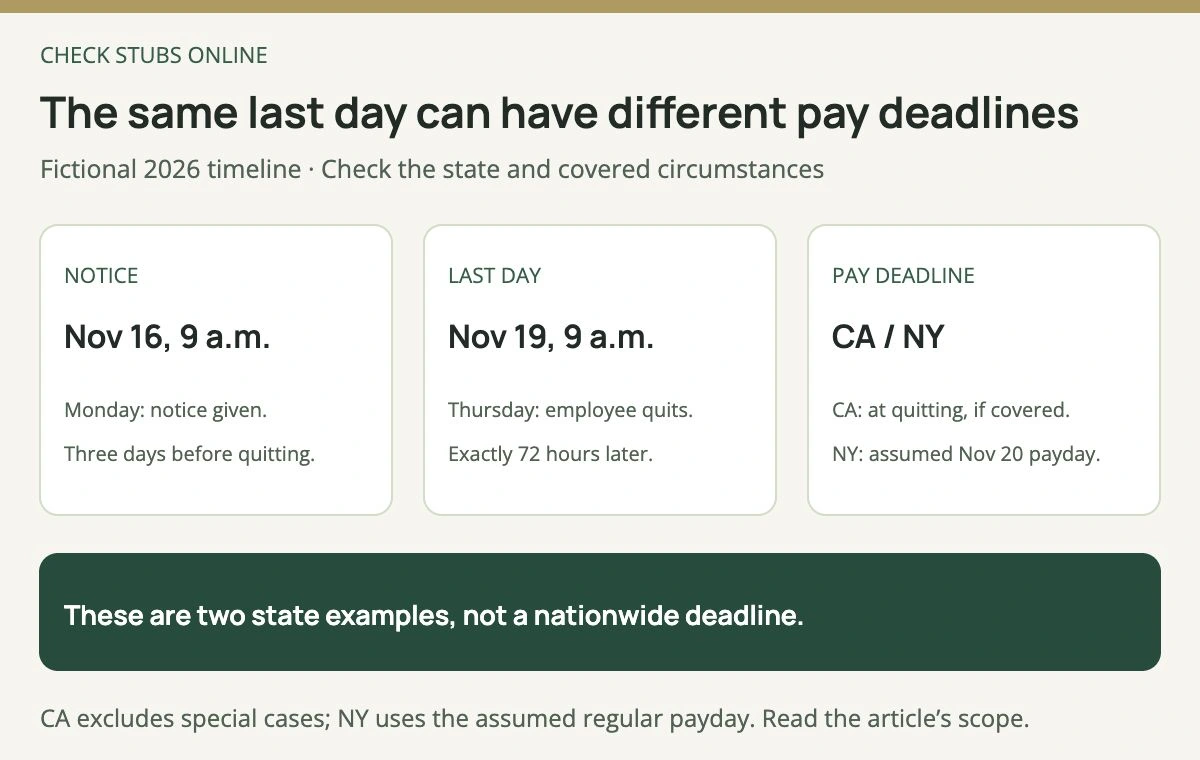
The notice interval and the payroll calendar are factual inputs. The applicable state rule determines how those inputs affect timing.
If the employer changes the actual separation date, preserve that communication. If the worker gave a different notice interval, do not reuse the example’s deadline. A screenshot of a recurring payday is useful evidence, but it does not replace the legal rule for the separation.
## List earnings before making a net-pay estimate
Gather the last statement, daily time records, effective pay rate, unpaid earning entries and the dates already covered by earlier payments. Identify hours still unpaid rather than treating all work in the last month as outstanding. Keep disputed items separate from amounts payroll agrees are due.
For hourly work, check the applicable workweeks and any overtime or differentials. A final period with fewer than 40 hours does not answer whether a prior workweek spanning the cutoff contained overtime. For salary, an apparent partial-period amount needs the actual salary and applicable rules; see [the prorated salary guide](https://blog.checkstubsonline.com/prorated-salary-paycheck).
Commissions, bonuses and reimbursements need their own source terms and timing review. Do not automatically add a future contingent bonus to wages already earned, or assume every outstanding expense claim is taxable wages. Ask which items payroll included, which remain unresolved and why.
## Unused vacation is not governed by one national payout rule
The [federal vacation-leave overview](https://www.dol.gov/general/topic/workhours/vacation_leave) explains that the FLSA generally does not require pay for vacation or other time not worked. It also identifies separate government-contract situations. State law and an applicable agreement or policy can impose additional obligations.
In California, the [state vacation FAQ](https://www.dir.ca.gov/dlse/faq_vacation.htm) explains that earned vacation is treated as wages and generally must be paid at the final rate when employment ends, unless otherwise stipulated by a qualifying collective bargaining agreement. This does not mean California requires every employer to provide a vacation benefit in the first place.
New York’s wage FAQ describes a different policy-based analysis, including written forfeiture conditions and payment of earned vacation when no written forfeiture policy applies. Keep the actual policy and balance record. Vacation, sick leave, combined PTO and severance should not be treated as interchangeable balances without reviewing the applicable rules.
Ask for the balance as of separation, its unit, the payout rate and any applicable policy condition. A portal showing “12” is incomplete if you do not know whether it means hours, days, available leave or an amount already used but not yet posted.
## Original amount example: separate gross owed, deductions and payment
Assume a fictional employee has 35 unpaid straight-time hours at $24, producing $840. Assume there is no overtime or other earned compensation. Separately assume 12 hours of unused vacation must be paid under the applicable rule or policy at $24 per hour, producing $288.
The illustrative final gross is $1,128. Supply $203.15 as the total lawful taxes and other employee deductions for this example only; this is not a withholding calculation or a statement that any particular deduction is permitted. The resulting assumed net is $924.85.
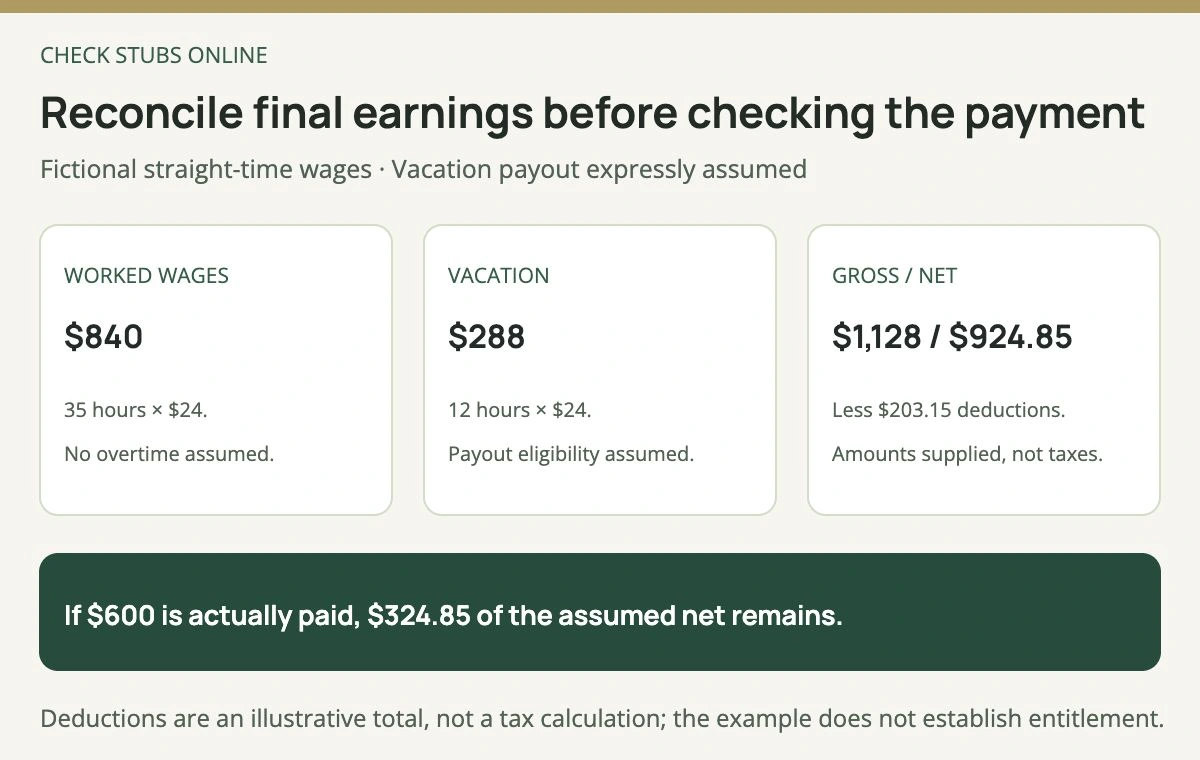
The vacation entitlement is an express assumption, not a national rule. The supplied deduction amount must be replaced with the actual supported payroll calculation.
If a $600 payment has actually been received and no other adjustment applies, $324.85 of that assumed net remains to reconcile. A proposed second transfer is not the same as a completed payment. Ask for the payment method, issue date and status, and keep any returned or replaced payment connected to the original record.
Do not compare $1,128 gross directly with a $600 bank credit and call the entire $528 difference unpaid net wages. That would skip the supplied $203.15 deductions. Equally, a complete-looking statement does not establish that the full $924.85 was delivered.
Any unexpected equipment, uniform or shortage deduction deserves a separate explanation. The [federal wage-deduction fact sheet](https://www.dol.gov/agencies/whd/fact-sheets/16-flsa-wage-deductions) describes minimum-wage and overtime restrictions for covered workers. State law can be stricter. An employer’s stated reason does not, by itself, establish a lawful deduction.
## Request the record, the calculation and the payment status
Send payroll the last day and notice details, relevant periods, supported unpaid earnings and the specific unresolved payment or deduction. Ask for an itemized final statement, an explanation of any leave payout and the actual payment arrangements. Keep your current mailing and contact details available through the employer’s accepted process.
Download records before portal access ends, while keeping the original files intact. Our [electronic statement guide](https://blog.checkstubsonline.com/electronic-pay-stubs-access) covers access and [the former-employer W-2 guide](https://blog.checkstubsonline.com/w2-from-former-employer) addresses annual records after departure. The final paycheck and the later tax form serve different purposes.
If wages remain unpaid, review the relevant state agency’s complaint process and the federal Department of Labor’s guidance. Do not assume an internal payroll ticket extends any filing time limit. For a record discrepancy, [the correction-request guide](https://blog.checkstubsonline.com/pay-stub-errors-correction) helps organize the evidence without inventing a claim about intent.
The [Check Stubs Online pay-stub maker](https://www.checkstubsonline.com/pay-stub-maker) is available for authorized preparation from accurate payroll data. It does not determine a final-pay deadline, resolve a leave entitlement, recover money or amend someone else’s issued statement. An employee should request the employer’s actual records rather than prepare an apparent replacement.
## Final-paycheck questions
### Will I always be paid on my last day?
No universal rule applies. Check the jurisdiction, type of separation and relevant notice or industry conditions.
### Does giving two weeks’ notice guarantee a vacation payout?
Not nationally. The benefit, applicable law and actual policy or agreement must be reviewed separately.
### Is my final stub proof the money arrived?
No. Match the net amount to actual payment records, including any split, replacement or returned payment.
### Can I use the example to calculate my taxes?
No. Its $203.15 deduction total was supplied solely to demonstrate a reconciliation. Actual withholding and lawful deductions require the real inputs.
The Check Stubs Online Editorial Team checked federal guidance and the two state examples, then verified the fictional notice interval, wage amounts and payment balance independently.
## Relevant document tool
Keep final wages, deductions and payments traceable
Use accurate earning periods, supported amounts and cumulative records when preparing an authorized final pay statement.
[Review the pay-stub maker](https://www.checkstubsonline.com/pay-stub-maker)
The maker does not establish legal payment deadlines, leave entitlement or payment receipt. Employees should request issuer records and corrections.
## Related guides
- [Pay Stub Errors: How to Request and Track a Correction](https://blog.checkstubsonline.com/pay-stub-errors-correction)
- [Prorated Salary Paycheck: First-Week Calculations and Checks](https://blog.checkstubsonline.com/prorated-salary-paycheck)
- [Pay Period vs. Pay Date: Read Your Payroll Calendar](https://blog.checkstubsonline.com/pay-period-vs-pay-date)