---
title: "Why Is My First Paycheck So Small?"
description: "Check a small first paycheck by matching covered dates, paid hours, deductions and deposits. Follow an original biweekly calendar and missing-hours example."
url: "https://blog.checkstubsonline.com/first-paycheck-low"
datePublished: "2026-11-09"
---
# Why Is My First Paycheck So Small?
Check a small first paycheck by matching covered dates, paid hours, deductions and deposits. Follow an original biweekly calendar and missing-hours example.
Published: 2026-11-09
By [Check Stubs Online Editorial Team](https://blog.checkstubsonline.com/editorial-policy#editorial-team)
**A small first paycheck may cover only part of a normal pay period, with taxes and benefit deductions reducing it further.** Check the statement’s covered dates and paid hours before comparing the deposit with a full-period salary or wage estimate. Then verify the deductions and payment method. A payroll cutoff can explain which cycle includes work; it does not automatically excuse wages missing their lawful due date.
Reviewed November 9, 2026 · U.S. first-paycheck review. The calendar, wage rate and deductions are fictional. Employer schedules, state wage-payment rules, worker classification and actual employment terms affect an individual case. This guide does not determine whether a particular payment was lawful.
The first deposit from a new job can arrive after you have already worked more hours than the first statement shows. That timing needs an explanation, but it is not enough on its own to calculate an underpayment. The statement may cover an earlier, shorter slice of your employment.
Use the offer, work records and payroll calendar together. Our [gross-versus-net paycheck reconciliation](https://blog.checkstubsonline.com/gross-vs-net-pay) explains the deduction stage; this guide concentrates on the first payment’s coverage and the records needed when it appears short.
## In this guide
1. [Separate coverage, earnings and deductions](#first-diagnosis)
2. [Read the payroll calendar](#first-dates)
3. [Follow a dated first-paycheck example](#first-example)
4. [Explain why the deposit is not exactly half](#first-net)
5. [Review salary and starting-week calculations](#first-salary)
6. [Test a specific missing-hours concern](#first-missing)
7. [Ask payroll a precise question](#first-request)
8. [Handle an overdue or unresolved payment](#first-escalation)
9. [First-paycheck questions](#first-faq)
## Which part of the first paycheck is smaller?
Begin with the earliest point where your expectation and the payroll statement diverge. If paid hours are lower than expected, investigate the covered period and time records. If gross earnings match but net pay differs, examine deductions. If net pay matches but the account credit differs, review distribution and payment status.
**A first-paycheck problem can arise at different stages**
| Stage | Compare these records | Question to resolve |
| --- | --- | --- |
| Coverage | Hire date, pay-period dates and payroll calendar | Which days of employment does this payment include? |
| Earnings | Work log, approved rates and earning codes | Were the included hours and rates counted correctly? |
| Deductions | Tax settings, benefit elections and statement lines | Which amounts reduced this particular payment? |
| Delivery | Net amount, payment reference and destination | Was the complete net payment issued through the expected route? |
A pay frequency is not a statement of coverage. “Biweekly” describes a recurring two-week schedule; it does not promise that a new employee’s first payment contains two full weeks of earnings. Similarly, the pay date need not be the last date in the period shown.
## Identify the period end, processing cutoff and pay date
Ask payroll for the calendar applying to your role. Identify the start and end of the earning period, any time-entry deadline and the scheduled payment date. Keep these dates separate from your first day at work and the date your bank displays a pending credit.
The [U.S. Department of Labor’s recordkeeping fact sheet](https://www.dol.gov/agencies/whd/fact-sheets/21-flsa-recordkeeping) includes the payment date and period covered among the records employers must keep for covered nonexempt workers, alongside hours and wage information. Those fields help connect the amount paid to the work being paid for.
A processing lag means an employer pays for a completed period later under its schedule. It should still be possible to identify when each set of earned wages is due. Do not accept “we hold the first week” as a complete explanation. Request the specific period and scheduled payment for the hours in question, then check applicable wage-payment requirements.
## Original example: starting halfway through a biweekly period
Assume a fictional employer’s first illustrated pay period runs from Monday, November 2 through Sunday, November 15, 2026, with payment on Friday, November 20. A worker starts Monday, November 9 and records 40 compensable hours during November 9–13 at $29 per hour. There is no earlier employment, overtime, premium or other earning in this first period.
The correct regular gross for those assumed facts is 40 × $29 = $1,160. It is not $2,320, because the worker did not have 80 paid hours in that covered period. Being on a biweekly payroll does not fill the pre-hire week with wages.
**Fictional calendar: each payment covers the stated earning period**
| Event | Covered work or assumed fact | Scheduled payment or amount |
| --- | --- | --- |
| November 2–15 period | Employee starts November 9; 40 hours included | November 20: $1,160 regular gross |
| November 16–29 period | Separately assume 80 compensable hours are recorded | December 4: $2,320 regular gross |
| Work after November 15 | Falls outside the first statement’s earning dates | Review its own period and payment date |
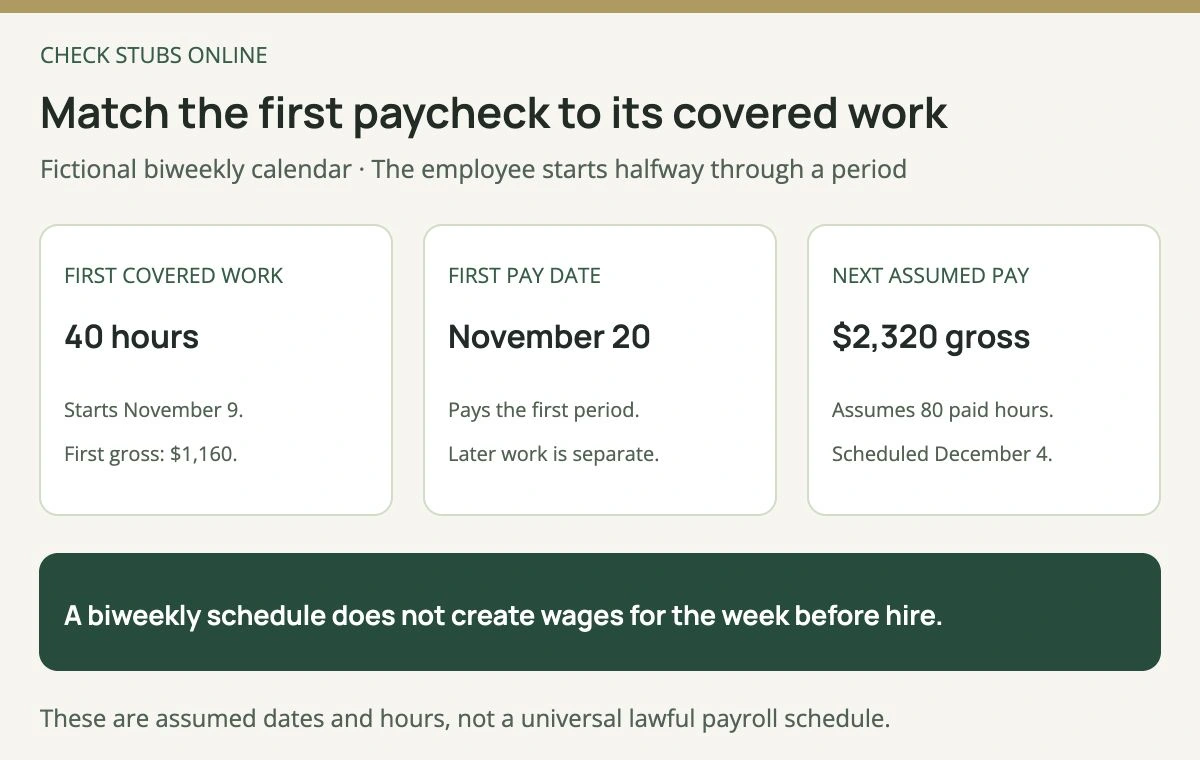
The calendar is invented. Both amounts exclude overtime, other earnings and employee deductions.
By November 20, the employee may also have worked during the second period. In this invented schedule, those later hours belong to the December 4 payment rather than the first payment. That explains the allocation; it does not establish that every employer may use these dates under every state’s rules.
The second period crosses a holiday week. Its 80-hour total is an explicit assumption about compensable time, not a claim that holidays must be paid or that this employee has a particular leave benefit. Replace all assumed hours with the actual work and paid-leave entries.
## Why the first bank deposit may not be half a normal deposit
Gross earnings and net pay do not necessarily shrink in the same proportion. Some deductions depend on wages, some reflect benefit elections, and others can be fixed dollar amounts per payment. Check the statement rather than applying one general deduction percentage.
For arithmetic only, assume $200 of total employee deductions on the $1,160 first gross amount. That leaves $960 net. Separately assume $350 of deductions on the later $2,320 gross amount, leaving $1,970 net. Half of $1,970 is $985, which is $25 more than the first $960 payment. No error follows merely from that unequal ratio.
These deduction totals are invented placeholders. They are not tax estimates, benefit quotes or permission for any deduction. Obtain the individual entries and supporting elections. The [IRS explanation of gross and take-home pay](https://apps.irs.gov/app/understandingTaxes/hows/tax_tutorials/mod01/tt_mod01_03.jsp) helps distinguish the earnings stage from amounts remaining after withholding.
Review whether benefits began immediately, later, or through an explained catch-up entry. Compare withholding settings with the information you submitted. Our [W-4 preparation guide](https://blog.checkstubsonline.com/w4-online-generator-guide) explains the certificate’s role; changing it does not correct uncounted work hours or automatically refund earlier deductions.
## What if the new job pays a salary?
Ask for the written method used to calculate the first payment and the dates to which it applies. Annual salary divided by the normal payment count is a useful full-period starting point, but it may not explain a partial initial period. A five-day assumption also may not fit the employee’s actual schedule or applicable rule.
The [Labor Department’s salary-basis fact sheet](https://www.dol.gov/agencies/whd/fact-sheets/17g-overtime-salary) identifies an exception concerning the initial or terminal week of employment for workers within the relevant federal exemption rules. That does not make every partial-period salary deduction permissible, and being paid a salary alone does not determine exemption. Review classification, the particular exception and any more protective state requirement.
If the first statement uses an unfamiliar daily rate, ask how the denominator was selected. A calculation can be internally consistent yet based on the wrong starting salary, covered dates or employment classification. Keep the employer’s explanation with the approved offer; our [offer-letter review guide](https://blog.checkstubsonline.com/offer-letter-generator-guide) identifies the underlying pay terms to confirm.
## Original check: two missing hours at $29
Return to the first hourly example and change one fact. Suppose the statement instead lists 38 hours at $29, while reliable records show 40 compensable hours within that same covered period. The listed regular gross would be $1,102. The expected regular gross on the stated assumptions is $1,160, leaving a $58 gross difference.
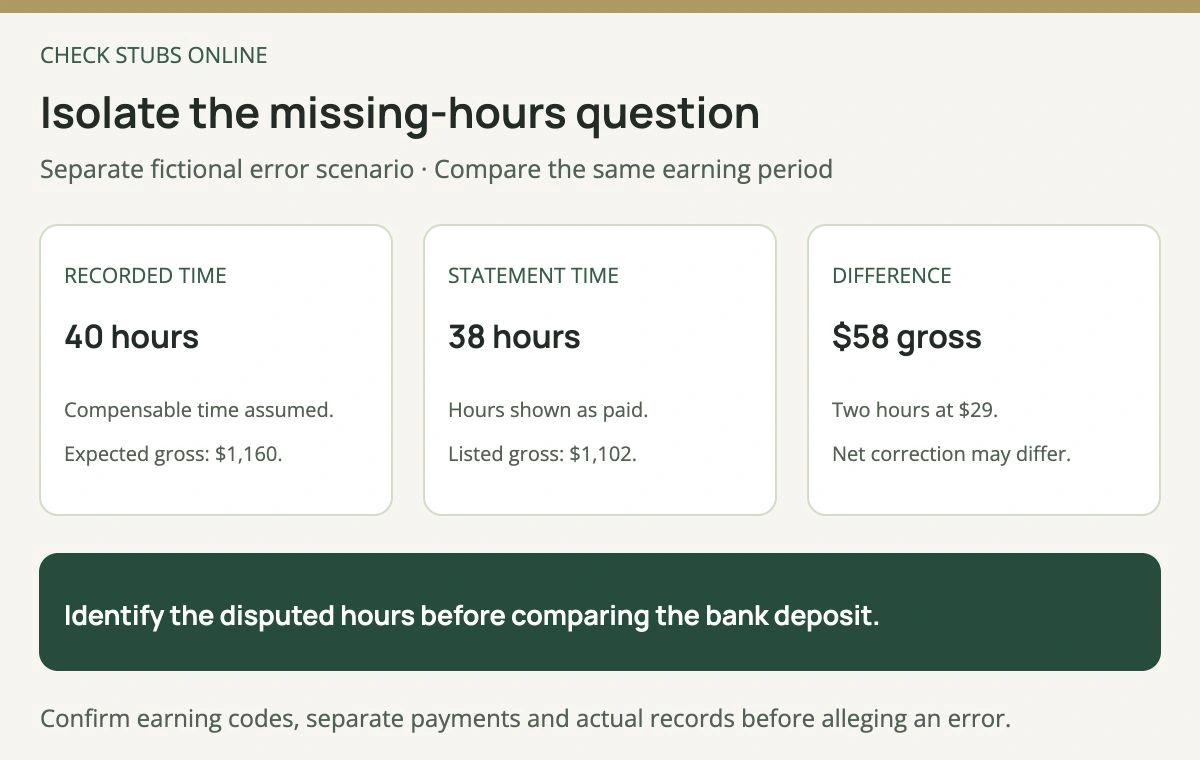
Compare the same covered period. A gross wage difference is not automatically the amount of an eventual net deposit.
This is a better question than “Why was the deposit low?” It isolates two specific hours. Verify that breaks, earning codes, paid leave and any separate payment have been interpreted correctly. If the difference remains, ask payroll to explain or correct those entries. Any resulting tax and deduction treatment must be calculated separately; do not promise yourself a $58 net correction.
## What information should a first-paycheck question include?
Provide the hire date, payment date, earning-period dates, disputed hours or amount, and the supporting work record. Distinguish an expected amount based on an offer from time actually worked. A clear request might say:
My first workday was November 9. The November 20 statement covers November 2–15 and lists 38 regular hours. My work record shows 40 compensable hours for November 9–13 at the approved $29 rate. Please reconcile the two-hour difference and identify any separate payment or correction.
Those details are fictional. Use your own records and an approved private channel. Our [payroll responsibility guide](https://blog.checkstubsonline.com/who-handles-payroll-in-a-company) helps identify whether a manager, payroll team or benefits contact should handle each part. Save the original statement, written response and any corrected version together.
## When should you look beyond a routine payroll explanation?
If scheduled wages were not paid, request a written status and correction date promptly. A processing cutoff is not a universal legal defense. The [Labor Department’s FLSA reference guide](https://www.dol.gov/agencies/whd/compliance-assistance/handy-reference-guide-flsa) states that wages required under that law are due on the regular payday for the covered period. State laws can impose additional rules.
For example, [Maryland’s wage-payment guidance](https://www.labor.maryland.gov/labor/wagepay/wppaidontime.shtml) addresses regular paydays and warns against keeping wages as security for a future event. That example applies to Maryland’s rules; it is not a national waiting-period formula. Contact the appropriate wage agency or qualified adviser when a payment remains overdue or the explanation conflicts with applicable requirements.
For planning, the [Check Stubs Online paycheck calculators](https://www.checkstubsonline.com/paycheck-calculator/) can help estimate a supported wage scenario. Enter the right annual or period units and the actual payment frequency. An estimate cannot establish which days payroll included, validate deductions or resolve a wage claim.
## First-paycheck questions
### Does biweekly payroll guarantee two full weeks on my first check?
No. Your start date and the covered period determine how much employment falls in that payment.
### Is a first paycheck always delayed by one week?
No. Ask for the actual payroll calendar and check the applicable payment deadline. There is no single schedule for every employer.
### Can a tax form explain missing work hours?
It can affect withholding, but it does not establish which hours should have been counted as earnings.
### Will a $58 gross correction produce a $58 deposit?
Not necessarily. Payroll must also calculate the applicable withholding and other adjustments.
The Check Stubs Online Editorial Team reviewed primary wage-record and payment guidance and independently checked the fictional calendar, gross amounts and missing-hours reconciliation.
## Relevant document tool
Estimate the pay scenario after confirming the covered period
Use the relevant calculator for the supported wage and withholding inputs. Keep its estimate separate from your employer’s actual dates, paid hours and deduction records.
[Explore paycheck calculators](https://www.checkstubsonline.com/paycheck-calculator/)
A calculator does not determine a wage-payment deadline or validate a payroll correction.
## Related guides
- [Prorated Salary Paycheck: First-Week Calculations and Checks](https://blog.checkstubsonline.com/prorated-salary-paycheck)
- [Gross vs. Net Pay: Reconcile Your Paycheck](https://blog.checkstubsonline.com/gross-vs-net-pay)
- [Who Handles Payroll in a Company? A Guide to the Right Contact](https://blog.checkstubsonline.com/who-handles-payroll-in-a-company)