---
title: "Gross vs. Net Pay: Reconcile Your Paycheck"
description: "Compare gross pay, taxable wages, net pay and bank deposits. Follow a checked paycheck example and trace deductions or split payments before reporting an error."
url: "https://blog.checkstubsonline.com/gross-vs-net-pay"
datePublished: "2026-11-09"
dateModified: "2026-11-09T09:15:07Z"
---
# Gross vs. Net Pay: Reconcile Your Paycheck
Compare gross pay, taxable wages, net pay and bank deposits. Follow a checked paycheck example and trace deductions or split payments before reporting an error.
Published: 2026-11-09 · Updated: 2026-11-09T09:15:07Z
By [Check Stubs Online Editorial Team](https://blog.checkstubsonline.com/editorial-policy#editorial-team)
**Gross pay is compensation before employee deductions; net pay is the pay left after those deductions.** Taxable wages are a separate measure used to calculate a particular tax. To understand a paycheck, reconcile the same pay period from earnings through deductions to net pay, then check how that net amount was distributed. One bank deposit may show only part of it.
Reviewed November 9, 2026 · U.S. employee paycheck interpretation. The calculations below use invented payroll facts and 2026 federal employee Social Security and Medicare rates. Income-tax withholding amounts are assumed, not quoted tax calculations. Actual benefits, tax coverage and state rules may differ.
You can earn the amount promised in an offer and still receive a smaller bank deposit. That does not by itself show a payroll error. The useful question is which number changed: earnings, the wage base used for a tax, an employee deduction, or the payment destination.
This guide follows one fictional paycheck all the way through those stages. For year-long salary projections, use our [gross annual income guide](https://blog.checkstubsonline.com/gross-annual-income). For the types of legally required deductions, see [mandatory paycheck deductions](https://blog.checkstubsonline.com/mandatory-paycheck-deductions).
## In this guide
1. [Identify the four amounts](#pay-amounts)
2. [Check gross earnings first](#pay-earnings)
3. [Reconcile a complete paycheck](#pay-example)
4. [Separate taxable wages from net pay](#pay-bases)
5. [Match the payment destinations](#pay-distribution)
6. [Compare two checks fairly](#pay-comparison)
7. [Resolve an unexplained difference](#pay-questions)
8. [Gross and net pay questions](#pay-faq)
## Which pay amount answers your question?
The [IRS payroll tutorial](https://apps.irs.gov/app/understandingTaxes/hows/tax_tutorials/mod01/tt_mod01_03.jsp) distinguishes wages earned from what remains after withholding and other employee deductions. A pay statement can show both figures, alongside additional tax-specific totals. Read the column heading before using a number.
**Four amounts that can appear around a single paycheck**
| Amount | What it measures | What it does not establish |
| --- | --- | --- |
| Gross pay | Earnings included in this payment before employee deductions | The amount available to spend |
| Taxable wages | Compensation subject to the particular tax being shown | A universal base shared by every tax |
| Net pay | Earnings remaining after payroll deductions, within the statement’s presentation | That every dollar went to the same account |
| Bank deposit | A specific transfer into an account | Total earnings or total take-home pay when there are multiple destinations |
These labels also need a period. A current-check gross amount is different from year-to-date gross, and an annual salary in an offer is different from wages paid on one date. Keep the time unit attached when copying a figure into an application, spreadsheet or calculator.
## Start with the wages, before investigating deductions
Check the listed earnings against approved work records and compensation terms. For hourly work, review each earning code, rate and paid-hour entry. For salary, identify the agreed pay frequency and any partial-period calculation. Do not divide an annual salary by 24 if the employer actually uses 26 payments.
For example, a fictional $62,400 annual salary spread evenly over 26 payments gives $2,400 of regular gross pay per payment. The same annual amount divided over 24 payments gives $2,600. The second check is larger because its payment interval differs; it does not represent a higher annual salary. Neither division calculates income-tax withholding.
For hourly wages, 40 paid hours in each of two workweeks at an assumed straight-time rate of $30 also totals $2,400. That particular pattern does not include overtime. Premiums, commissions, paid leave and adjustments require their own entries. A total that combines different earning types should be checked line by line rather than tested only against an ordinary hourly rate.
## Original example: reconcile $2,400 of gross pay
Assume one fictional employee receives $2,400 of wages in a biweekly payment. A traditional 401(k) elective deferral is $120. There are no other pretax deductions, taxable fringe benefits, reimbursement entries, wage-base-limit effects or special tax exemptions. Assume $220 federal income-tax withholding and $70 state income-tax withholding solely to demonstrate the reconciliation.
For this illustration, all $2,400 is subject to employee Social Security and Medicare tax. The [IRS employment-tax rate guidance](https://www.irs.gov/taxtopics/tc751) gives 6.2% for employee Social Security within its annual wage base and 1.45% for regular employee Medicare. We assume the employee is below the applicable Social Security cap and Additional Medicare withholding threshold. These assumptions are essential to the example.
**Fictional biweekly pay reconciliation: income-tax amounts are assumptions**
| Line | Amount | Treatment in this example |
| --- | --- | --- |
| Gross earnings | $2,400.00 | Starting compensation |
| Traditional 401(k) deferral | −$120.00 | Employee pretax retirement contribution |
| Federal income-tax withholding | −$220.00 | Assumed amount; not calculated from a bracket |
| State income-tax withholding | −$70.00 | Assumed amount; no jurisdictional rate implied |
| Employee Social Security | −$148.80 | $2,400 × 6.2% |
| Employee Medicare | −$34.80 | $2,400 × 1.45% |
| After-tax employee deduction | −$20.00 | Invented authorized deduction |
| Net pay | $1,786.40 | Gross less $613.60 of employee deductions |
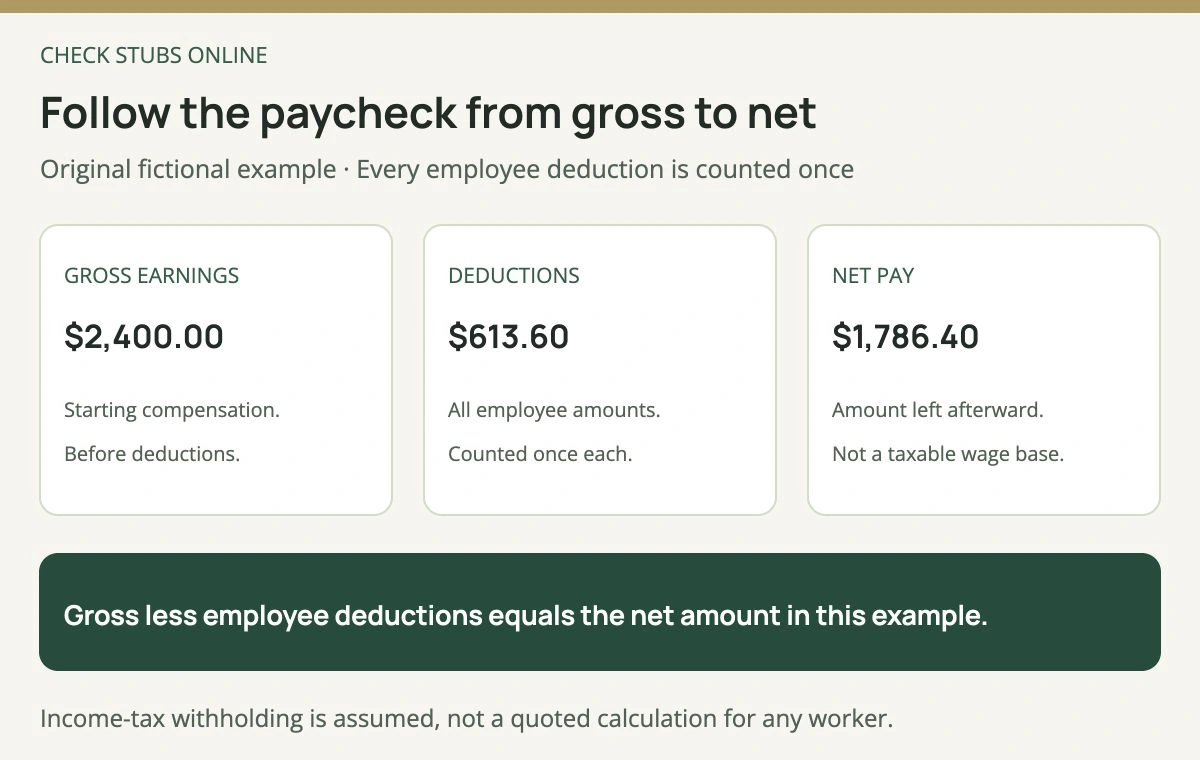
All employee deductions appear once. The example does not estimate withholding for a particular person or state.
Add the deductions independently: $120 + $220 + $70 + $148.80 + $34.80 + $20 = $613.60. Subtract that total from $2,400 to obtain $1,786.40. A pretax contribution affects both the cash reconciliation and certain taxable-wage calculations, but it is taken from gross pay only once when calculating net pay.
The employer’s own tax contributions are separate from these employee deductions. If a statement displays an employer-paid benefit or tax in an informational panel, do not subtract it again merely because it appears on the page. Ask payroll whether an unfamiliar line affects your wages, taxable benefits, deductions or only an employer-cost display.
## Why taxable wages can differ from gross pay and net pay
In the assumed example, the $120 traditional 401(k) deferral reduces wages subject to federal income-tax withholding from $2,400 to $2,280. It does not reduce the employee Social Security and Medicare wage bases here. The [IRS retirement contribution guidance](https://www.irs.gov/taxtopics/tc424) explains that traditional elective deferrals generally remain subject to those employment taxes. Roth contributions have different income-tax treatment.
Thus the same payment has $2,400 gross earnings, $2,280 federal taxable wages and $1,786.40 net pay. Using $2,280 as take-home pay would omit the remaining deductions. Using net pay as a tax base would put the calculation in the wrong order.
Other benefit arrangements can affect different taxes differently. Check the actual plan and payroll treatment instead of labeling every retirement, insurance or savings entry “pretax.” Our [federal withholding calculator guide](https://blog.checkstubsonline.com/federal-withholding-calculator-guide) explains why input units and withholding settings matter when estimating the income-tax component.
Tax withheld from wages is also different from a final tax bill. The [IRS wage-reporting guidance](https://www.irs.gov/taxtopics/tc401) explains that wages used to pay withholding still count as received for income-reporting purposes. You do not report only the bank deposits as employment wages simply because taxes never reached your account.
## Why your checking deposit may not equal net pay
Now assume the fictional $1,786.40 net amount is split between two accounts: $300 to savings and the remaining $1,486.40 to checking. The smaller checking deposit is fully explained by the distribution. It is not another $300 payroll deduction.
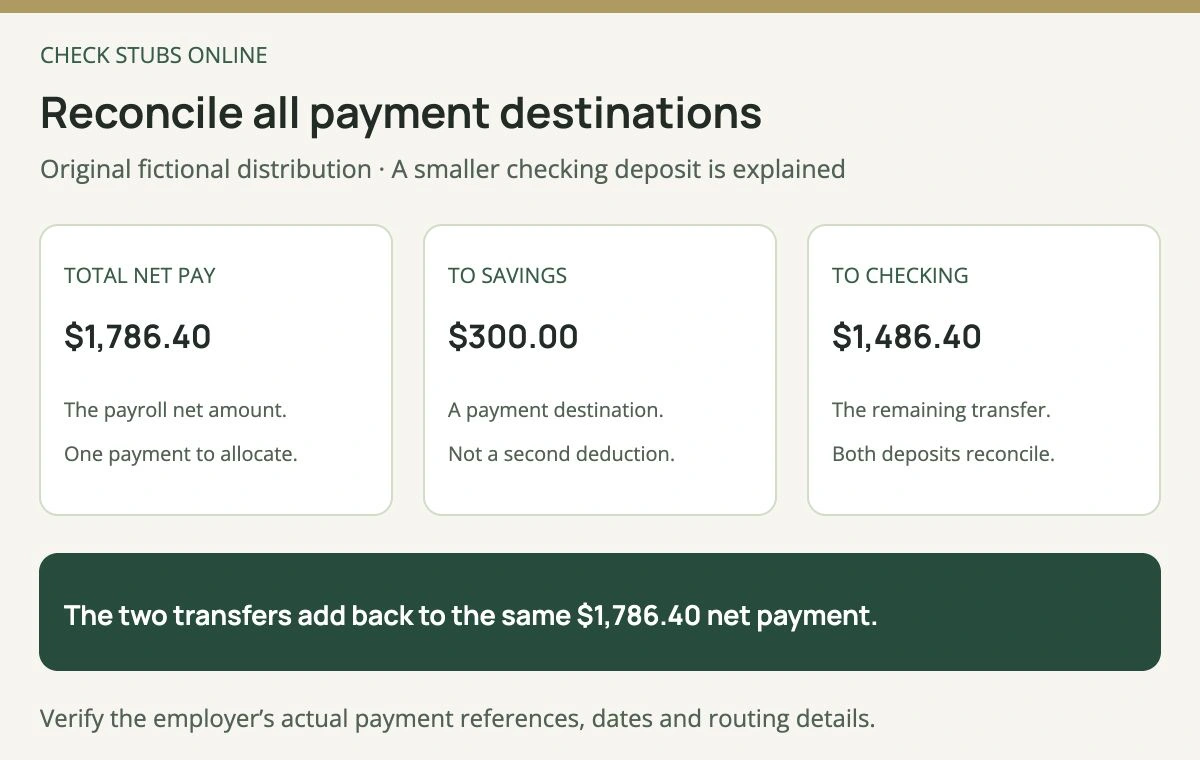
Match every destination for the same payment before deciding that a single deposit is short.
The [Wisconsin state employee pay-stub explanation](https://dpm.wi.gov/Documents/JobAids/SelfService/ESS/ViewPaycheck.pdf) illustrates a separate net-pay distribution section. Its format is employer-specific, but it shows why the earnings calculation and the payment routing deserve separate checks.
Reconcile all distributions using the actual pay date and payment reference. A reimbursement processed separately, an advance recovery or an off-cycle correction can require additional records. Do not add a reimbursement to earnings or subtract an account transfer from net pay without checking how the employer presented the transaction. A posted bank balance is not a replacement for a payroll ledger.
## How to compare two paychecks without mixing periods
Place the statements next to each other and compare the same fields in the same order. First identify covered dates and earnings. Then compare each deduction, the tax-specific wage bases and the payment distribution. A benefit enrollment change or a different pay frequency can explain a change that an hourly-rate comparison misses.
- Use current-period amounts with current-period amounts; do not compare current deductions with year-to-date earnings.
- Separate an ordinary check from one containing a bonus, retroactive adjustment or partial period.
- Keep the actual number of payments in a year distinct from the number of months.
- Use verified net pay for a cash budget, while following the stated income definition on a housing or credit application.
The [biweekly budgeting guide](https://blog.checkstubsonline.com/biweekly-paycheck-budget) helps map actual pay dates to bills. When comparing employment packages, our [two-offer comparison](https://blog.checkstubsonline.com/compare-two-job-offers) adds benefit costs and work commitments that a single net-pay figure cannot capture.
## What to send payroll when a difference remains
Identify the exact payment, the disputed line and your calculation. A useful request says: “For the payment dated November 20, I total $613.60 in employee deductions against $2,400 gross. Please explain the net amount and each payment destination.” Replace those fictional numbers with the actual statement details.
Attach only relevant work records or election confirmations through the employer’s approved channel. Ask for the calculation basis and a corrected statement if an error is confirmed. Retain both versions and the explanation. Our [payroll contact guide](https://blog.checkstubsonline.com/who-handles-payroll-in-a-company) helps route a pay question when the manager, payroll provider and benefits team handle different parts.
You can use the [Check Stubs Online paycheck calculators](https://www.checkstubsonline.com/paycheck-calculator/) for an independent estimate within their supported inputs. An estimate does not authenticate a statement, model every deduction or establish the employer’s legal obligation. Use actual records to resolve a specific discrepancy.
## Gross and net pay questions
### Is net pay the same as taxable wages?
No. Taxable wages are the base for a named tax; net pay is the remaining payment after deductions.
### Does a higher gross paycheck always mean a proportionally higher deposit?
No. Deductions, benefit elections and payment routing can change the relationship. Compare the actual entries.
### Should I subtract a pretax deduction twice?
No. Account for its applicable tax-base effect, but include the employee deduction only once in the gross-to-net cash calculation.
### Which figure should I put on an application?
Use the requester’s stated definition and period. Ask for clarification when it does not identify gross, net, monthly or annual income.
The Check Stubs Online Editorial Team checked primary payroll explanations and independently reconciled the original earnings, deductions, wage-base and split-payment examples.
## Relevant document tool
Start an estimate with the right pay units
Choose the relevant paycheck calculator, enter the supported wage and withholding information, then compare the estimate with the actual deductions shown by payroll.
[Explore paycheck calculators](https://www.checkstubsonline.com/paycheck-calculator/)
An estimate does not verify an employer statement or include every possible payroll deduction.
## Related guides
- [Gross Annual Income: Actual Earnings vs. Annualized Pay](https://blog.checkstubsonline.com/gross-annual-income)
- [YTD Gross Pay: Meaning, Calculation and Correction Checks](https://blog.checkstubsonline.com/ytd-gross-pay)
- [Gross Monthly Income: Calculate Actual Pay and Monthly Averages](https://blog.checkstubsonline.com/gross-monthly-income)