---
title: "Group-Term Life Imputed Income: Pay Stub and W-2 Checks"
description: "Understand group-term life imputed income, the IRS age table and W-2 Code C. Follow an original coverage-cost calculation and cash-pay reconciliation."
url: "https://blog.checkstubsonline.com/group-term-life-imputed-income"
datePublished: "2026-11-26"
dateModified: "2026-11-26T14:50:46Z"
---
# Group-Term Life Imputed Income: Pay Stub and W-2 Checks
Understand group-term life imputed income, the IRS age table and W-2 Code C. Follow an original coverage-cost calculation and cash-pay reconciliation.
Published: 2026-11-26 · Updated: 2026-11-26T14:50:46Z
By [Check Stubs Online Editorial Team](https://blog.checkstubsonline.com/editorial-policy#editorial-team)
**Group-term life imputed income is a taxable benefit value, not an extra cash payment or the policy’s death benefit.** For qualifying employee coverage under the ordinary federal rule, payroll values coverage above $50,000 using the IRS age table and accounts for applicable employee payments. The resulting value can increase wage-tax bases without increasing cash earnings. Confirm the plan, coverage period and applicable exceptions before checking the amount.
Reviewed November 26, 2026 · Federal 2026 employee payroll and W-2 records. Original examples assume qualifying employer-carried group-term coverage, an ordinary current employee, availability of the normal exclusion and the stated after-tax contribution. Key-employee discrimination, more-than-2% S corporation shareholder treatment, former employees and other insurance arrangements require separate review.
A line marked “GTL,” “life imputed” or another payroll code can make taxable gross exceed the wages available for deposit. The insurer’s premium, the coverage amount and the taxable value measure different things. Ask payroll what its code represents before treating the number as a charge.
The [employer-paid benefits overview](https://blog.checkstubsonline.com/employer-paid-benefits-pay-stub) separates informational costs, employee deductions and noncash offsets. This guide goes further into the group-term life valuation and annual reporting; its calculations are independent of that overview’s deliberately unspecified fringe-benefit example.
## In this guide
1. [Separate coverage, premium and value](#gtl-terms)
2. [Confirm the ordinary exclusion applies](#gtl-scope)
3. [Calculate an original monthly value](#gtl-example)
4. [Review age and coverage dates](#gtl-age)
5. [Reconcile a monthly cash payment](#gtl-cash)
6. [Check annual wages and Code C](#gtl-w2)
7. [Identify cases needing a different review](#gtl-special)
8. [Ask payroll for the valuation bridge](#gtl-request)
9. [Life-insurance payroll questions](#gtl-faq)
## Three life-insurance amounts can appear in the same file
[IRS Publication 15-B for 2026](https://www.irs.gov/publications/p15b) explains the group-term life exclusion, monthly cost table and reporting treatment. The table’s calculated cost is not automatically the actual invoice paid to the carrier. The employee’s own after-tax contribution is a separate fact needed for the valuation.
**Amounts to identify before interpreting a life-insurance payroll entry**
| Amount | What it measures | What it does not establish |
| --- | --- | --- |
| Coverage or face amount | The policy’s stated insurance protection. | The amount paid in wages or added to taxable income. |
| Carrier premium | The actual insurance charge under the arrangement. | The ordinary IRS table value by itself. |
| Imputed value | The benefit cost included for specified tax purposes after the applicable calculation. | A cash bonus or automatic employee premium deduction. |
| Employee contribution | What the employee pays toward the insurance under the relevant arrangement. | That any pre-tax or employer-paid amount qualifies for the same reduction. |
Obtain the plan description, coverage level, effective dates, applicable age and contribution record. A life-insurance label alone does not establish that the policy meets the group-term rules or that the ordinary $50,000 exclusion is available to that individual.
## Confirm this is the ordinary employee coverage case
Publication 15-B describes conditions for qualifying group-term coverage, including the general death benefit and an employer-carried group arrangement. It also discusses group-size requirements and exceptions. Do not apply the ordinary formula to every product called life insurance without confirming the arrangement.
The ordinary rule generally excludes the cost of the first $50,000 of qualifying protection. That is a coverage threshold; it does not mean that $50,000 is subtracted directly from the employee’s taxable wages. The cost attributed to coverage beyond the threshold is the quantity being valued.
The IRS says the resulting includable cost is subject to employee Social Security and Medicare taxes. Federal income-tax withholding on that value is optional under these rules, even though it is included in federal W-2 wages. Inclusion in wages and a requirement to withhold a particular tax are different questions.
## Original example: $110,000 coverage and an after-tax contribution
Assume a fictional current employee has qualifying employer-carried protection of $110,000 throughout twelve full months of 2026. The employee is 46 on the final day of the tax year, is not affected by the special cases discussed below and pays $2 each month toward the insurance on an after-tax basis. The normal exclusion is available.
Under the [IRS monthly cost table, Table 2-2](https://www.irs.gov/publications/p15b), the age-45-through-49 band uses $0.15 for each $1,000 of excess protection per month. Here the coverage amounts are exact thousands, so the table’s coverage-rounding instruction does not change the result.
**Original constant-coverage monthly group-term life calculation**
| Step | Calculation | Amount |
| --- | --- | --- |
| Coverage beyond the ordinary threshold | $110,000 − $50,000 | $60,000.00 |
| Thousands of excess protection | $60,000 ÷ $1,000 | 60 units |
| Monthly IRS table cost | 60 × $0.15 | $9.00 |
| After-tax employee payment | Assumed monthly contribution | −$2.00 |
| Monthly imputed value | $9 − $2 | $7.00 |
| Twelve identical months | $7 × 12 | $84.00 |
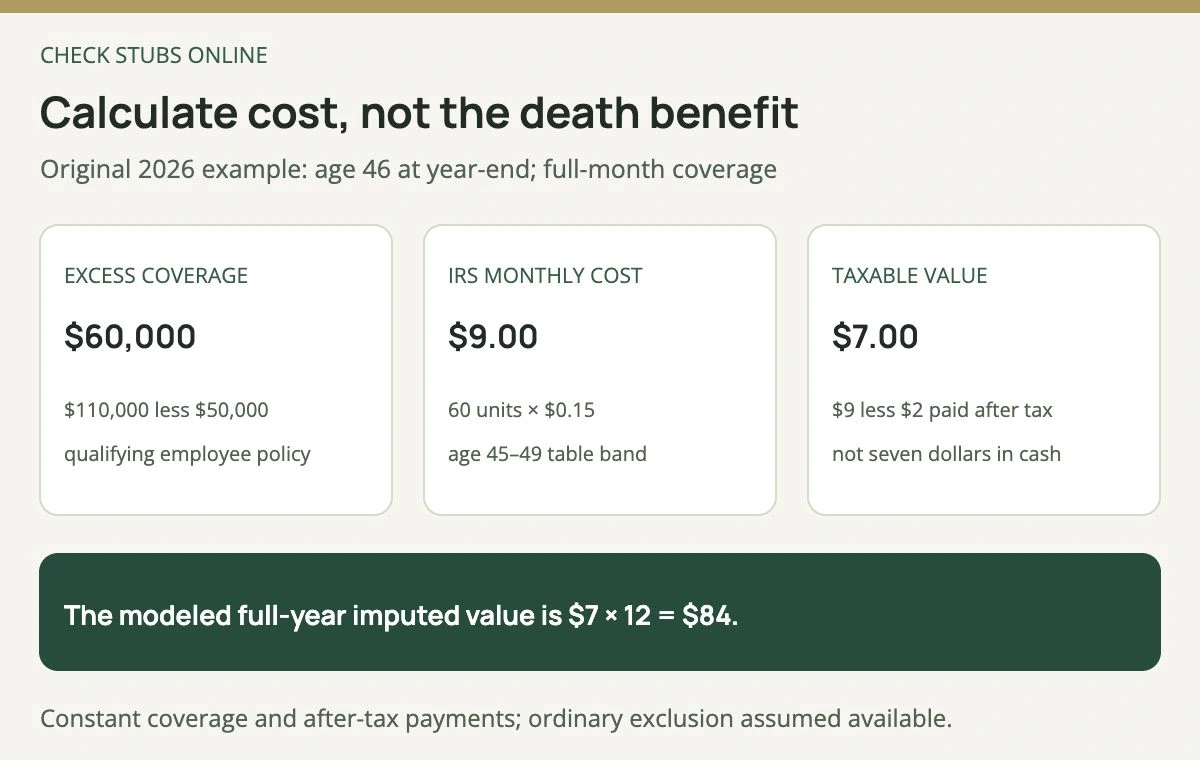
The $84 is an annual benefit value under the supplied facts, not the employee’s insurance protection or an additional cash payment.
Without the assumed $2 monthly payment, the same table calculation would produce $108 over twelve full months. The $24 paid after tax during the year reduces that figure to $84 in this illustration. Confirm the actual contribution treatment rather than assuming that every insurance deduction has the same effect.
## Use the prescribed age and the actual coverage period
Publication 15-B uses the employee’s age on the final day of the employee’s tax year for coverage within that year. Do not automatically switch the cost band only in the birthday month. If an employee finishes the year in a new band, ask payroll how that prescribed age was applied across the covered periods.
For example, someone who is 44 early in a calendar tax year and turns 45 before year-end falls within the year-end age-45-through-49 band for this rule. This is a timing illustration, not a calculation for a different plan or coverage amount.
A change in insured salary, supplemental coverage, enrollment or termination can change the coverage being valued. The IRS also requires proration where coverage lasts less than a full month. Obtain the dated coverage and calculation rather than multiplying one unfamiliar paycheck entry by the annual number of checks. This guide’s $84 example deliberately assumes twelve complete, identical months.
## Original paycheck example: taxable wages rise but cash wages do not
Use one full month from the same fictional policy. Assume $3,000 cash wages, the $7 imputed value, the $2 after-tax employee payment and no other benefits or wage adjustments. All $3,007 is covered by ordinary employee FICA, with enough remaining Social Security wage base and no Additional Medicare withholding. Federal income-tax withholding is separately supplied as $300; it is not derived here from a W-4 or personal tax situation.
[IRS Publication 15 for 2026](https://www.irs.gov/publications/p15) lists 1.45% for the regular employee Medicare calculation and 6.2% for the covered employee Social Security calculation. For this illustration, each tax line is rounded to cents using half-up rounding.
**Original monthly cash-payment bridge with a $7 noncash value**
| Line | Calculation or role | Amount |
| --- | --- | --- |
| Cash wages | Available before employee cash reductions | $3,000.00 |
| Imputed value | Noncash addition to the assumed taxable bases | $7.00 |
| Taxable wage base used here | $3,000 + $7 | $3,007.00 |
| Employee Social Security | $3,007 × 6.2%, rounded | −$186.43 |
| Employee Medicare | $3,007 × 1.45%, rounded | −$43.60 |
| Federal withholding | Supplied for the illustration | −$300.00 |
| Employee insurance contribution | After-tax cash deduction | −$2.00 |
| Net cash paid | $3,000 − $186.43 − $43.60 − $300 − $2 | $2,467.97 |
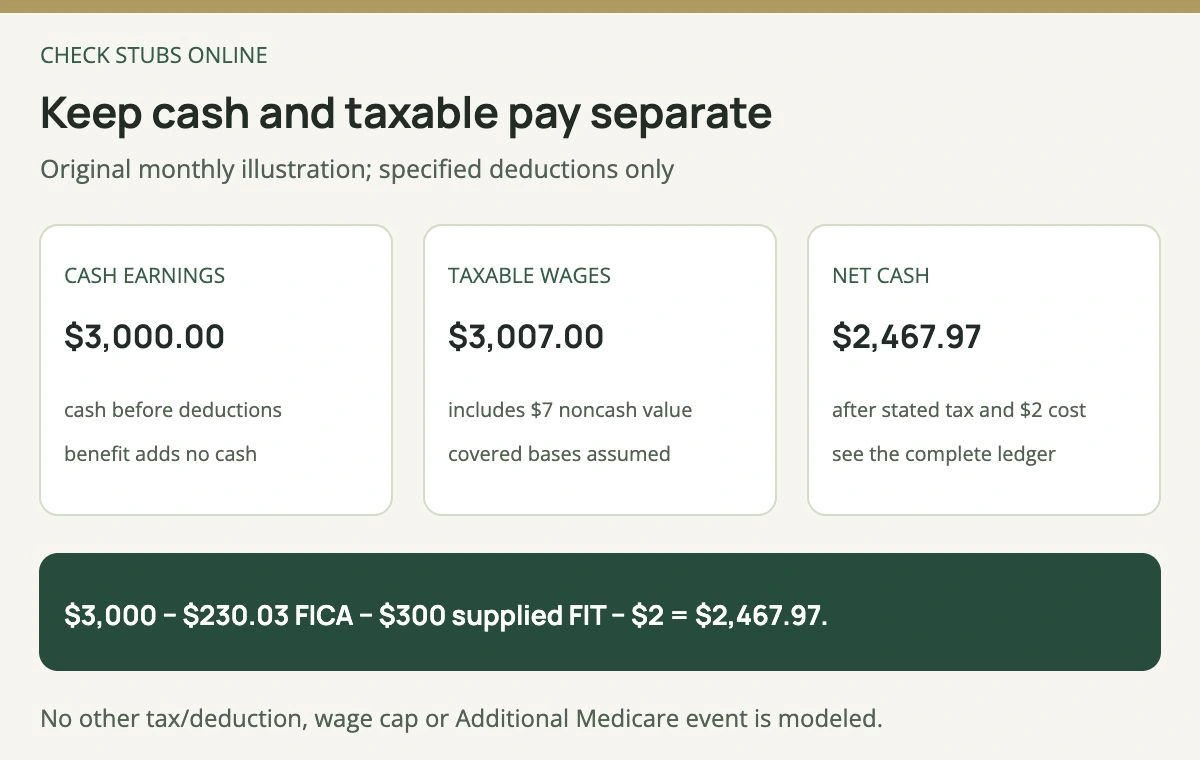
The $300 federal amount is an assumption, not a tax estimate. State/local taxes and every other deduction are excluded from this fictional payment.
Without the $7 noncash inclusion, ordinary FICA on $3,000 would total $229.50 under these assumptions. On $3,007 the two rounded lines total $230.03, a $0.53 difference. That demonstrates a possible cash effect from taxes without adding seven dollars of cash wages.
If the payroll layout displays $3,007 as earnings, an equal $7 noncash offset can bring the cash starting point back to $3,000. Subtracting the stated taxes and $2 contribution then produces the same $2,467.97. Do not subtract the imputed value again from a cash-wage starting point that already excludes it. The [gross and net reconciliation guide](https://blog.checkstubsonline.com/gross-vs-net-pay) explains that presentation difference.
## Check annual wages and W-2 Box 12 Code C together
Publication 15-B directs employers to report the includable cost in W-2 Boxes 1, 3 and 5 and separately identify it in Box 12 with Code C, subject to the applicable wage-base rules. Under the constant-coverage example, the annual imputed amount is $84. Assume the employee still has sufficient room under the annual Social Security wage base, with no other reporting adjustment affecting this illustration.
The same $84 identified by Code C is already part of the relevant wage-box calculation; it is not another $84 of wages to add on top. Nor should the $110,000 policy coverage be entered as ordinary wages. Our [W-2 wage-box comparison](https://blog.checkstubsonline.com/w2-boxes-1-3-5-different) explains why actual boxes can differ for other reasons.
Reconcile the coverage worksheet and monthly or payroll allocations to the annual amount. A single statement may show a current entry or a cumulative total; those columns are not interchangeable. If a correction changes the policy dates or contribution treatment, ask for the revised annual bridge as well as the corrected current statement.
## When should you stop using the ordinary example?
Insurance for a spouse or dependent, accidental-death-only coverage and arrangements with permanent benefits are not automatically the same employee group-term case. Publication 15-B discusses their different treatment. The employee’s own $50,000 threshold should not be copied into a family-policy calculation without review.
A plan favoring key employees can require a different inclusion calculation for those employees. More-than-2% S corporation shareholder treatment also differs from the ordinary employee exclusion. Ask the plan administrator which rule applies rather than inferring eligibility from job title or an insurance deduction.
Coverage after employment ends has separate collection and reporting provisions. The IRS discusses uncollected employee Social Security and Medicare amounts for former employees and W-2 Codes M and N. That is outside this current-employee cash-payment example; use the actual separation dates and current instructions.
## Ask payroll for the valuation, not just the premium
A useful request identifies the policy, coverage dates, year-end age, applicable threshold, table cost and employee payments. Ask which taxes and wage boxes include the value and how the amount is allocated across paychecks. Keep the response with the benefit election and original statements.
For the fictional example, the question is reproducible: “Please confirm the $110,000 qualifying coverage, the age-46 year-end band, the $9 monthly table cost and the $2 after-tax payment that leave $7 imputed monthly.” Use your own supported details rather than treating these figures as a universal insurance charge.
If the record is wrong, use the employer’s correction process. The [pay-stub correction guide](https://blog.checkstubsonline.com/pay-stub-errors-correction) and [W-2 correction comparison](https://blog.checkstubsonline.com/reissued-w2-vs-w2c) distinguish a corrected record from a duplicate copy. A self-created document does not change the employer’s tax ledger or insurance coverage.
## Questions about life-insurance imputed income
### Does $100,000 of life insurance mean $100,000 taxable pay?
No. Protection and calculated taxable cost are different quantities. Establish the plan’s treatment and applicable valuation before checking a wage amount.
### Can the benefit affect my deposit without adding cash?
Yes. Applicable employee taxes can increase while the benefit itself remains noncash. The original monthly example shows the calculation under explicit assumptions.
### Is Code C another employee insurance deduction?
It identifies the includable group-term life cost on the W-2. Check the payroll contribution separately; do not subtract Code C from cash pay merely because it is visible.
### Can I value every policy using the employer’s premium?
No. The ordinary table method and special-case rules must be distinguished. The invoice is useful evidence but does not alone select the tax treatment.
### Can I use one month to estimate the whole year?
Only if coverage, contributions and the applicable treatment stay consistent for the stated full periods. Otherwise reconcile the actual dated changes.
The Check Stubs Online Editorial Team checked the 2026 IRS fringe-benefit rules, group-term cost table, reporting instructions and regular employee FICA rates. The insurance and cash-payment ledgers were independently built for this guide and are not customer or insurer results.
## Relevant document tool
Use the IRS group-term life cost rules
Review the qualifying coverage, year-end age, monthly cost table and contribution treatment before comparing payroll and annual wages.
[Review IRS fringe-benefit guidance](https://www.irs.gov/publications/p15b)
The ordinary example does not value every insurance policy or decide an individual’s eligibility for an exclusion.
## Related guides
- [Pay Stub Errors: How to Request and Track a Correction](https://blog.checkstubsonline.com/pay-stub-errors-correction)
- [Employer-Paid Benefits on a Pay Stub: What Changes Your Pay?](https://blog.checkstubsonline.com/employer-paid-benefits-pay-stub)
- [Gross vs. Net Pay: Reconcile Your Paycheck](https://blog.checkstubsonline.com/gross-vs-net-pay)