---
title: "Moving Reimbursement on Your Paycheck: Tax and Gross-Up Checks"
description: "Check taxable moving reimbursement, employer-paid movers and relocation gross-ups with original payroll examples, 2026 exceptions and a record checklist."
url: "https://blog.checkstubsonline.com/moving-reimbursement-paycheck"
datePublished: "2026-11-27"
---
# Moving Reimbursement on Your Paycheck: Tax and Gross-Up Checks
Check taxable moving reimbursement, employer-paid movers and relocation gross-ups with original payroll examples, 2026 exceptions and a record checklist.
Published: 2026-11-27
By [Check Stubs Online Editorial Team](https://blog.checkstubsonline.com/editorial-policy#editorial-team)
**An ordinary employee’s 2026 employer-paid moving reimbursement generally enters taxable wages.** Receipts and a “relocation” label do not create an exclusion. Trace the cash recipient, any value already paid to a mover, and the actual withholding. A gross-up adds taxable pay toward a defined net target; its terms and calculations need their own review.
Reviewed November 27, 2026 · Federal payroll treatment of ordinary civilian relocation in 2026, with specified military and intelligence-community exceptions. All calculations below are invented examples. They exclude state/local taxes, contractual disputes and unlisted payroll adjustments unless expressly stated.
A relocation offer often bundles an allowance, paid invoices, storage and a tax allowance. The first useful question is not whether the package says “reimbursement.” It is which actual payment or service each line represents and which rule payroll applied.
## In this guide
1. [Classify the move and each payment](#move-classify)
2. [Identify the narrow exclusions](#move-exceptions)
3. [Trace an original vendor-payment example](#move-vendor)
4. [Distinguish withholding from final tax](#move-withholding)
5. [Calculate and recheck a defined gross-up](#move-grossup)
6. [Check records and annual reporting](#move-records)
7. [Handle repayment and correction separately](#move-repayment)
8. [Moving-pay questions](#move-faq)
## A permanent relocation is not automatically a business-travel reimbursement
[Publication 15-B for 2026](https://www.irs.gov/publications/p15b) says the general moving-reimbursement exclusion has been permanently eliminated, with specified exceptions. It did not simply return after 2025. An ordinary employee moving for a new job should not treat older guidance about a temporary suspension as permission to exclude the payment.
Keep relocation, ordinary work travel and other benefits in separate categories. The employer may need to examine the assignment and each expense before choosing its treatment. Our [expense-reimbursement guide](https://blog.checkstubsonline.com/expense-reimbursements-pay-stub) addresses the records supporting business expenses; it does not make a permanent household move an accountable-plan business trip.
**Relocation package entries to identify before reconciling payroll**
| Entry | What actually happened | Question for payroll |
| --- | --- | --- |
| Cash allowance | Employee receives money before deductions. | What portion is taxable wages and what withholding method applies? |
| Expense reimbursement | Employer repays a cost already paid by the employee. | Which expense and payment are being reimbursed, and is any exclusion actually available? |
| Direct mover payment | Employer pays the supplier instead of the employee. | What taxable value and noncash offset were recorded? |
| Tax gross-up | Employer adds compensation under a defined promise. | Which taxes, target and reconciliation period does the agreement cover? |
A receipt establishes an expense and possibly its payer. It does not by itself establish the employee’s tax exception. Likewise, changing the recipient from the employee to a moving company does not by itself make an ordinary taxable relocation benefit excluded.
## Which workers and moves can receive different treatment?
The current [IRS moving-expense topic](https://www.irs.gov/taxtopics/tc455), updated November 25, 2026, addresses active-duty Armed Forces moves under the qualifying military-order/permanent-change-of-station rules. It also addresses eligible intelligence-community employees and new appointees relocating in 2026 or later for a qualifying assignment change. Publication 15-B states the corresponding employer-reimbursement exceptions.
These categories require the actual statutory facts. A civilian employee does not qualify merely because a private employer required the move. Nor does working with a government customer automatically make a person an eligible intelligence-community employee.
Only eligible expenses receive the specified treatment. The IRS topic identifies reasonable qualifying costs for moving possessions, storage and travel including lodging, and excludes meals from the moving-expense deduction. It also prevents deducting costs already covered by an excluded government payment. Ask the relevant administrator about orders, assignment status, expense categories and the proper reporting rather than applying an exception to an entire package by its name.
## Original example: payroll records a service already paid to the mover
Assume an ordinary civilian employee receives $2,400 cash salary. The employer separately pays a $1,550 taxable moving invoice to the supplier. No exclusion applies. For this payroll, all $3,950 is covered by regular employee Social Security and Medicare, and no Additional Medicare withholding is triggered. Federal income tax withheld on the payroll is supplied as $385; it is not estimated from the employee’s W-4. No other deduction is included.
**Original direct-to-mover payment and employee cash reconciliation**
| Line | Calculation or meaning | Amount |
| --- | --- | --- |
| Cash salary | Money available to pay the employee | $2,400.00 |
| Taxable mover service | Already delivered through the employer’s supplier payment | $1,550.00 |
| Combined covered wages | $2,400 + $1,550 | $3,950.00 |
| Employee Social Security | $3,950 × 6.2% | −$244.90 |
| Employee Medicare | $3,950 × 1.45%, rounded | −$57.28 |
| Federal withholding | Supplied payroll result | −$385.00 |
| Employee cash | $2,400 − $244.90 − $57.28 − $385 | $1,712.82 |
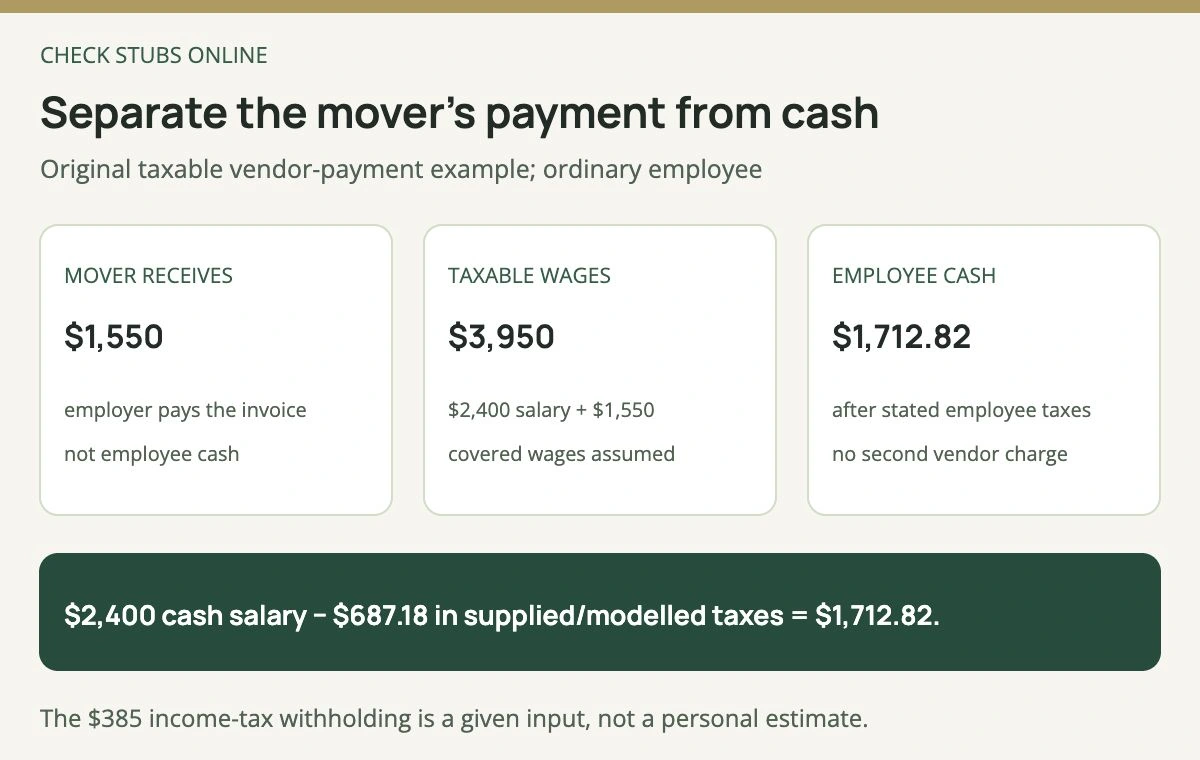
The mover receives the invoice payment. The employee’s deposit starts from cash salary, not combined taxable compensation.
A layout that starts with $3,950 can show a $1,550 noncash offset before employee taxes. That produces the same $1,712.82 deposit. The offset prevents paying an already delivered benefit again; it is not evidence of a separate debt or second charge.
If the same $1,550 were instead reimbursed directly to the employee, total cash before these stated taxes would be $3,950 and cash after them would be $3,262.82. Those are different payment routes. Do not subtract a mover offset from a reimbursement that the employee actually receives. See the [cash and wage-base reconciliation guide](https://blog.checkstubsonline.com/gross-vs-net-pay) when a displayed gross amount does not match the bank deposit.
## Is relocation taxed at a special 22% rate?
No universal final relocation tax rate applies. [2026 Publication 15, section 7](https://www.irs.gov/publications/p15) describes supplemental-wage withholding. The optional flat 22% method has conditions, including separately identified supplemental pay and regular-wage income-tax withholding in the current or immediately preceding year. The employer’s permitted method and the over-$1-million rule must also be considered.
The employee cannot simply choose 22% because it looks favorable. Social Security, Medicare and relevant state/local withholding are separate from that federal income-tax withholding percentage. The actual annual income-tax liability is determined through the return.
The [supplemental-pay withholding guide](https://blog.checkstubsonline.com/bonus-tax-withholding) explains the broader distinction. It is useful when checking a relocation payment, but its label or a withholding percentage does not establish that a move qualifies for an exclusion.
## Original gross-up example: verify the cents, not just the division
Consider a separate cash-only relocation payment. The written agreement targets $2,500 after the specified payroll withholding. Assume the employer can properly use the optional 22% federal method, the payment remains fully below the Social Security wage limit, ordinary Medicare applies, and there is no Additional Medicare, state/local tax or other deduction. These assumptions are deliberately narrow.
The combined modeled rate is 22% + 6.2% + 1.45% = 29.65%. Before line-by-line cent rounding, gross pay is the target divided by 70.35%: $2,500 ÷ 0.7035. Simply adding 29.65% of the target would ignore tax on the extra compensation.
**Original $2,500 cash target under the stated limited withholding model**
| Line | No gross-up: $2,500 gross | Gross-up to the defined net |
| --- | --- | --- |
| Gross cash payment | $2,500.00 | $3,553.67 |
| Federal withholding at 22% | $550.00 | $781.81 |
| Employee Social Security at 6.2% | $155.00 | $220.33 |
| Employee Medicare at 1.45% | $36.25 | $51.53 |
| Total specified withholding | $741.25 | $1,053.67 |
| Cash after these amounts | $1,758.75 | $2,500.00 |
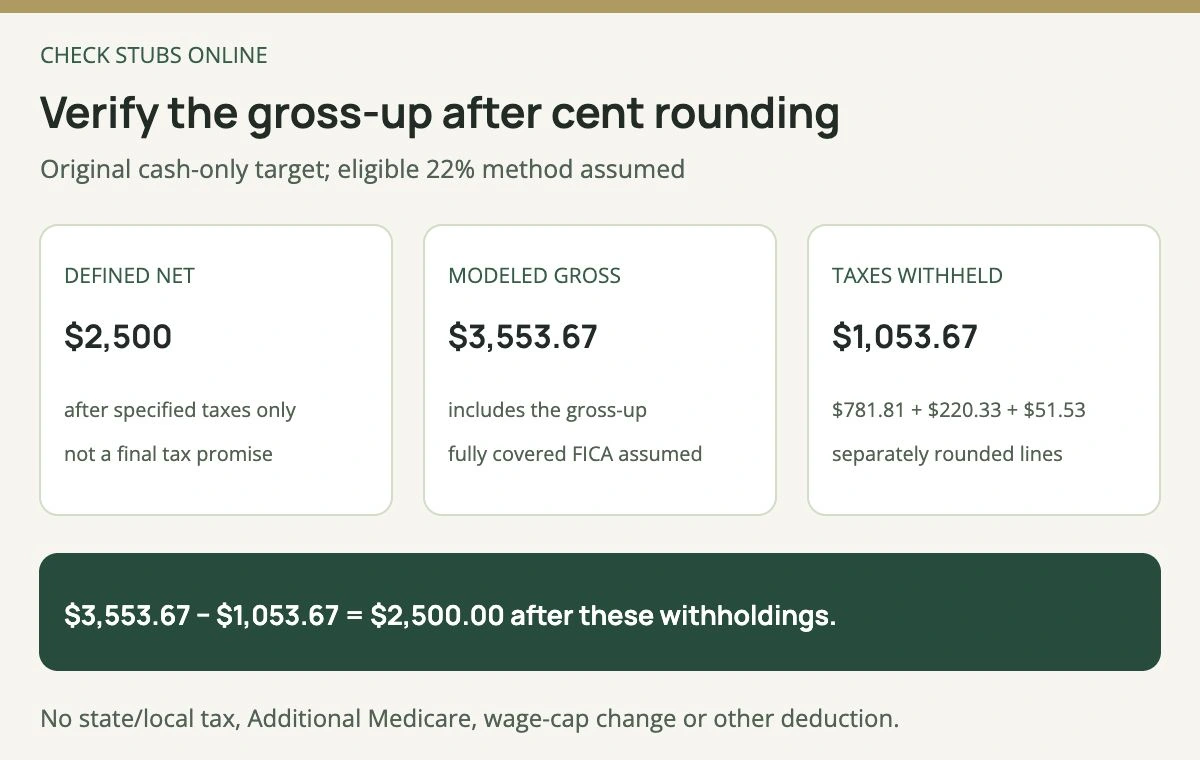
The agreement’s $2,500 target is reached only for the listed assumptions. It is not a guarantee of the employee’s final tax position.
The initial division rounds to $3,553.66. When the three tax lines are each rounded to cents, that amount leaves $2,499.99. Increasing gross by one cent to $3,553.67 leaves the tax lines at $781.81, $220.33 and $51.53 and reaches $2,500.00. Recheck an actual payroll’s rounding and tax rules instead of treating the initial quotient as the final result.
The extra $1,053.67 is additional taxable gross compensation. A different wage-base position, tax method or state can require a different result. A gross-up covering only these withholdings is not a promise to settle all future personal tax, and the agreement may provide a later adjustment.
## Reconcile the agreement, invoices, paycheck and annual statement
1. **Separate promised amounts from paid amounts.** Record each allowance, invoice payment and completed reimbursement.
2. **Record the payment destination.** Identify the employee, mover or other supplier for each transaction.
3. **Obtain the payroll explanation.** Confirm taxable value, any noncash offset, withholding method and period or year-to-date adjustments.
4. **Check the gross-up promise.** Match its target, tax coverage, caps and later reconciliation with the actual computation.
5. **Review annual reporting.** Compare taxable relocation with the relevant wage boxes, and investigate mismatches through the employer.
The [2026 W-2 instructions](https://www.irs.gov/instructions/iw2w3) reserve code P for the specified excludable moving reimbursements paid directly to eligible Armed Forces or intelligence-community workers. It is not a general code for any moving payment. Qualified in-kind or third-party services have their own reporting treatment; confirm the actual arrangement rather than assigning code P from an invoice description.
## Repayment is a separate wage, contract and tax-year question
Read any repayment clause before accepting that a later payroll deduction is correct. Ask what event triggered repayment, how the amount was calculated, whether the employer seeks gross or net cash, which taxes are being corrected, and which year the original benefit belongs to. This guide does not determine the enforceability of a relocation agreement or a deduction under state law.
Our [payroll repayment guide](https://blog.checkstubsonline.com/payroll-overpayment-repayment) helps organize the year and tax records; a relocation clawback is not automatically an accidental payroll overpayment. If the original statement is wrong, use the [issuer correction steps](https://blog.checkstubsonline.com/pay-stub-errors-correction). Making a new statement cannot fulfill the gross-up promise or change the employer’s tax reporting.
## Questions about moving reimbursements and paychecks
### Do receipts make an ordinary relocation reimbursement tax-free?
No. Receipts support the expense, but an actual applicable exclusion is still necessary. The ordinary 2026 federal moving-reimbursement exclusion is unavailable outside the specified exceptions.
### Why did my paycheck shrink if the employer paid the mover?
A taxable noncash service can add wages and employee taxes without adding employee cash. Check the value, tax lines and offset before assuming the mover was charged twice.
### Does a gross-up make relocation nontaxable?
No. It adds compensation intended to reach the agreement’s defined net after specified taxes. The added pay is itself part of the calculation.
### Can I reuse the gross-up percentage for another paycheck?
Only after verifying the new facts and permitted tax method. Wage caps, other taxes and rounding can change the result, even when the net target is unchanged.
The editorial team checked the IRS’s 2026 moving, fringe-benefit, supplemental-withholding and annual-reporting guidance. The vendor ledger and cent-rounded gross-up are separate original illustrations with limited assumptions.
## Relevant document tool
Check the current moving-benefit rules
Identify the payment, recipient and applicable exception before reconciling a relocation amount or agreeing a gross-up target.
[Review IRS fringe-benefit guidance](https://www.irs.gov/publications/p15b)
A relocation worksheet does not establish a tax exclusion or decide a repayment agreement.
## Related guides
- [Gross vs. Net Pay: Reconcile Your Paycheck](https://blog.checkstubsonline.com/gross-vs-net-pay)
- [Payroll Overpayment: Records to Check Before Repaying Your Employer](https://blog.checkstubsonline.com/payroll-overpayment-repayment)
- [Bonus Tax Withholding: Why Your Bonus Check Is Smaller](https://blog.checkstubsonline.com/bonus-tax-withholding)