---
title: "On-Call Pay and Callback Hours: Check Your Pay Stub"
description: "Separate standby restrictions, actual callback work and minimum payments. Follow a checked two-call example and learn what to ask payroll."
url: "https://blog.checkstubsonline.com/on-call-pay-callback-hours"
datePublished: "2026-11-25"
---
# On-Call Pay and Callback Hours: Check Your Pay Stub
Separate standby restrictions, actual callback work and minimum payments. Follow a checked two-call example and learn what to ask payroll.
Published: 2026-11-25
By [Check Stubs Online Editorial Team](https://blog.checkstubsonline.com/editorial-policy#editorial-team)
**On-call time and callback pay need separate checks: standby restrictions can make waiting time compensable, while a callback creates actual work to record.** A policy may also guarantee more pay than the time spent on the call. Preserve the restriction details, duty start/end times and guarantee calculation. Do not turn every paid minimum into worked hours, or assume a small standby payment settles what the law requires.
Reviewed November 26, 2026 · U.S. employee standby, callback and wage-record questions. The fictional case assumes a covered nonexempt employee, one employer, already reviewed compensable time and an expressly supplied lawful pay guarantee. No travel, other restricted standby, special overtime method or more protective state requirement is modeled.
A schedule might say “on call Saturday,” a time record might show two short remote assignments, and the pay stub might contain a four-hour callback entry. Those records can describe different things without necessarily contradicting one another. The task is to identify what each field measures before deciding whether time or money is missing.
This guide is separate from a [per-diem shift or canceled-shift question](https://blog.checkstubsonline.com/per-diem-job-offer). It follows standby constraints, actual callback duty and a stated minimum-payment policy. A particular employer may use different earning codes; ask for its definitions.
## In this guide
1. [Distinguish standby, work and guarantees](#call-terms)
2. [Record the actual standby constraints](#call-restrictions)
3. [Capture callback duty time](#call-time)
4. [Check a supplied two-hour minimum](#call-example)
5. [Reconcile hours and gross pay](#call-week)
6. [Review regular-rate treatment separately](#call-rate)
7. [Ask payroll for the missing explanation](#call-request)
8. [On-call pay questions](#call-faq)
## Three things a single on-call label can hide
A standby assignment describes when you must be available. Actual callback work describes the duties performed after a call, message or system alert. A minimum-pay guarantee describes the amount payable under the governing policy or agreement. The units beside those entries are not automatically interchangeable.
**Keep availability, worked time and pay guarantees distinct**
| Item | Record to retain | Question to resolve |
| --- | --- | --- |
| Standby window | Required location, availability terms and restrictions | Could the person use the waiting period for personal purposes? |
| Actual callback duty | Task start/end, required preparation and completion detail | Which time was work? |
| Minimum payment | Policy version, trigger and calculation | Does the payment exceed earnings for actual work? |
| Paycheck row | Earning-code explanation and amount | Does the hours column show work time or a payment unit? |
The [DOL hours-worked fact sheet](https://www.dol.gov/agencies/whd/fact-sheets/22-flsa-hours-worked) explains that waiting circumstances and restrictions matter. Remaining on the employer’s premises while on call is treated differently from merely being reachable away from the premises. Additional limits on personal freedom can change the latter result. A label such as “unpaid standby” is not a complete factual analysis.
## What should you record about the standby arrangement?
Keep the actual instructions, not only the roster. Identify where you must remain, how quickly and in what way you must respond, how often interruptions occur and what activities the instructions prevent. Save changes to those requirements. A written policy allowing personal time can conflict with the way the assignment actually operates.
[29 CFR 785.17](https://www.ecfr.gov/current/title-29/section-785.17) focuses on required presence and whether proximity restrictions prevent effective personal use of the time. Do not treat one response-time number as a nationwide automatic test. Apply the real conditions and the governing jurisdiction, including any more protective rule.
For example, a person required to stay at a prescribed worksite between tasks needs a different review from someone who can leave contact details and pursue ordinary personal activities. That comparison identifies the missing facts; it does not decide a real employee’s claim. Ask payroll or the responsible wage specialist which hours its review included.
## Record the work performed after the call
A short remote assignment still needs accurate duty time. Record when the required work begins and ends, including required task preparation and completion activity rather than only the length of a phone conversation. Do not assume that the system’s call log captures every compensable task.
Keep the task identifier, dates, time zone where relevant, instructions and any approved correction. Protect customer or patient information: a payroll question normally needs the timing and work reference, not unrelated confidential content. If travel occurred, identify it separately for the applicable travel-time review instead of silently treating it as zero.
The original example below assumes the reported minutes already include all compensable callback duties and no travel. If additional standby or task time is later found compensable, the hour ledger must be revised before the overtime check. A payment guarantee cannot substitute for that missing investigation.
## Original example: two callbacks, each with a two-hour pay minimum
Assume a fictional lawful policy pays at least two hours at $28 for each qualifying callback. Callback A contains 75 minutes of actual duty; callback B contains 45 minutes. There is no overlap between the calls. The policy applies to each event separately, and no other compensable time has been omitted under the supplied facts.
Seventy-five minutes is 1.25 hours, so actual-work earnings for A are $35. Forty-five minutes is 0.75 hours, giving $21 for B. The stated two-hour minimum is $56 for each event. The respective additions above actual-work earnings are therefore $21 and $35, totaling $56.
**Original callback guarantee ledger at $28 per hour**
| Callback | Actual duty | Actual-work earnings | Policy payment | Additional minimum pay |
| --- | --- | --- | --- | --- |
| A | 75 minutes / 1.25 hours | $35.00 | $56.00 | $21.00 |
| B | 45 minutes / 0.75 hours | $21.00 | $56.00 | $35.00 |
| Total | 120 minutes / 2 hours | $56.00 | $112.00 | $56.00 |
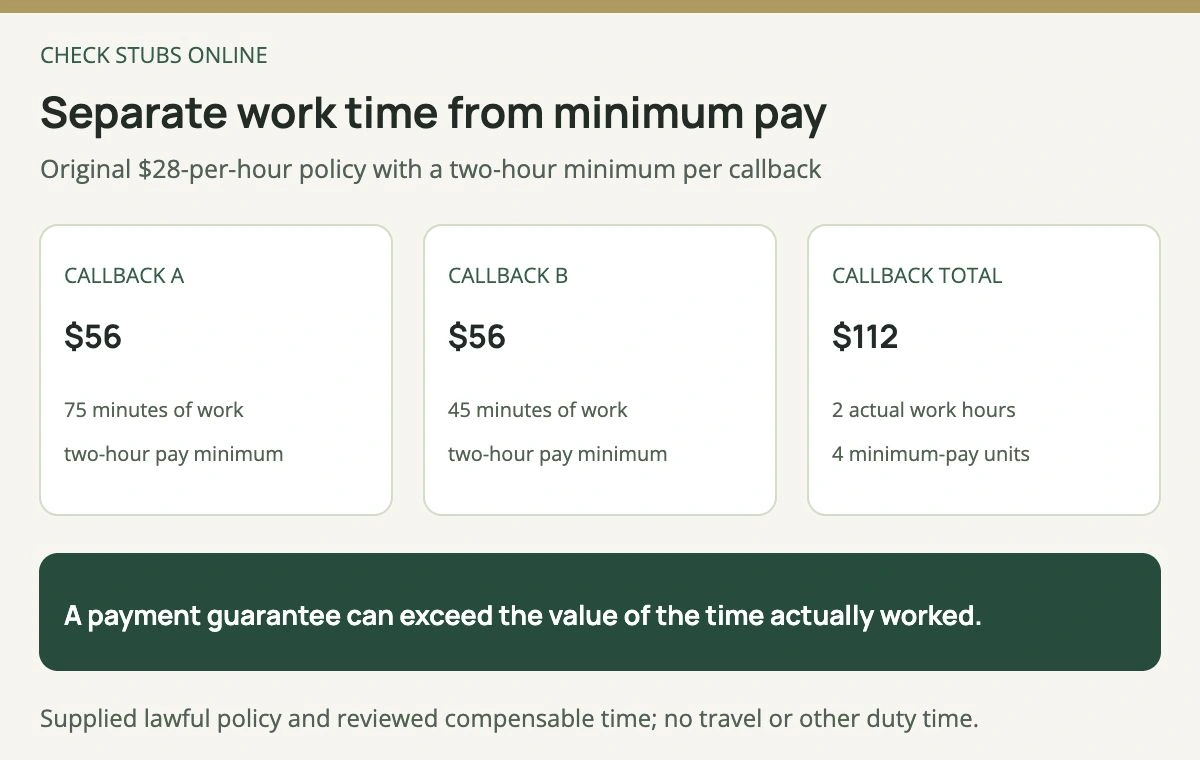
The four minimum-pay units explain the money. They do not establish four hours of actual callback work.
The supplied policy is a minimum, not a maximum. If an event actually lasted longer than its guaranteed period, the additional work would still require review and payment under the applicable rules. Also check whether overlapping calls, a continuous assignment or another trigger changes how many guarantees the policy provides.
## Add actual hours and actual payment amounts in separate columns
Now assume the same employee worked 38 other hours at $28 during that established workweek. Those scheduled hours produce $1,064. The callback payments add $112, making $1,176 gross before employee deductions. Actual work is 38 + 2 = 40 hours. Dividing the gross by $28 would produce 42 equivalent payment units, not a reliable measure of work time.
**Original weekly bridge with all relevant work assumed included**
| Component | Actual worked hours | Gross payment |
| --- | --- | --- |
| Scheduled work | 38 | $1,064.00 |
| Two callbacks | 2 | $112.00 |
| Total | 40 | $1,176.00 |
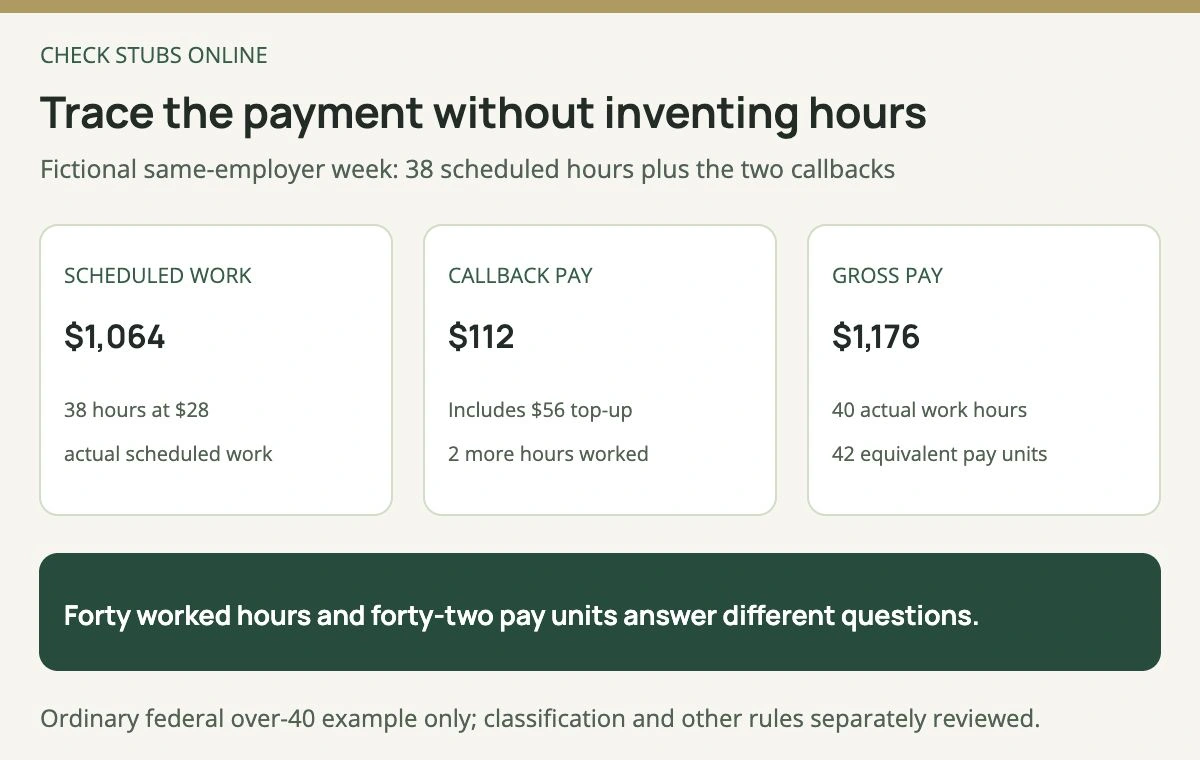
The illustration does not create two ordinary federal overtime hours merely because a payment display totals 42 units.
If another hour of actual work later occurred in this same week, the supplied 40-hour record would become 41. That changes the ordinary weekly overtime question. The rate calculation still needs the full pay classification; the example does not assume every guarantee payment has one universal regular-rate treatment.
Match the workweek independently of the pay period. A Sunday callback can be in a different employer-defined week from the following Monday, and a paycheck can cover both. Our [workweek and payroll-cutoff guide](https://blog.checkstubsonline.com/semimonthly-paycheck-hours) helps keep the calendars distinct.
## A callback minimum is not automatically an overtime premium
[29 CFR 778.221](https://www.ecfr.gov/current/title-29/subtitle-B/chapter-V/subchapter-B/part-778/subpart-C/section-778.221) discusses qualifying unanticipated callback payments. It distinguishes compensation for actual work from an extra minimum-payment amount. A qualifying extra amount may be excluded from the regular rate, but cannot simply be credited against statutory overtime owed. Prearranged payments have a different treatment under that provision.
Ask whether the extra duty was anticipated and reasonably could have been scheduled. A routinely planned task does not become unanticipated solely because a supervisor starts it with a phone call. [The related rule for similar payments](https://www.ecfr.gov/current/title-29/subtitle-B/chapter-V/subchapter-B/part-778/subpart-C/section-778.222) also distinguishes certain scheduling-related extra amounts from actual worked time and addresses prearrangement.
Keep this regular-rate classification separate from income-tax and benefit questions. Ask which earning codes enter the overtime calculation and which component, if any, payroll treats as a qualified exclusion. If actual work has different job rates, our [mixed-rate overtime example](https://blog.checkstubsonline.com/two-hourly-rates-overtime) shows why simply taking one displayed hourly rate can miss the calculation.
## Ask for the policy trigger and time calculation together
A useful request says: “For the identified workweek, my records show 38 scheduled hours and callbacks of 75 and 45 minutes. Please explain whether the four-unit callback row is a two-hour minimum per event, confirm the actual worked-hours total and identify the guarantee component used in the regular-rate review.” Replace these fictional details with your own documented events.
Attach the relevant instruction, time log and policy through the employer’s approved channel. Ask whether required setup, interrupted waiting or a later correction is missing. Preserve the employer’s response with the original and revised records; our [payroll correction guide](https://blog.checkstubsonline.com/pay-stub-errors-correction) explains that audit trail.
If you issue statements from authorized payroll records, check the [pay stub maker’s available earning fields](https://www.checkstubsonline.com/pay-stub-maker) against the completed register. Where actual work and a guarantee cannot be represented clearly, select a suitable workflow. A preview should not convert a minimum-payment unit into an hour worked.
## On-call and callback pay questions
### Is every hour carrying a phone an hour worked?
Not automatically. Required presence, restrictions and actual duties need review. Record those facts rather than deciding from the device alone.
### Does receiving an on-call allowance prove all waiting time was paid correctly?
No. The allowance’s amount and the legally compensable time are separate questions. Request the time and pay analysis.
### Can a four-hour callback entry mean only two worked hours?
Under the supplied two-event minimum policy, yes. The original ledger explains the $112 payment while preserving two hours of actual callback duty.
### Can a guarantee replace overtime otherwise due?
Do not assume so. The federal callback rule distinguishes qualified extra minimum pay from a creditable overtime premium. Review the actual components and method.
The Check Stubs Online Editorial Team reviewed the linked DOL guidance and complete official eCFR sections from the latest available November 23, 2026 title-29 issue. The callback, minimum-pay and weekly ledgers are original supplied-policy illustrations with independently checked arithmetic.
## Relevant document tool
Check the official hours-worked framework
Use the Department of Labor’s explanation of waiting and on-call time, then document the actual restrictions and callback duties.
[Review DOL hours worked](https://www.dol.gov/agencies/whd/fact-sheets/22-flsa-hours-worked)
The guidance does not decide an individual claim, state rule, plan guarantee or the facts of a particular assignment.
## Related guides
- [Semimonthly Paycheck Hours: Actual Time, Salary and Overtime](https://blog.checkstubsonline.com/semimonthly-paycheck-hours)
- [Overtime With Two Hourly Rates: Paycheck Checks](https://blog.checkstubsonline.com/two-hourly-rates-overtime)
- [Pay Stub Errors: How to Request and Track a Correction](https://blog.checkstubsonline.com/pay-stub-errors-correction)