---
title: "Paid Training Time: Meetings, Online Courses and Overtime"
description: "Check when employee training and meetings count as paid work. Review the four federal conditions, online attendance records and a worked overtime example."
url: "https://blog.checkstubsonline.com/paid-training-time-paycheck"
datePublished: "2026-11-26"
---
# Paid Training Time: Meetings, Online Courses and Overtime
Check when employee training and meetings count as paid work. Review the four federal conditions, online attendance records and a worked overtime example.
Published: 2026-11-26
By [Check Stubs Online Editorial Team](https://blog.checkstubsonline.com/editorial-policy#editorial-team)
**Required employee training or meetings generally belong in the paid work-time review, including sessions held after a shift.** Under the ordinary federal guidance, attendance can be left out of working time only when all four conditions apply: it occurs outside normal hours, attendance is voluntary, it is unrelated to the job and no other work is performed during it. Count compensable attendance in the covered nonexempt employee’s workweek before checking overtime.
Reviewed November 26, 2026 · U.S. existing-employee training and meeting records under the ordinary federal hours-worked framework. Fictional wage calculations assume covered nonexempt hourly employment, one employer, a known workweek and the stated single rate. Special apprenticeship, educational, industry, exemption and state-law issues are outside the worked calculation.
A course may be called optional while a supervisor expects everyone to complete it. A meeting may appear on a calendar without its time appearing in payroll. The useful question is what attendance actually required and how the employer recorded that time—not simply whether the invitation used the word “training.”
This guide concerns attendance time and wages. Payment of a tuition bill, a course fee or another employee benefit is a separate transaction. Keep those costs apart from the hours ledger; the [employer-paid benefits guide](https://blog.checkstubsonline.com/employer-paid-benefits-pay-stub) explains why a benefit amount is not automatically an employee cash deduction.
## In this guide
1. [Check all four exclusion conditions](#training-four)
2. [Review required and off-hours sessions](#training-required)
3. [Record actual attendance and work](#training-record)
4. [Follow an original weekly wage example](#training-example)
5. [Interpret the earnings and premium rows](#training-payrows)
6. [Compare an expressly voluntary case](#training-voluntary)
7. [Separate attendance from course costs](#training-payment)
8. [Document a payroll question](#training-request)
9. [Paid-training questions](#training-faq)
## All four ordinary exclusion conditions matter
The [DOL hours-worked fact sheet](https://www.dol.gov/agencies/whd/fact-sheets/22-flsa-hours-worked) sets out the four-part framework for lectures, meetings and training. It is not a rule that an employer can select whichever one condition is most convenient. Review the complete situation and any applicable special rule.
**Questions behind the ordinary federal training-time exclusion**
| Condition | Practical question | Evidence to keep |
| --- | --- | --- |
| Outside normal work hours | When does the session occur relative to the employee’s normal schedule? | Work schedule and actual session times. |
| Voluntary attendance | Was the employee actually free to decline attendance? | Invitation, manager instructions and attendance requirements. |
| Not related to the job | What does the session teach or require for the employee’s work? | Course description and stated purpose. |
| No concurrent work | Did the employee also handle calls, messages, customers or other duties? | Task record and the timing of work performed. |
A completion certificate can show that a course was finished without explaining these conditions. Likewise, a calendar entry can identify the planned start time without establishing actual attendance or whether productive duties continued during the session. Preserve both the instruction and the time record.
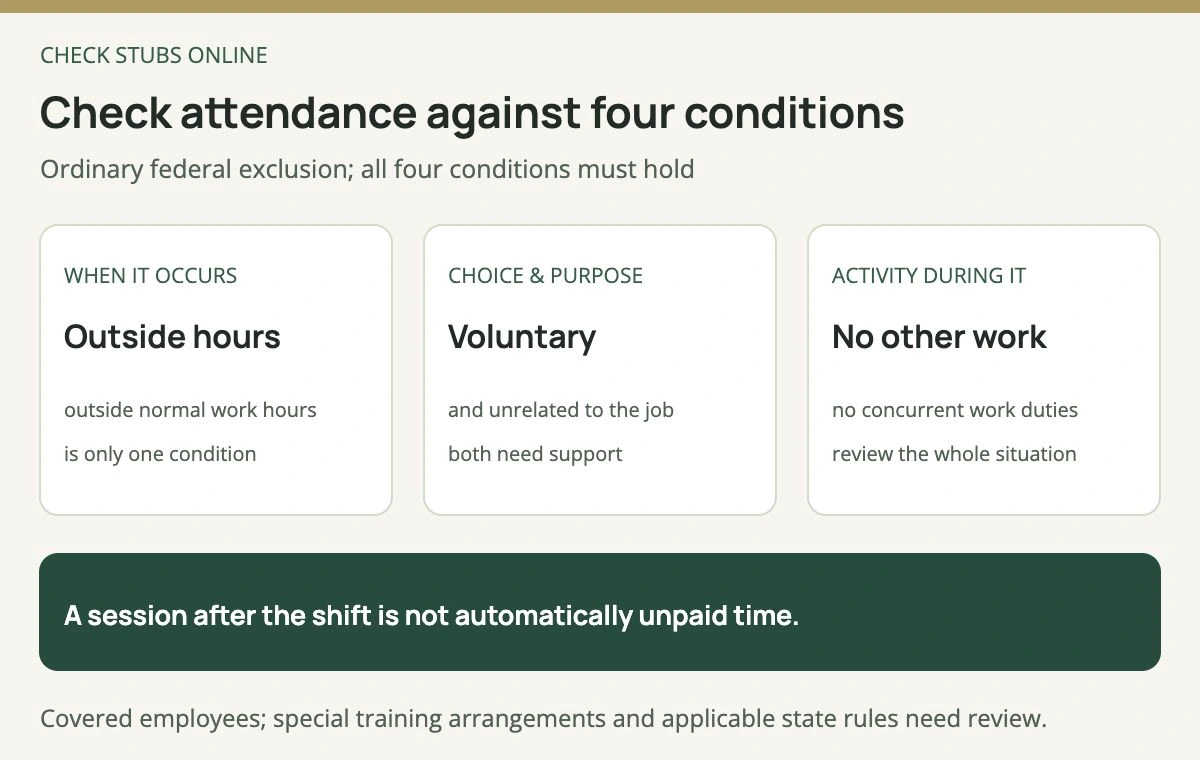
This decision aid summarizes the ordinary framework. It does not determine employee coverage or resolve a specialized training arrangement.
## After-hours scheduling does not make required attendance unpaid
If an existing employee is directed to attend a job-related safety briefing after the scheduled shift, the timing does not make the attendance voluntary or unrelated to the job. Under the ordinary framework described above, the employer cannot rely on the outside-hours condition alone to omit the time. Identify the actual instruction and the applicable employment rules.
The same review applies to assigned online modules completed at home. Record actual time spent on the required activity and any separate work. Being away from the employer’s premises does not, on its own, establish that the activity is outside paid work. The DOL fact sheet also explains work that an employer permits even when it was not specifically requested.
Do not infer that every educational activity has identical treatment. An independent school course, a specialized apprenticeship or a disputed applicant arrangement may need a different analysis. This article assumes an existing covered employee and ordinary employer-required attendance; it does not classify an unpaid internship or every continuing-education program.
## Record the time actually spent on the activity
Keep the assignment, attendance dates, actual start and end times, genuine off-duty intervals and the established workweek. If a course has several sessions, identify each one rather than placing the entire program into the week when the certificate arrived. Ask how the employer expects remote attendance time to be reported.
A module advertised as “30 minutes” is not a complete time record for every learner. Document the actual supported time, including required work or a necessary assigned retake, and distinguish it from unrelated personal activity. Do not inflate an entry simply because a browser tab remained open; explain the activity behind the claimed time.
Use consistent units. Ninety minutes is 1.5 hours, not 1.90 hours. Preserve the raw timestamps before conversion or rounding. Our [minutes and payroll-rounding guide](https://blog.checkstubsonline.com/time-clock-rounding-paycheck) helps distinguish a decimal conversion from a separate time-rounding policy.
## Original example: a required three-hour session takes the week to 41 hours
Assume a fictional covered nonexempt employee performs 38 hours of ordinary duties and attends three additional hours of required job-related training in one established workweek. All 41 hours are confirmed compensable work. One $22 straight-time rate applies throughout. There are no differentials, bonuses, paid absences, special overtime methods or state daily-overtime rules in this illustration.
The [DOL overtime explanation](https://www.dol.gov/agencies/whd/fact-sheets/23-flsa-overtime-pay) uses an established workweek and the applicable regular rate for ordinary covered work beyond forty hours. The additional attendance cannot be dropped merely to keep this example’s work total below that threshold.
**Original 41-hour training-week calculation at one stated rate**
| Earning component | Calculation | Amount |
| --- | --- | --- |
| Ordinary duties at straight time | 38 × $22 | $836.00 |
| Required training at straight time | 3 × $22 | $66.00 |
| Straight pay for all 41 hours | $836 + $66 | $902.00 |
| Additional weekly overtime premium | 1 × $22 × 0.5 | $11.00 |
| Gross for the assumed workweek | $902 + $11 | $913.00 |
If only the 38 ordinary duty hours had been paid at the supplied rate, the comparison would start at $836. Including the three training hours adds $66 of straight pay and creates an $11 additional weekly premium under these assumptions. The complete gross difference is $77. Adding only the $66 attendance amount would leave the premium out of this worked example.
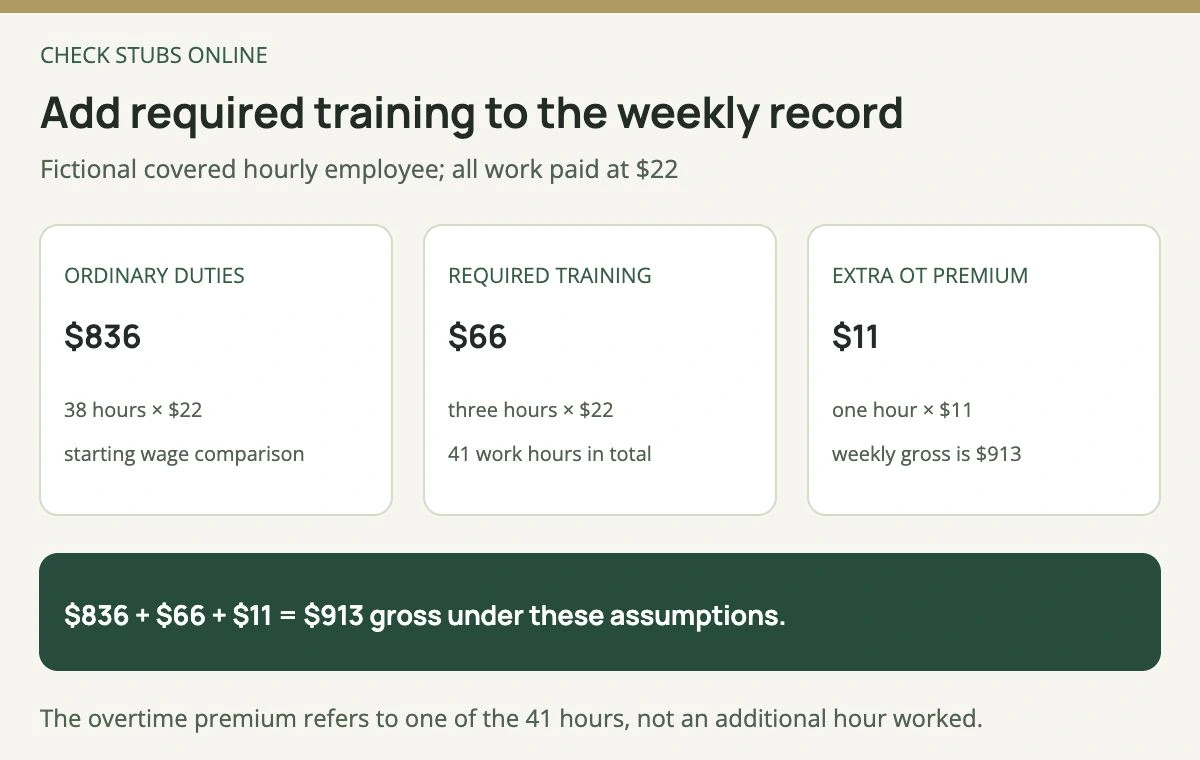
The wage bridge is for the supplied single-rate workweek. It does not calculate withholding or predict the amount ultimately deposited.
## A training code should explain time without counting it twice
Payroll might combine the training hours with regular hours or display a separate attendance earning code. Neither layout alone establishes whether the time was included properly. Reconcile actual hours, rates and total gross with the supporting register.
Here, paying all 41 hours at $22 and adding the $11 half-time premium produces $913. Displaying 40 hours at $22 and one hour at the full $33 overtime rate produces the same total. A premium-only reference to one hour does not create a forty-second hour actually worked.
A different agreed training rate requires a different regular-rate calculation. Do not use this single-rate illustration unchanged. The [mixed-rate overtime guide](https://blog.checkstubsonline.com/two-hourly-rates-overtime) explains the ordinary weighted approach and its qualifications. Other includable compensation also can affect the rate; see the separate [bonus and overtime guide](https://blog.checkstubsonline.com/bonus-overtime-regular-rate) when that is part of the actual week.
Workweek boundaries remain important even when a statement covers a longer payroll period. Check each week on its own. A two-week payment total should preserve the underlying weekly calculations rather than averaging away attendance in a higher-hour week.
## Compare a case where every ordinary exclusion condition is expressly met
For a separate fictional illustration, suppose an employee chooses a two-hour community course outside normal work hours. Attendance is genuinely optional, the course is unrelated to the job, and no employment duties are performed during it. Assume the ordinary DOL framework applies without a special arrangement or more protective rule. Under those supplied facts, the attendance can be excluded from federal working time.
That conclusion cannot be transferred to a required session just because both last two hours. If the employee must attend, the job relationship differs or work is performed concurrently, the stated comparison has changed. Obtain the reason for the employer’s classification rather than copying an “unpaid training” label.
This comparison addresses the ordinary federal attendance-time test. It does not decide whether a contract, policy or another law separately promises a payment. Keep any such promise and the actual wage arrangement with the record.
## Attendance wages, tuition assistance and expense repayment are different entries
Paid attendance compensates time. Tuition assistance pays or reimburses an educational cost. An expense repayment addresses an employee’s supported cost under the relevant arrangement. Approval of one category does not automatically establish the amount or treatment of the others.
For example, a statement could contain wages for the confirmed training hours while an accounts-payable record separately documents the course fee. Keep the invoice and any reimbursement evidence distinct from the hours record. Our [reimbursement article](https://blog.checkstubsonline.com/expense-reimbursements-pay-stub) covers why not every employer-funded amount should be added to wage gross or subtracted from net again.
If attendance involves a journey, review its time separately. The [travel-time pay guide](https://blog.checkstubsonline.com/travel-time-paycheck) explains ordinary commuting, between-site trips and the qualified overnight distinction. A valid course-hours calculation does not by itself classify the journey.
## Ask payroll which time, rate and week it used
Provide the session instruction, completion or attendance record, actual time and the employer’s workweek. State whether the issue is omitted attendance, a disputed rate, a misplaced week, an overtime premium or the cash payment. Avoid combining these into a single unexplained net-pay complaint.
A fictional request might say: “My record for the identified week shows 38 ordinary hours and three required training hours at $22. I calculate $902 straight pay and an $11 weekly overtime premium under the stated ordinary method. Please confirm the compensable time, actual rate calculation and the earnings rows used.” Replace these example facts with supported details.
DOL’s overtime fact sheet explains that an advance announcement against unauthorized overtime does not eliminate the right to compensation for compensable overtime actually worked. Follow the employer’s reporting process, preserve accurate records and distinguish any scheduling-policy question from the wage calculation itself.
Obtain an issuer correction where needed and follow the revised amount through to payment. Our [pay-stub correction guide](https://blog.checkstubsonline.com/pay-stub-errors-correction) gives a practical record trail. The $77 gross difference in the example is not a guaranteed $77 net deposit after actual deductions.
## Questions about training and meeting pay
### Can required training be unpaid because it happens at home?
Location alone does not establish an exclusion. Review the actual requirement, job relationship, work performed and applicable rules.
### Does an optional label settle whether attendance is voluntary?
No. Keep the instructions and facts showing whether the employee could actually decline. The ordinary exclusion requires all four conditions, not a label.
### Does a salaried employee automatically get a separate training payment?
This hourly illustration does not establish that result. Salary arrangements, exemption status and applicable rules need their own review; a salary label alone does not decide coverage.
### Should a completion certificate’s estimated duration replace actual time?
No. Use a supported attendance and work record. The certificate can support completion while serving a different purpose from the time ledger.
### Will an online calculator decide whether the session counts?
No. Establish the compensable time and wage method first. A numerical output cannot supply the missing employment facts.
Check Stubs Online’s editorial review used the current official DOL hours-worked and overtime explanations, with their visible July 2008 and October 2019 revision dates retained in the research record. The attendance comparisons and weekly dollar calculations are original examples, not reported employee cases.
## Relevant document tool
Review the ordinary federal hours-worked guidance
Compare the session’s timing, requirements, purpose and actual activity before deciding how its attendance belongs in the pay record.
[Read DOL hours-worked guidance](https://www.dol.gov/agencies/whd/fact-sheets/22-flsa-hours-worked)
General federal information does not resolve every exemption, state rule, apprenticeship or education arrangement.
## Related guides
- [Travel Time Pay: Which Hours Belong on Your Paycheck?](https://blog.checkstubsonline.com/travel-time-paycheck)
- [Time Clock Rounding: Check Minutes on Your Paycheck](https://blog.checkstubsonline.com/time-clock-rounding-paycheck)
- [Overtime With Two Hourly Rates: Paycheck Checks](https://blog.checkstubsonline.com/two-hourly-rates-overtime)