---
title: "Payroll Overpayment: Records to Check Before Repaying Your Employer"
description: "Check an employer payroll overpayment using original and corrected pay, gross-versus-net examples, repayment receipts, state rules and tax-year distinctions."
url: "https://blog.checkstubsonline.com/payroll-overpayment-repayment"
datePublished: "2026-11-24"
---
# Payroll Overpayment: Records to Check Before Repaying Your Employer
Check an employer payroll overpayment using original and corrected pay, gross-versus-net examples, repayment receipts, state rules and tax-year distinctions.
Published: 2026-11-24
By [Check Stubs Online Editorial Team](https://blog.checkstubsonline.com/editorial-policy#editorial-team)
**If your employer says payroll overpaid you, request a written calculation before agreeing to a repayment amount or method.** Confirm the affected pay dates, the earnings actually owed, tax and benefit corrections, money already recovered and the rules governing deductions where you work. A gross wage correction is not automatically the same amount as the cash to return, and a prior-year repayment can require different tax treatment.
Reviewed November 24, 2026 · U.S. employee clerical payroll-error records, current federal payroll guidance and a specifically identified New York statutory example. Figures are fictional. This guide does not decide an individual debt, authorize a deduction or replace state-specific advice.
An extra deposit might reflect a duplicate payment, wrong rate, extra hours, a valid retroactive adjustment or another item. Start by identifying the transaction. A message saying “repay gross” is not a complete reconciliation, and a bank deposit alone does not establish what the employee earned.
This guide concerns wages paid by mistake. A repayment clause attached to a legitimate award is a different starting point; see [signing-bonus repayment records](https://blog.checkstubsonline.com/signing-bonus-repayment) for that contractual situation.
## In this guide
1. [Confirm the payment and request the calculation](#overpay-confirm)
2. [Reconcile gross pay and cash](#overpay-example)
3. [Check the recovery method and state rules](#overpay-method)
4. [Separate current-year and prior-year corrections](#overpay-year)
5. [Credit amounts already recovered](#overpay-credits)
6. [Send a focused payroll request](#overpay-request)
7. [Check the final records](#overpay-completion)
8. [Payroll overpayment questions](#overpay-faq)
## Confirm which payment was wrong and why
Contact payroll through an established employer channel. Ask for the original statement, the proposed corrected statement and a line-by-line explanation. If the employer identifies the error as hours, compare approved time records; if it is a rate, compare the effective rate and its approval date. For a duplicate payment, identify both payment references and check whether either was already reversed.
**Records that help validate an alleged payroll overpayment**
| Issue identified | Evidence to compare | Question that remains |
| --- | --- | --- |
| Incorrect hours or rate | Time record, effective pay agreement and original statement | Which earnings should have been paid for this period? |
| Duplicate payment | Both transaction references and posted payment history | Were two payments actually received and did one already return? |
| Tax or benefit mismatch | Original and corrected deductions, agency or plan adjustment record | Which amounts change, and who returns or credits them? |
| Later repayment demand | Notice, calculation and any previous repayment receipts | What balance remains, under which recovery process? |
Keep earned retroactive pay distinct from an error. A pay increase effective earlier can create a legitimate additional payment; our [retroactive-pay guide](https://blog.checkstubsonline.com/retroactive-pay-raise-overtime) explains that calculation. Equally, a lower new deposit may reflect a separate payroll deduction rather than recovery of the error being discussed.
Verify an unexpected request for money, particularly if it comes from a purported new employer or redirects payment to an unfamiliar person. The [FTC’s fake-check guidance](https://consumer.ftc.gov/articles/how-spot-avoid-and-report-fake-check-scams) describes checks followed by demands to send part of the funds elsewhere. Apparent bank availability does not establish that a check is genuine. A known employer’s real payroll correction and an unsolicited check-return scheme need different responses.
## Original example: a $300 gross change and a $240 cash difference
Assume a fictional employer verifies a 2026 clerical wage error and completes a lawful same-year correction. Its independently established payroll calculations are supplied below. All deductions that change in this illustration are tax withholding; other benefits are unchanged. The example does not calculate a tax rate or establish that these amounts apply to another employee.
**Fictional original and corrected payroll calculations**
| Component | Originally issued | Correct amount | Difference |
| --- | --- | --- | --- |
| Gross wages | $3,100.00 | $2,800.00 | $300.00 |
| Total specified deductions | $550.00 | $490.00 | $60.00 |
| Net payment | $2,550.00 | $2,310.00 | $240.00 |
The calculation is $3,100 − $550 = $2,550 originally, compared with $2,800 − $490 = $2,310 correctly. The extra cash is $240. The gross difference is $300 because it also includes the $60 deduction difference.
For this fictional settlement, assume payroll confirms it will process the $60 tax adjustment and requires only $240 back from the employee. The record must show that treatment. This is not a universal rule that every overpayment is repaid net: a different year, benefit treatment or correction process can produce another valid reconciliation. Ask who handles each component before returning a gross amount or assuming the employer will recover all taxes automatically.
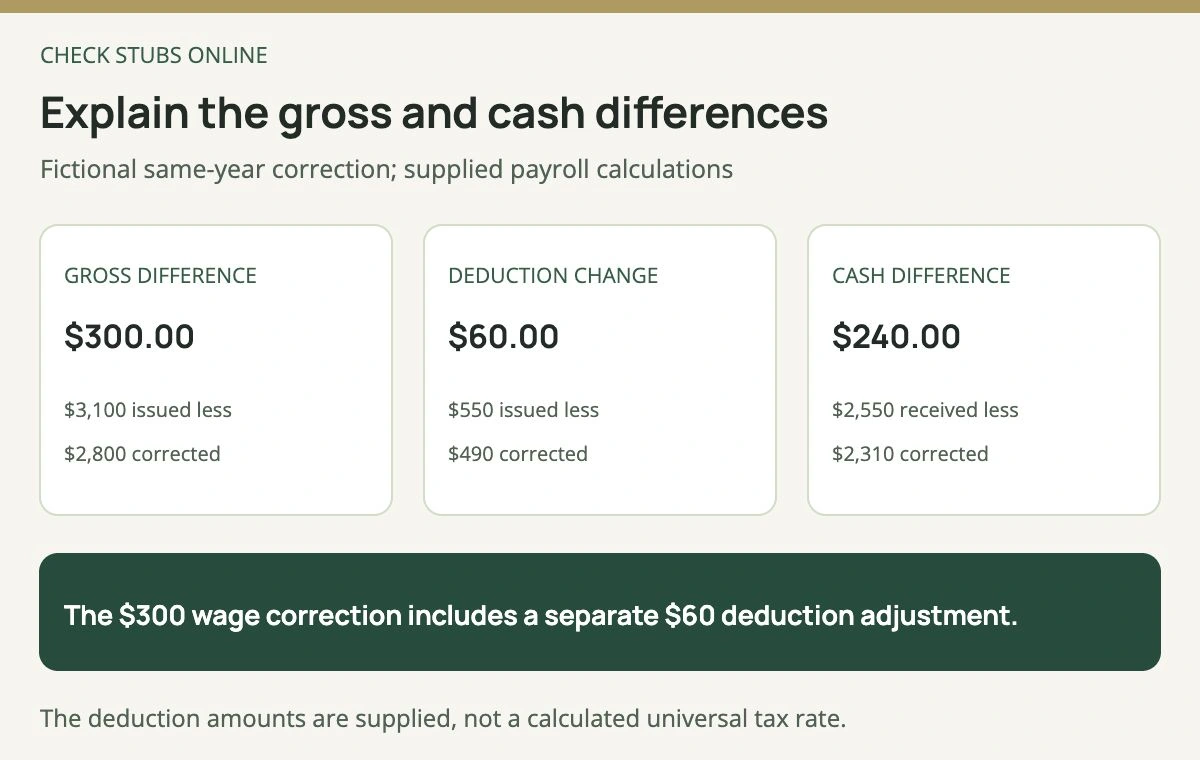
The issued statement, corrected calculation and actual cash movement explain different parts of the same payroll error.
## Can the employer take the entire amount from the next paycheck?
Do not assume that an overpayment authorizes an unlimited deduction. Check the applicable wage-payment law, employee coverage, notice, permitted amount, dispute process and proposed payment method. A payroll tax rule explains tax reporting; it does not, by itself, authorize a state wage deduction.
New York provides a specific example. The current text of [Labor Law section 193](https://www.nysenate.gov/legislation/laws/LAB/193) permits a regulated recovery route for employer mathematical or clerical wage errors and requires regulations addressing notice, recovery limits and a dispute procedure. That does not make a contractual bonus clawback, every alleged debt or every employee situation the same type of recovery. The statute reviewed here identifies the current provision as effective until November 6, 2028; do not rely on an older sunset date.
For an actual New York case, obtain the current implementing rules and the employer’s specific notice rather than treating this statutory overview as a complete deduction calculation. Elsewhere, consult the labor agency for the state where the relevant work and wage-payment rules apply. Keep any collective bargaining or public-employment rules in scope. A requested separate transfer also needs review; changing the collection channel does not automatically remove wage-law restrictions.
If the amount is disputed, identify the exact hours, rate, payment or prior receipt you disagree with and use the applicable response process promptly. Ask for a written calculation and explanation of any deduction while that issue is reviewed. Where a final paycheck is involved, our [final-pay guide](https://blog.checkstubsonline.com/final-paycheck-after-quitting) separates payment deadlines and agreed wages from other disputes.
## Keep the payment year and repayment year separate
[IRS Publication 15 for 2026](https://www.irs.gov/publications/p15), under Wage Repayments, distinguishes an error repaid within the payment year from wages returned in a later year. For a current-year earlier-quarter repayment, it describes employer adjustments through Form 941-X. Ask payroll what it will correct and when; an employee should not subtract amounts from an issued W-2 without issuer action.
**Federal record questions depend on the repayment year**
| Situation | Question for payroll | Record to retain |
| --- | --- | --- |
| 2026 wages corrected and repaid during 2026 | Which wage and withholding adjustments will be processed for 2026? | Corrected payroll calculation and repayment confirmation |
| 2026 wages repaid during 2027 | Which prior-year Social Security/Medicare records change, and what remains in Box 1? | Employer explanation, any W-2c and dated repayment evidence |
| Repayment spans calendar years | Which amounts were actually returned in each year? | A dated installment ledger, not only the initial demand |
For wages received in error in a prior year, Publication 15 directs specific Social Security and Medicare corrections but says not to reduce W-2c Box 1 for that repayment. Ordinary prior-year federal income-tax withholding is not simply refunded through the same payroll adjustment. Additional Medicare Tax has separate employee-return treatment. These distinctions are why “just amend last year and remove the wages” can be wrong.
An employee’s possible deduction or credit in the repayment year has its own requirements. [Publication 525](https://www.irs.gov/publications/p525) discusses repayments, including the conditions relevant to amounts over $3,000. That threshold does not promise that every debt qualifies, that smaller repayments receive the same treatment or that the tax benefit equals cash returned. The currently available 2025 edition is background guidance; review the instructions applicable to the actual repayment-year return with qualified help where needed.
## Credit amounts already recovered before collecting more
Continue the fictional same-year $240 cash settlement. Suppose the employee makes one verified $150 repayment, which the employer receives and applies to this exact error. No other deductions, reversals or repayments have occurred. The remaining cash balance is $240 − $150 = $90.
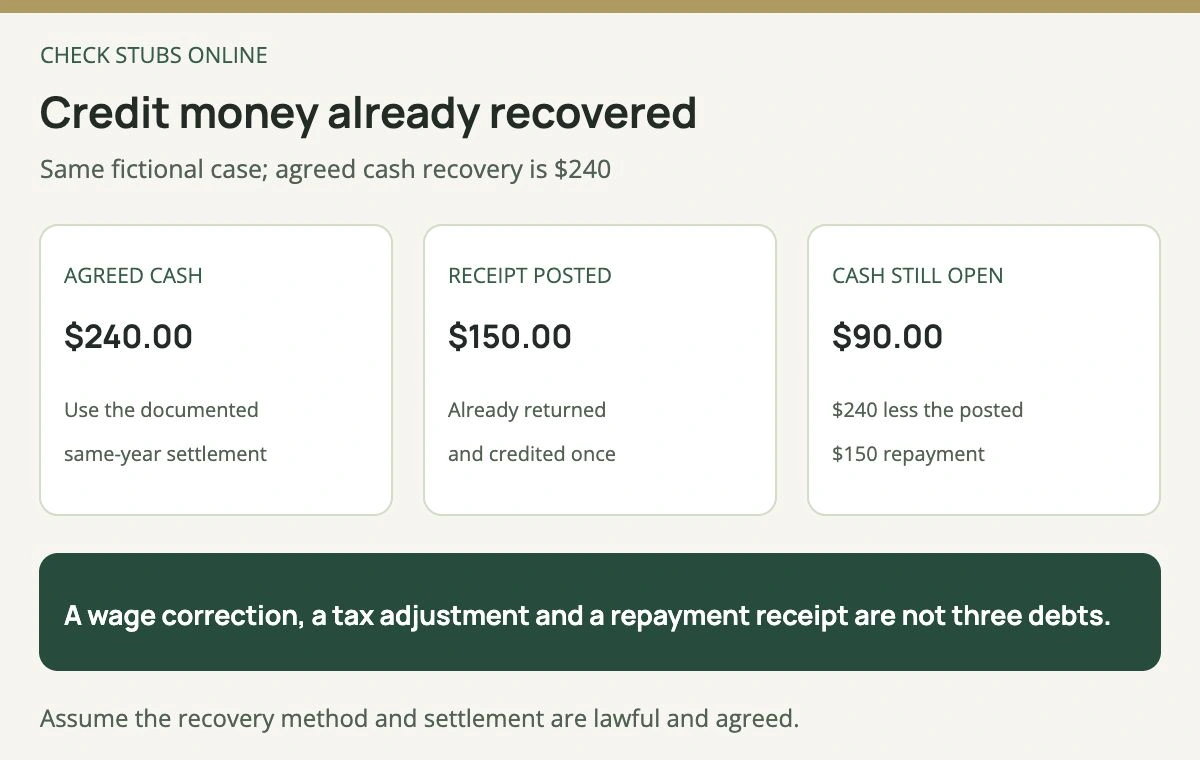
A receipt changes the open cash balance. Keep its date and reference alongside the corrected payroll figures.
If payroll later lists $240 still due, the question is whether the $150 receipt was missed, misapplied or not yet posted. Do not begin by inventing another $300 debt from the original gross difference. Conversely, a promise to repay is not a completed $150 receipt. Mark scheduled, pending and completed amounts distinctly.
Ask whether an employer bank-reversal request or payroll deduction is also in progress before making a separate payment. Obtain confirmation of the amount actually posted, not just initiated. The purpose is to reconcile one error once, not to assume a requested reversal has succeeded or to collect through two channels without matching credits.
## A focused request for the repayment worksheet
Use your employer’s approved payroll channel and identify only the affected pay periods. The following is an original request structure, not an admission that every amount demanded is owed:
Please provide the calculation for the alleged overpayment on \[pay date\], including the original and correct hours, rates and gross earnings.
Please show the original and corrected tax and benefit deductions, the cash amount requested from me, and which adjustments payroll will handle. Identify the payment year and repayment year.
Please also credit any amount already recovered, explain the proposed recovery method and schedule, and provide the applicable notice and dispute instructions. I would like the final corrected statement and a receipt showing the remaining balance.
Use actual dates and source records. Send banking information only through the employer’s secure established process. The [payroll contact guide](https://blog.checkstubsonline.com/who-handles-payroll-in-a-company) can help distinguish an HR contact, payroll processor and former-employee records request.
## What should the completed correction packet contain?
- The employer’s reason for the error and affected pay-period list.
- Original and corrected earnings and deduction calculations.
- The lawful recovery arrangement, notices and any dispute resolution.
- Dated receipts for actual cash returned or amounts deducted.
- Tax or benefit adjustment details and any issuer-produced annual correction.
- A final balance confirmation matching the payments actually posted.
If an authorized preparer uses a [pay stub maker](https://www.checkstubsonline.com/pay-stub-maker) to document the resulting pay, the entries should follow these reconciled employer records. A generated statement does not establish a repayment debt, initiate a refund, authorize a deduction or file a W-2c. Use the employer’s [statement correction process](https://blog.checkstubsonline.com/pay-stub-errors-correction) rather than privately changing an official record.
## Payroll overpayment questions
### Can I assume an unexpected deposit is mine to spend?
An unexplained deposit is not confirmation of earned pay. Compare it with payroll and ask the employer to identify any error. The legal outcome depends on the facts and applicable rules; this guide does not decide that you may keep it.
### Do employees always repay gross wages?
No single gross-versus-net answer covers every correction. In the supplied same-year settlement, the $300 wage change is resolved through a $60 tax adjustment and $240 cash recovery. Ask for the actual treatment, especially across years.
### Does paying the employer automatically correct my W-2?
No. Keep the receipt and ask which annual fields the issuer must correct. Prior-year Box 1 treatment differs from certain Social Security and Medicare corrections.
### What if I already repaid part of the amount?
Match each completed receipt to the specific demand. In the fictional $240 settlement, a credited $150 payment leaves $90, assuming no other recovery or adjustment.
### Is an overpayment the same as a signing-bonus clawback?
No. One starts with allegedly erroneous payroll; the other may arise from conditions attached to an otherwise valid award. The agreement, wage-law analysis and tax classification need their own review.
The Check Stubs Online Editorial Team reviewed current IRS wage-repayment guidance, New York’s current statute and FTC scam guidance. Supplied payroll figures and the repayment ledger are original, independently checked illustrations; no personal legal or tax outcome is promised.
## Relevant document tool
Keep wage repayment and tax correction in sync
The IRS employer guide distinguishes current-year and prior-year wage repayments. State law separately governs the recovery method.
[Read IRS wage-repayment guidance](https://www.irs.gov/publications/p15)
A tax-reporting procedure does not authorize a wage deduction or determine whether a disputed debt is owed.
## Related guides
- [Who Handles Payroll in a Company? A Guide to the Right Contact](https://blog.checkstubsonline.com/who-handles-payroll-in-a-company)
- [Retroactive Pay After a Raise: Check Hours and Overtime](https://blog.checkstubsonline.com/retroactive-pay-raise-overtime)
- [Pay Stub Errors: How to Request and Track a Correction](https://blog.checkstubsonline.com/pay-stub-errors-correction)