---
title: "Proof of Income Without Pay Stubs: Choose the Right Records"
description: "Need proof of income without pay stubs? Match employer, tax, business, bank and benefit records to the requested fact, with examples and clear document limits."
url: "https://blog.checkstubsonline.com/proof-of-income-without-pay-stubs"
datePublished: "2026-11-10"
---
# Proof of Income Without Pay Stubs: Choose the Right Records
Need proof of income without pay stubs? Match employer, tax, business, bank and benefit records to the requested fact, with examples and clear document limits.
Published: 2026-11-10
By [Check Stubs Online Editorial Team](https://blog.checkstubsonline.com/editorial-policy#editorial-team)
**To document income without pay stubs, ask the recipient which fact and period it needs, then provide existing records that answer that request.** Depending on the income source and the recipient’s rules, the file might include an employer response, tax records, business accounts, payment evidence or an official benefit letter. Explain each document’s limits; no alternative is accepted everywhere, and a self-prepared summary does not become an employer-issued record.
Reviewed November 10, 2026 · U.S. income-document preparation. Examples are fictional, and recipient requirements control the requested evidence. This guide does not determine housing, credit, program or employment eligibility. The wage example’s deductions are assumed records, not calculated taxes.
Missing pay stubs can mean several different things. An employee may have lost portal access. A self-employed person may never receive employer payroll statements. A benefit recipient may need an agency letter rather than wage records. Begin with the actual situation so the replacement evidence addresses the right question.
This guide offers a general evidence map. For a closed business, use [the employer-closure record search](https://blog.checkstubsonline.com/pay-stubs-employer-closed); for a mortgage involving business income, use [the focused self-employed mortgage guide](https://blog.checkstubsonline.com/self-employed-mortgage-income-documents).
## In this guide
1. [Clarify the requested fact](#proof-request)
2. [Choose records by income source](#proof-map)
3. [Request existing wage records](#proof-wages)
4. [Reconcile payroll and bank amounts](#proof-example)
5. [Understand historical tax records](#proof-tax)
6. [Document business and benefit income](#proof-business)
7. [Assemble an accurate file](#proof-package)
8. [Questions about missing pay stubs](#proof-faq)
## Ask what the reviewer actually needs to confirm
Before uploading documents, ask whether the request concerns current job status, a current gross wage rate, money actually received, prior-year income or business profit. Also confirm the required date range, whose income is included, acceptable issuers and the delivery method.
A document can be authentic and still answer only part of the question. An offer describes proposed job terms. A payment confirmation shows a transaction. A historical tax record covers its tax period. None automatically establishes every other fact or promises future earnings.
Keep the recipient’s instructions with the file. If an alternative is permitted, record exactly which alternative was requested rather than relying on a general online list. Our [employment-verification guide](https://blog.checkstubsonline.com/employment-verification-process) explains the distinction between a job fact and the record used to support it.
## Match the record to the income source
**Potential records to discuss with the recipient; acceptance is case-specific**
| Income or question | Existing records to request or organize | Important limit |
| --- | --- | --- |
| Current employee wages | Employer payroll history, an authorized verification response and matching payments | A job-status response may not state actual earnings |
| Earlier employee earnings | Employer W-2, relevant tax transcript or retained payroll documents | A prior year does not establish today’s wage |
| Independent business income | Books, profit-and-loss summary, invoices, receipts and expense support | Client deposits are not automatically net business profit |
| Social Security or SSI status | Official SSA benefit verification letter and relevant payment evidence | Read whether it confirms receipt, an application or another status |
| Other benefits or retirement | The issuing agency or plan’s current statement and payment record | A tax form and a current benefit statement cover different facts |
| Proposed new employment | The actual offer and any requested employer confirmation | An offer is not wages already paid |
## For employee income, start with the employer’s records
Contact payroll or the authorized records contact. Ask for the specific missing periods and whether a payroll-history report, reissued statement or employer response is available. If a portal has closed, request an alternative retrieval process rather than guessing the old login route.
The [DOL recordkeeping fact sheet](https://www.dol.gov/agencies/whd/fact-sheets/21-flsa-recordkeeping) describes wage and time information covered employers must maintain for nonexempt workers. That recordkeeping duty is not itself a universal employee-access procedure or a rule requiring one particular printed pay-stub format. State requirements and the employer’s process need separate review.
If a verification letter is allowed, the employer should confirm only facts supported by its records, with an authorized contact and a clear date. A letter naming a rate should not silently represent that every scheduled hour has already been worked or paid. See [the employer-letter preparation guide](https://blog.checkstubsonline.com/employment-verification-letter-generator) for that distinct task.
## Original wage example: connect a $2,540 deposit to the source
Assume a fictional employer’s October 2026 payroll report shows $3,200 in cash gross wages and $660 in recorded employee taxes and benefit deductions. There is one net payment and no split deposit, reimbursement, garnishment outside that total or separate adjustment.
The net payment is $3,200 minus $660, or $2,540. A matching bank credit supports receipt of that amount. The employer report supplies the gross amount and reductions. The bank credit alone does not show that gross wages were $3,200; another combination of wages and deductions could produce the same net.
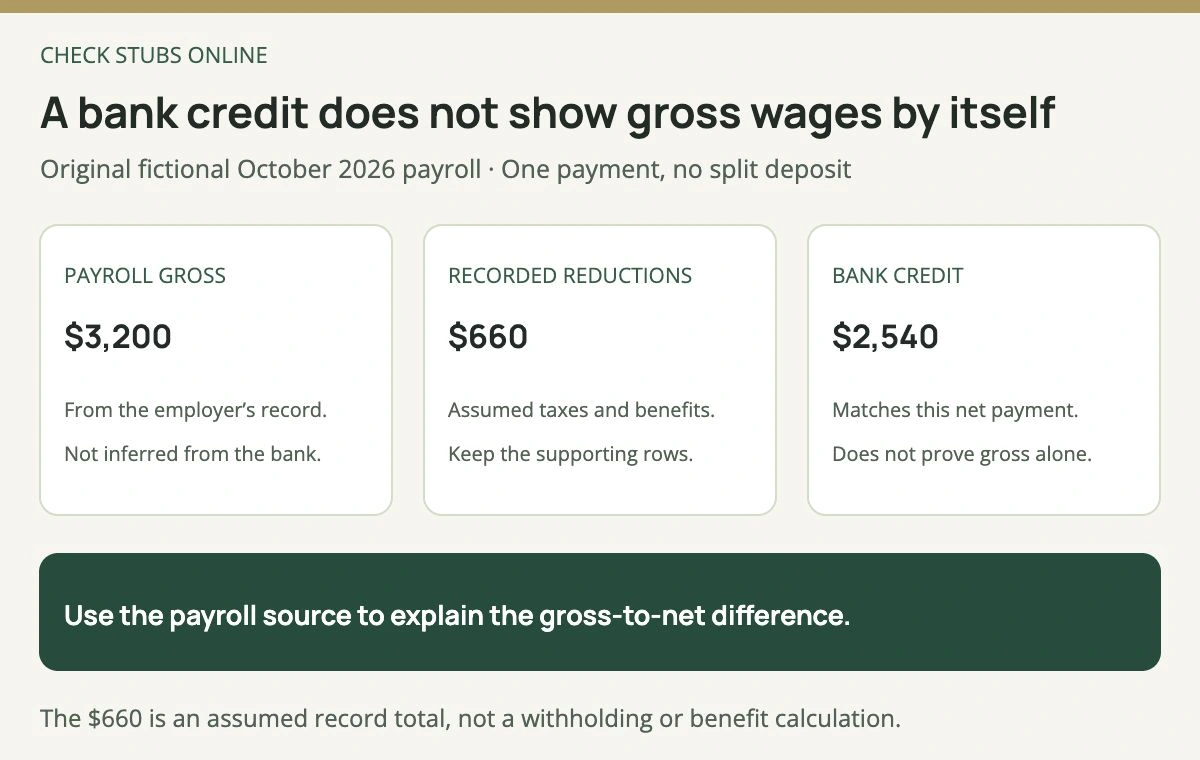
A matching amount is useful, but retain the payer, payment date and reference needed to connect the records.
Do not add the $3,200 payroll figure and the $2,540 bank credit as two income sources. They are two views of the same fictional payment. Likewise, a transfer from checking to savings should not be listed as a new wage payment.
If the amounts differ, investigate the stated period, split routing, fees or other actual entries before preparing an explanation. Do not edit the original record to force a match. The [gross versus net pay guide](https://blog.checkstubsonline.com/gross-vs-net-pay) explains the general reconciliation.
## Tax records are useful historical evidence, with limits
The [IRS tax-records service](https://www.irs.gov/individuals/get-transcript) provides routes to transcripts and related records. Choose the type relevant to the request. A transcript is not automatically a photocopy of an original return or a replacement for a current employer payroll report.
According to the [IRS transcript-type explanation](https://www.irs.gov/individuals/transcript-types-for-individuals-and-ways-to-order-them), wage and income transcripts reflect information-return data received by the IRS and may not include every document issued. A non-filing letter says no processed return is on record for the stated request; it does not establish zero income or settle whether filing was required.
For an original timing example, suppose the employee also has a 2025 W-2 showing $54,000 in Box 1 wages. That historical taxable-wage figure is not proof that current gross wages are $4,500 every month. Dividing by 12 produces an arithmetic average for that past annual measure, not a verified current pay rate.
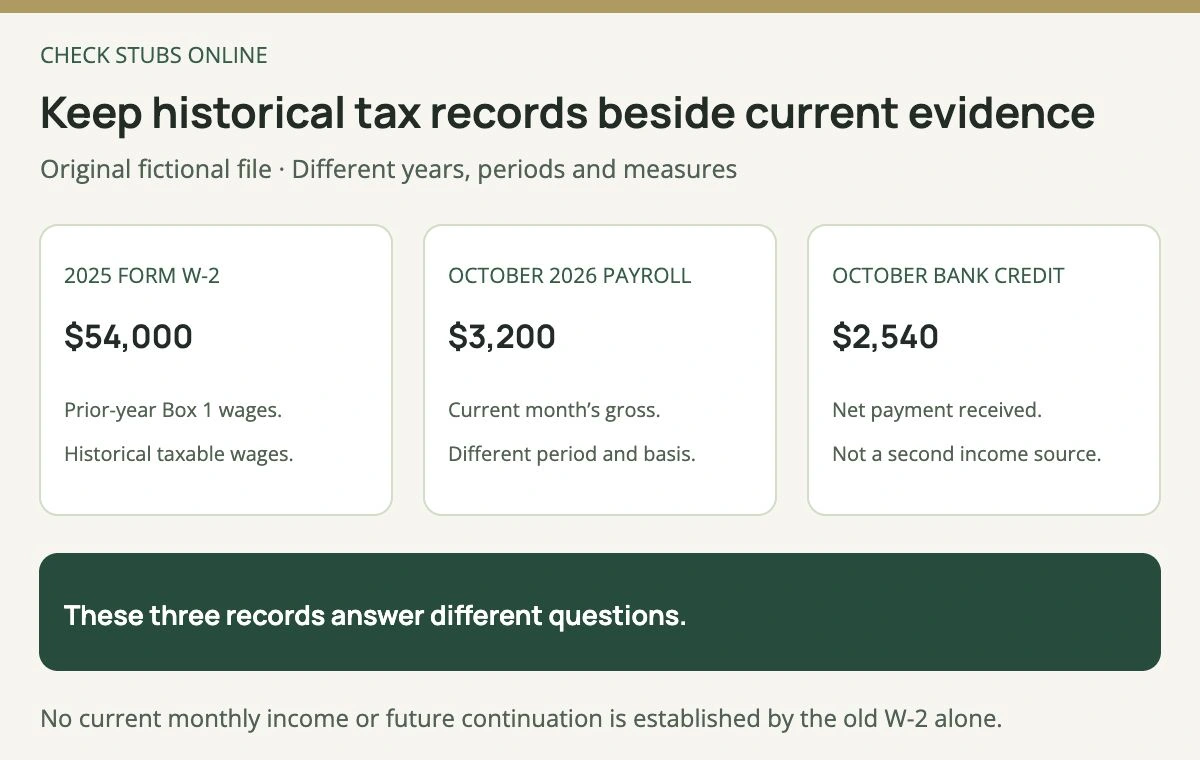
Keep the 2025 annual taxable-wage record, October 2026 gross-pay report and corresponding net credit labeled separately.
The difference between a W-2 wage box and gross payroll can also involve tax treatment, not just timing. For a detailed reconciliation, read [the year-end pay-stub versus W-2 guide](https://blog.checkstubsonline.com/year-end-pay-stub-vs-w2). Do not overwrite one measure with another simply to make all documents display an identical total.
## Business income and benefits need their own source records
A self-employed person can organize a dated profit-and-loss summary with the underlying books, invoices, received payments, refunds and expense records. The [IRS business-record guidance](https://www.irs.gov/businesses/small-businesses-self-employed/recordkeeping) emphasizes support for recorded income and expenses. The recipient decides which business evidence and review process it requires.
For a separate fictional cash worksheet, assume $6,900 in collected customer receipts and $2,600 in paid business expenses, all expressly assumed allowable. With no refunds, inventory, special tax items or timing adjustments, the illustrative profit is $4,300. It is not $6,900, and it is not necessarily the amount available after the owner’s personal taxes.
An unpaid $900 invoice remains separate because this illustration assumes neither receipt nor unrestricted availability. A bill sent to a customer and that customer’s eventual payment should not be counted as two receipts. Our [invoice and receipt guide](https://blog.checkstubsonline.com/invoice-vs-receipt-payment-records) explains their different functions.
For Social Security or SSI, use [SSA’s official benefit-verification letter route](https://www.ssa.gov/manage-benefits/get-benefit-letter). The agency says the letter can show benefit receipt, an application or non-receipt, depending on the person’s status. Read the actual letter before describing it as evidence of current payments.
For another benefit or pension, contact the actual issuer for its statement and any requested payment history. Do not rename a benefit as employment wages or assume a taxable-income label determines how the recipient will assess it.
## Prepare a file the reviewer can follow
Use a short document index listing the source, period, measure and purpose of each item. Identify any gap explicitly, such as a current employer response still pending. Keep a brief reconciliation separate from the originals so the explanation does not look like a modified issuer document.
Use the recipient’s secure upload route. Ask whether masking unrelated identifiers is permitted, and keep required names, dates, amounts and page context intact. Retain the original download and the copy submitted so you can answer a follow-up accurately.
If you need to prepare a supported earnings statement, the [Check Stubs Online pay stub maker](https://www.checkstubsonline.com/pay-stub-maker) arranges information you enter. It does not recover missing employer documents, turn an estimate into actual earnings or certify recipient acceptance. Obtain source records first and use a prepared summary only for its accurately described role.
## Questions about proving income without pay stubs
### Are bank statements enough by themselves?
That depends on the request. A bank entry can show money received without proving its gross wage amount, business profit or future continuation.
### Can a prior-year W-2 prove my current salary?
It shows a historical wage record for its year. Current salary or earnings needs current supporting evidence.
### Does an unpaid invoice prove income was received?
No. It records an amount billed. Keep payment and accounting-method facts separate.
### Will an alternative document guarantee approval?
No. Ask the recipient what it requires and what additional checks apply.
The Check Stubs Online Editorial Team reviewed primary wage-record, IRS transcript and SSA benefit-letter guidance, then independently checked the original payroll and business examples.
## Relevant document tool
Arrange a supported earnings statement
Prepare a clear summary only after obtaining the actual payroll or payment details and confirming what the recipient needs.
[Open the pay stub maker](https://www.checkstubsonline.com/pay-stub-maker)
The maker does not retrieve missing records, verify payment or guarantee that a recipient will accept a statement.
## Related guides
- [Gross vs. Net Pay: Reconcile Your Paycheck](https://blog.checkstubsonline.com/gross-vs-net-pay)
- [Invoice vs. Receipt: How to Document Client Payments Clearly](https://blog.checkstubsonline.com/invoice-vs-receipt-payment-records)
- [How to Get Pay Stubs When Your Former Employer Has Closed](https://blog.checkstubsonline.com/pay-stubs-employer-closed)