---
title: "Prorated Salary Paycheck: First-Week Calculations and Checks"
description: "Check a partial salary payment with an original first-week example. Review the divisor, covered dates, full-week pay and the limits of federal salary proration."
url: "https://blog.checkstubsonline.com/prorated-salary-paycheck"
datePublished: "2026-11-10"
---
# Prorated Salary Paycheck: First-Week Calculations and Checks
Check a partial salary payment with an original first-week example. Review the divisor, covered dates, full-week pay and the limits of federal salary proration.
Published: 2026-11-10
By [Check Stubs Online Editorial Team](https://blog.checkstubsonline.com/editorial-policy#editorial-team)
**A prorated salary paycheck pays the supported portion of a salary for a qualifying partial period, using an appropriate method and the actual covered time.** Do not assume that dividing a monthly salary by 30 is always correct. For an employee covered by federal salary-basis rules, the first and last employment weeks have a specific exception; an ordinary shortened day does not automatically permit the same reduction.
Reviewed November 10, 2026 · U.S. salary-proration concepts, with the federal Part 541 salary-basis rule identified where relevant. Examples are fictional and expressly assume a properly classified employee, a permitted initial-week proration, equal scheduled days and no overriding state or contractual rule. This guide does not determine a real worker’s exempt status.
A smaller first salary payment can be explained accurately only after the job’s start date, weekly salary, period coverage and calculation method are known. “Prorated” is a description of the result, not a substitute for those inputs.
The [small first-paycheck guide](https://blog.checkstubsonline.com/first-paycheck-low) covers other causes of a low deposit. Here the focus is the salary allocation itself.
## In this guide
1. [Identify the salary and covered period](#prorate-inputs)
2. [Check when the first/last-week exception applies](#prorate-rule)
3. [Calculate an original first-week example](#prorate-example)
4. [Combine partial and complete weeks](#prorate-period)
5. [Review the divisor and method](#prorate-method)
6. [Keep proration separate from other reductions](#prorate-errors)
7. [Ask for a documented calculation](#prorate-review)
8. [Salary-proration questions](#prorate-faq)
## Collect the inputs before choosing a formula
Identify the stated annual or weekly salary, the employer’s payment frequency, the workweek, scheduled days and actual start or end date. Read the pay statement’s coverage dates too. A hiring date inside a period and a payday after that period are different parts of the calculation.
**Inputs needed for a salary-proration review**
| Input | Evidence to request | Mistake to avoid |
| --- | --- | --- |
| Salary amount and unit | Offer terms and payroll rate record | Treating an annual amount as monthly pay |
| Coverage dates | Statement and payroll calendar | Counting days outside the paid period |
| Workweek and schedule | Defined workweek and expected daily pattern | Assuming every calendar day is a workday |
| Reason for partial pay | Initial/final employment date or another stated basis | Assuming all salary reductions follow the same rule |
| Method and divisor | Payroll’s written calculation | Mixing calendar days, workdays and hours midway |
Our [pay-period and pay-date explanation](https://blog.checkstubsonline.com/pay-period-vs-pay-date) helps align the coverage dates. Once the inputs are established, keep the arithmetic and the legal basis as separate checks: a mathematically consistent formula can still be inappropriate for the situation.
## The federal first/last-week exception is specific
[29 CFR 541.602(b)(6)](https://www.ecfr.gov/current/title-29/subtitle-B/chapter-V/subchapter-A/part-541/subpart-G/section-541.602) allows a proportionate part of full salary for time actually worked in the initial or terminal employment week. The provision discusses a daily or hourly equivalent. It does not create a general permission to reduce exempt salary whenever fewer hours are recorded.
The [DOL salary-basis fact sheet](https://www.dol.gov/agencies/whd/fact-sheets/17g-overtime-salary) explains the broader full-salary rule and limited exceptions. Confirm which rule applies before applying an initial-week example to sickness, personal absences, discipline, leave or an ordinary ongoing workweek.
Salary is not itself proof of an overtime exemption. The [DOL exemption overview](https://www.dol.gov/agencies/whd/fact-sheets/17a-overtime) describes additional requirements for the relevant exemptions. State law, the employment agreement and special categories can require their own review.
## Original example: three days of a $1,250 week
Assume a fictional job has a $65,000 annual salary allocated as $1,250 for each of 52 weekly salary units. The agreed schedule is five equal eight-hour workdays, Monday through Friday. Assume the employee is properly classified under the applicable rules and a daily-equivalent method is valid for this initial week.
The worker begins employment Wednesday, October 7, 2026, and performs the scheduled work on October 7, 8 and 9. There is no work for this employer before the start date and no other compensation in this illustration. The first week’s included time is three equal workdays, or 24 hours.
**Original initial-week salary allocation under explicit assumptions**
| Step | Calculation | Gross amount |
| --- | --- | --- |
| Weekly salary unit | $65,000 ÷ 52 | $1,250 |
| Daily equivalent | $1,250 ÷ 5 scheduled equal days | $250 |
| Initial three workdays | $250 × 3 | $750 |
| Equivalent hours check | $1,250 ÷ 40 × 24 | $750 |
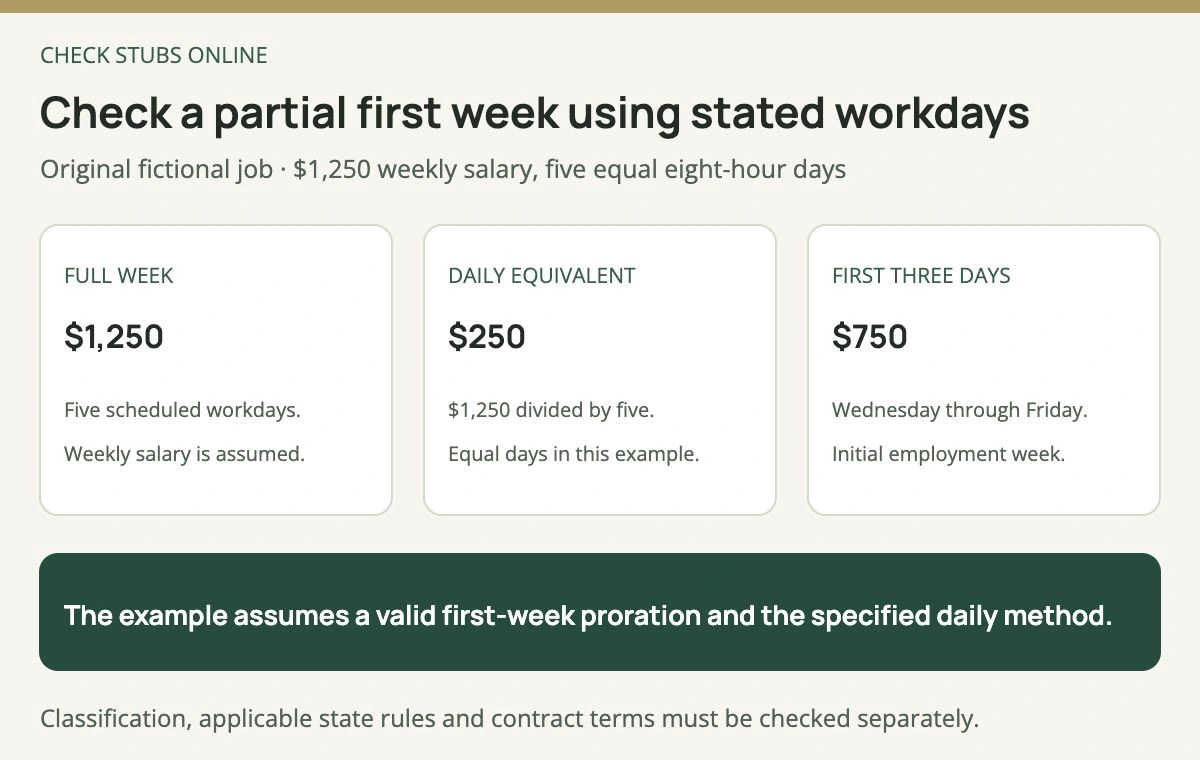
Both methods reach the same result because the example expressly assumes five equal eight-hour days. Different schedules need their own supported allocation.
The hourly equivalent of $31.25 is used only to verify this proportionate initial-week salary calculation. It does not reclassify the worker as hourly or establish how an unrelated overtime calculation should be performed.
## Add the full second week without applying the reduction again
Assume the first biweekly payroll covers the initial week and the following complete week. The second week is worked in full at the ordinary $1,250 salary. Gross salary for the payment is therefore $750 + $1,250 = $2,000.
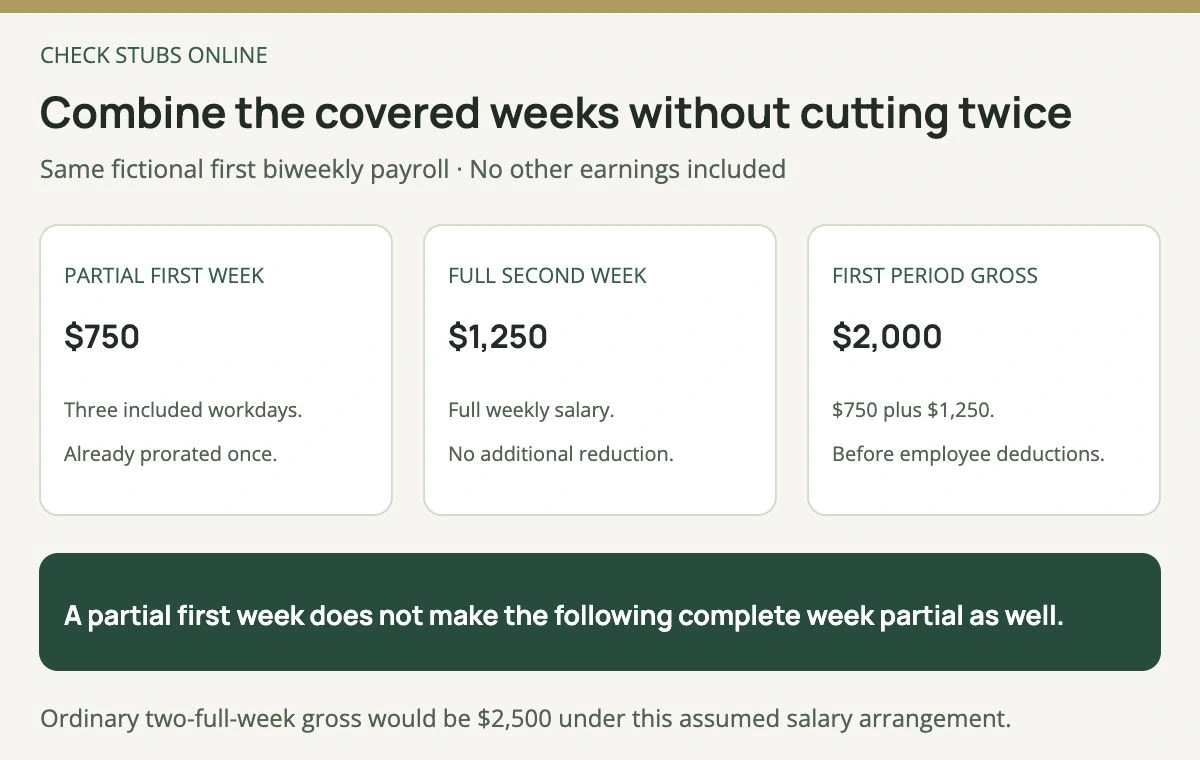
The example compares covered weeks, not the number of days between hiring and payday.
Two complete weeks would produce $2,500 under the same arrangement. The first payment is $500 lower because of the two pre-employment workdays excluded from the initial week. It should not be cut again by another “partial paycheck” percentage after the first week has already been allocated.
If payroll pays semimonthly rather than biweekly, establish how its salary allocation and period boundaries relate to the covered weeks. This two-week example should not be relabeled a half-month calculation without that additional explanation.
## Why the divisor needs an explanation
A workday method counts included scheduled workdays against the corresponding scheduled workdays in the supported salary unit. An hours method needs a supported time basis. A calendar-day method counts a different denominator and can produce a different result. Do not choose the smallest or largest answer first and then search for a divisor that reproduces it.
For deductions allowed under its paragraph (b), the federal salary-basis regulation’s paragraph (c) describes daily, hourly or other proportional calculations. The actual reason, worker coverage and facts remain essential. An employer’s written policy does not automatically override legal restrictions.
A statement that “everyone uses annual salary divided by 365” is insufficient for a real review. Ask what salary unit and time basis were used and why they fit the situation. Leap years, uneven monthly workdays, part-time patterns and changed schedules can make casual shortcuts particularly misleading.
For the separate conversion from supported annual earnings to a monthly average, use [the monthly-income guide](https://blog.checkstubsonline.com/gross-monthly-income). That normalization does not decide a lawful first- or final-week proration.
## A short day, missing time and deductions are different issues
The [DOL furlough and pay-reduction FAQ](https://www.dol.gov/agencies/whd/fact-sheets/70-flsa-furloughs) explains restrictions on salary deductions for reduced work and the distinction between salary payments and leave-bank adjustments. Do not apply the first-week example to a routine partial-day absence or an employer-directed closure without reviewing the applicable rules.
For an hourly nonexempt worker, start from recorded compensable hours and the applicable rates, minimum wage and overtime requirements. That is a different task from allocating the assumed exempt salary above. A label on a stub does not remove the need to record actual work correctly.
After gross salary is established, check taxes and benefit deductions separately. For an original cash illustration, assume the $2,000 gross payment has $320 of employee tax withholding and one $80 after-tax deduction. The net amount would be $1,600. Both reductions are invented inputs, not tax estimates or a claim that benefits should be charged at that frequency.
A benefit charge may follow an election or allocation rule different from the salary proration. Confirm the election, effective date and deductions rather than assuming every line must shrink by the same percentage. Our [benefit-entry guide](https://blog.checkstubsonline.com/employer-paid-benefits-pay-stub) explains those separate roles.
## Ask payroll to show the calculation and its basis
A useful request identifies the salary unit, included dates and amount in question: “My first week began Wednesday. Please confirm the scheduled-day divisor and the three included days used for the $750 gross salary entry.” Keep the explanation beside the offer terms and original statement.
If the issue is missing work inside the covered dates, ask for the timekeeping correction separately. If it is a deduction from ongoing exempt salary, ask which permitted basis is being applied. An unresolved wage-law question should be reviewed with the relevant labor agency or qualified adviser for the actual location and facts.
The [Check Stubs Online paycheck calculators](https://www.checkstubsonline.com/paycheck-calculator/) can explore supported gross-pay and deduction scenarios after the wage amount is established. They do not determine exemption status, select the legally appropriate divisor or verify an employer’s attendance records.
## Salary-proration questions
### Is monthly salary divided by 30 always the correct method?
No. The salary unit, covered time, permitted basis and applicable rules must support the method.
### Can a first biweekly salary payment include one partial week and one full week?
Yes. The fictional example adds those two covered amounts separately.
### Does using an hourly equivalent make a salaried employee hourly?
Not by itself. A calculation method and the underlying pay arrangement are different questions.
### Can a calculator decide whether a salary deduction is lawful?
No. It needs the actual employment facts and governing rules, beyond arithmetic.
The Check Stubs Online Editorial Team reviewed the current federal salary-basis provision and agency explanations, and independently checked the original date, daily/hourly allocation and gross-to-net examples.
## Relevant document tool
Explore deductions after checking the salary allocation
Use supported paycheck inputs once the covered dates, wage amount and payment frequency are established.
[Explore paycheck calculators](https://www.checkstubsonline.com/paycheck-calculator/)
Calculators do not decide employment classification, permitted salary deductions or the appropriate proration method.
## Related guides
- [Why Is My First Paycheck So Small?](https://blog.checkstubsonline.com/first-paycheck-low)
- [Semimonthly Paycheck Hours: Actual Time, Salary and Overtime](https://blog.checkstubsonline.com/semimonthly-paycheck-hours)
- [Gross Monthly Income: Calculate Actual Pay and Monthly Averages](https://blog.checkstubsonline.com/gross-monthly-income)