---
title: "Self-Employed Income Letter: Example and Supporting Records"
description: "Write a clear self-employed income letter with an owner-authored example, defined period, checked profit calculation and records separating receipts, draws and loans."
url: "https://blog.checkstubsonline.com/self-employed-income-verification-letter"
datePublished: "2026-11-11"
---
# Self-Employed Income Letter: Example and Supporting Records
Write a clear self-employed income letter with an owner-authored example, defined period, checked profit calculation and records separating receipts, draws and loans.
Published: 2026-11-11
By [Check Stubs Online Editorial Team](https://blog.checkstubsonline.com/editorial-policy#editorial-team)
**A self-employed income letter can summarize the owner’s records, but it should identify who prepared it, the exact period, the accounting basis and the supporting evidence.** Separate receipts, expenses, profit and withdrawals. Ask the recipient whether an owner-authored statement is acceptable or whether independent documentation is required; adding a signature or a professional-looking layout does not independently verify the figures.
Reviewed November 11, 2026 · U.S. sole-proprietor record summaries. The original fictional example covers July 1–October 31, 2026 using a simplified cash-basis service ledger. It does not calculate a tax return, establish deductible expenses, determine recipient qualifying income or apply corporate payroll rules.
Someone who works for themselves may not have an employer who can write a conventional salary confirmation. The solution is not to invent that employer relationship. Prepare a clearly attributed summary and connect its figures to the actual business records, leaving the recipient’s verification and acceptance process visible.
## In this guide
1. [Confirm the recipient’s request](#owner-request)
2. [Define the figures being described](#owner-terms)
3. [Build an original four-month summary](#owner-example)
4. [Read the owner-authored letter example](#owner-letter)
5. [Reconcile deposits and owner transfers](#owner-deposits)
6. [Attach a focused records index](#owner-support)
7. [Review attribution and delivery](#owner-review)
8. [Self-employed income-letter questions](#owner-faq)
## Ask what the recipient needs to establish
Before drafting, ask whether the request concerns business activity, historical profit, current receipts, personal cash available or another fact. Ask which period and records are required, whether the recipient has its own form and whether it accepts a statement from the owner.
If an accountant’s letter, a filed return or direct third-party verification is required, do not relabel an owner statement as equivalent. An accountant should describe only the work and conclusions they actually performed. Do not insert a professional’s name, signature or credentials without that person issuing the document.
A landlord, lender and benefits program can use different income definitions and review rules. A letter designed for one request should not be assumed sufficient for another. Our [self-employed mortgage records guide](https://blog.checkstubsonline.com/self-employed-mortgage-income-documents) addresses a more specific lending file.
If the request instead concerns wages from an actual employer, use [the employer verification-letter workflow](https://blog.checkstubsonline.com/employment-verification-letter-generator). Ownership alone does not answer how a particular business is taxed or whether someone receives wages through a separate entity.
## Define receipts, expenses, profit and withdrawals
The [IRS self-employed tax center](https://www.irs.gov/businesses/small-businesses-self-employed/self-employed-individuals-tax-center) distinguishes business income and expenses and explains that self-employment and income taxes require separate consideration. A business result before the owner’s taxes is not automatically personal take-home pay.
[Publication 334](https://www.irs.gov/publications/p334), currently the 2025 edition, explains cash-method receipt and expense timing, including constructive receipt qualifications. It also states that a sole proprietor is not their own employee and cannot deduct personal withdrawals as their own salary. Those principles inform the distinctions here; the example is not a 2026 tax calculation.
State the basis actually used. Do not combine unpaid invoice totals with collected cash simply because the larger number looks more helpful. If your books use accrual accounting or require other adjustments, describe that basis accurately and obtain appropriate assistance rather than calling the result cash-basis income.
**Terms to label in a sole-proprietor income summary**
| Term | What the letter should explain |
| --- | --- |
| Service receipts | Customer amounts included under the stated method and period |
| Business expenses | Which supported costs are included and what is excluded |
| Book profit | The stated ledger result, with its limitations |
| Owner withdrawals | Money moved for personal use, separately from business costs |
| Average monthly result | The calculation period and divisor; no forecast implied |
| Tax or recipient qualifying income | A separate determination, not established merely by the letter |
## Original example: four months of a service business
Assume a fictional sole proprietor, Avery Reed of Cedar Lane Design, keeps a complete simplified cash-basis service ledger for July 1 through October 31, 2026. It records $28,500 collected customer service receipts and $9,200 supported paid business expenses. Assume no inventory, capital-cost adjustments, constructive-receipt timing differences or other unmodeled items change this limited book summary.
Subtracting expenses gives $19,300 book profit before the owner’s taxes. Dividing by four full calendar months gives $4,825 average monthly book profit for that window. The expense amounts are supplied and assumed appropriate to the example ledger; this arithmetic does not establish tax deductibility.
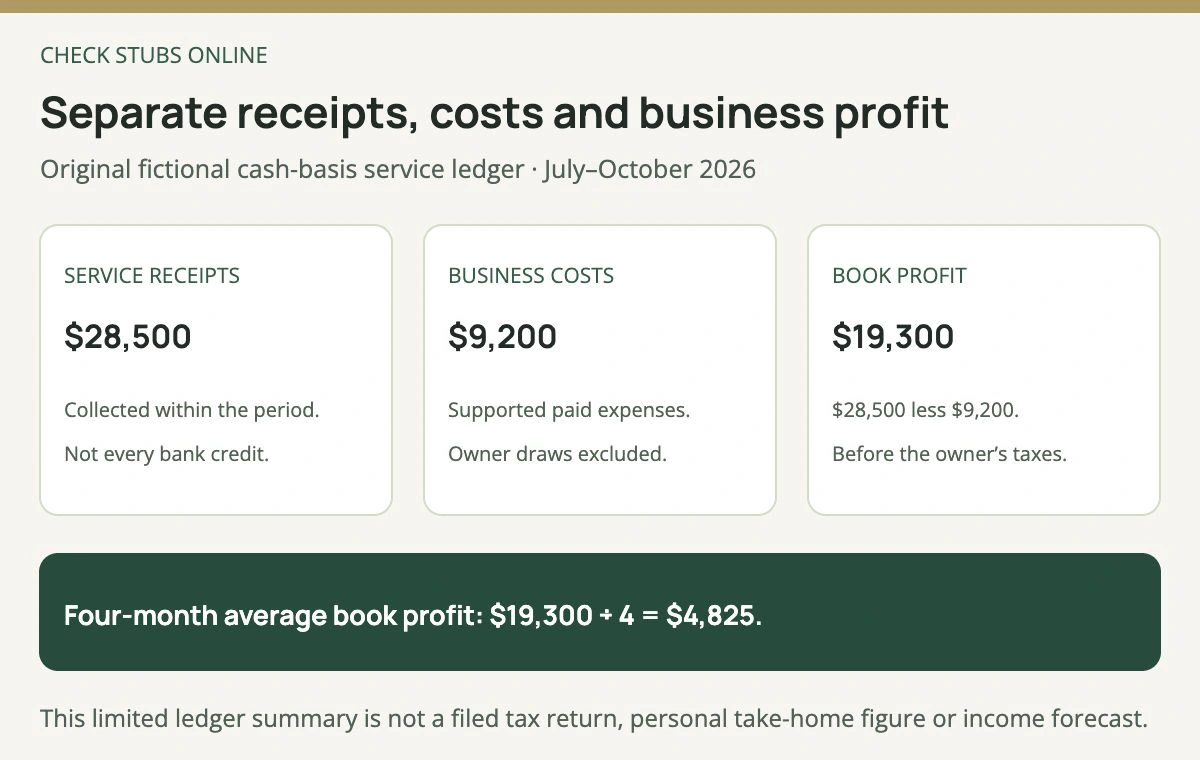
The $4,825 is a historical four-month average. It is neither an employer salary nor a projection of future monthly profit.
Assume the owner also withdrew $12,000 for personal use during the period. That transfer does not turn $12,000 into deductible wages to the proprietor, and it is not added to the $19,300 profit as a second income source. Keep it on its own line when cash movements need explanation.
A four-month window is not a full tax year. Do not call the $19,300 annual income or the $4,825 a guaranteed monthly amount. If the recipient requests a longer or different period, prepare that actual period rather than multiplying the strongest recent result without disclosure.
## Original owner-authored income letter example
The following is a fictional demonstration of clear attribution and limited statements. Use only facts supported by your own records, remove inapplicable statements and follow the recipient’s requirements. The bracketed contact and signature fields are placeholders, not a representation that anyone has signed or verified this example.
**Owner-prepared business income summary — fictional example**
Date: November 11, 2026
To: \[Recipient\]
Re: Avery Reed / Cedar Lane Design — July 1 through October 31, 2026
I am the sole proprietor of the fictional service business identified above. I prepared this summary from the cash-basis records listed in the attached index. It is my statement of those records, not an independent accountant’s certification.
For the four-month period, the example ledger records $28,500 collected service receipts and $9,200 paid business expenses, producing $19,300 book profit before my taxes. Dividing that result by four gives $4,825 average monthly book profit for this period only.
Owner withdrawals of $12,000 are shown separately and are not deducted as wages to me or added again to the stated profit. The deposit reconciliation also separates owner funds and genuine loan proceeds from customer receipts.
This summary is not a filed tax return, a personal after-tax cash calculation or a promise of future earnings. Please identify any further records or independent verification your process requires.
\[Owner’s business contact details\]
\[Owner signature, if required\]
The title deliberately says who prepared the statement. The body distinguishes the calculation from a tax return and names the supporting index. Those features are useful even if the recipient ultimately requests a different form or additional evidence.
## Original deposit check: bank credits are not all sales
Assume bank credits in the same fictional period total $34,800: $28,500 customer receipts, $4,000 transferred from the owner’s personal funds and $2,300 genuine loan proceeds that remain repayable. The source records support those categories; no debt cancellation is involved.
Owner funding and borrowing together total $6,300. Subtracting that from $34,800 leaves the $28,500 customer receipts already recorded. Then the $9,200 business costs lead to the $19,300 book-profit result. Do not subtract the $6,300 a second time from profit after it has already been excluded from receipts.
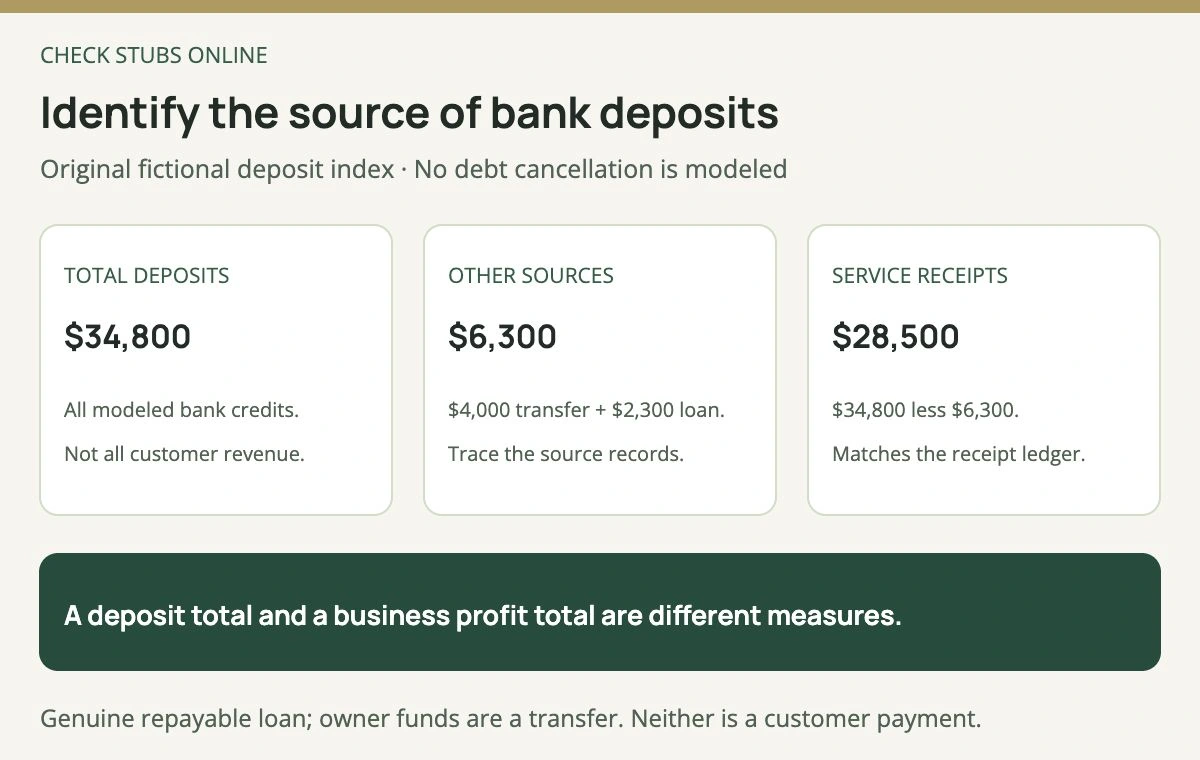
The deposit index explains sources of cash. It is not a complete balance sheet, available-cash calculation or independent verification.
[IRS Publication 583](https://www.irs.gov/publications/p583) explains why records should identify receipt sources and separate business and nonbusiness items. The [IRS debt guidance](https://www.irs.gov/taxtopics/tc431) separately explains that an obligation to repay is debt and that later cancellation can have tax consequences. This example concerns an outstanding genuine loan, not forgiven debt or a disguised customer payment.
An invoice can support what was billed without proving when it was paid. Our [invoice and payment-receipt guide](https://blog.checkstubsonline.com/invoice-vs-receipt-payment-records) explains that evidence distinction. Keep the corresponding payment reference when using a collected-receipts summary.
## Attach an index that traces each material statement
The [IRS supporting-records overview](https://www.irs.gov/businesses/small-businesses-self-employed/what-kind-of-records-should-i-keep) identifies items such as invoices, receipts, deposit slips and paid bills as support for the books. A summary should point to relevant records rather than replacing them with another unsupported total.
**Original example’s supporting-document index**
| Index item | What it supports | What it does not prove by itself |
| --- | --- | --- |
| Receipt ledger and matched customer payments | The $28,500 included receipts and period | Future customer work or continuing income |
| Expense ledger and supporting paid bills | The supplied $9,200 book-cost total | Every expense’s final tax treatment |
| Bank-credit reconciliation | The $34,800 credit total and source categories | Business profit without the expense review |
| Owner-transfer record | The $4,000 funding transfer and separate withdrawals | New customer revenue |
| Loan agreement and funding record | The $2,300 genuine borrowing | Cancellation treatment or recipient acceptance |
| Relevant filed return, if requested | Historical tax information for that return year | A complete current-period result |
Give each attachment a clear issuer, date and period. If one customer payment appears in the invoice file, bank record and receipt ledger, cross-reference it as one receipt supported three ways. Adding the three representations together would triple-count the same money.
When no information return arrives, records still matter. Our [missing-1099 business income guide](https://blog.checkstubsonline.com/report-self-employment-income-without-1099) covers the reporting question separately. A customer’s form is evidence about payments, not a substitute for every expense and timing entry.
## Review the issuer, limitations and delivery
Before sending, check the legal owner or business identity, requested window, accounting basis, arithmetic and attachment references. State any known limitation plainly. A missing expense record should remain an unresolved item rather than silently becoming a zero cost.
If the recipient requires a third party, arrange that actual work and let the professional issue their own document. A notarized signature, where requested, should not be described as an audit or certification of income merely because the owner signed before someone else.
For a separate actual contractor-payment record, the [Check Stubs Online preparation tool](https://www.checkstubsonline.com/pay-stub-maker) offers an employment-status selection that includes Contractor. Use accurate underlying details and review its preview. Selecting that option does not establish legal worker classification, create an employer relationship or convert an owner’s draw into employee wages.
The tool does not independently verify this letter, reconstruct missing business books or guarantee acceptance. Keep the owner-authored summary, the actual payment records and any professional verification clearly attributed. Send only necessary information through the recipient’s verified secure channel.
## Self-employed income-letter questions
### Can I write my own letter?
You can prepare a truthful owner statement, but ask whether the recipient accepts it or requires independent evidence.
### Are all deposits business income?
No. Identify their actual source; the example separates customer receipts, owner funding and genuine borrowing.
### Can I call owner withdrawals a salary?
Do not use that label to imply employee wages in the sole-proprietor example. Other business structures need their own analysis.
### Is average monthly book profit take-home pay?
No. The example is before the owner’s taxes and does not calculate personal cash available or recipient qualifying income.
The Check Stubs Online Editorial Team reviewed primary business-record guidance and independently checked the original four-month profit, average and deposit reconciliation.
## Relevant document tool
Prepare an accurately attributed contractor-payment record
If a separate payment statement is appropriate, enter accurate issuer, person, period and earnings details and inspect the preview before use.
[Review payment-record preparation](https://www.checkstubsonline.com/pay-stub-maker)
The Contractor option does not determine classification, make an owner an employee, certify this letter or guarantee recipient acceptance.
## Related guides
- [Self-Employed Mortgage Income: Documents, Profit and Deposit Checks](https://blog.checkstubsonline.com/self-employed-mortgage-income-documents)
- [How to Report Self-Employment Income Without a 1099](https://blog.checkstubsonline.com/report-self-employment-income-without-1099)
- [Employment Verification Letter: Create an Accurate Employer Letter](https://blog.checkstubsonline.com/employment-verification-letter-generator)