---
title: "SUI on a Pay Stub: Check the Deduction"
description: "Identify SUI employee deductions versus employer costs. Check state rules and follow original Alaska wage-cap and Pennsylvania contribution examples for 2026."
url: "https://blog.checkstubsonline.com/sui-on-pay-stub"
datePublished: "2026-11-09"
---
# SUI on a Pay Stub: Check the Deduction
Identify SUI employee deductions versus employer costs. Check state rules and follow original Alaska wage-cap and Pennsylvania contribution examples for 2026.
Published: 2026-11-09
By [Check Stubs Online Editorial Team](https://blog.checkstubsonline.com/editorial-policy#editorial-team)
**SUI usually refers to state unemployment insurance, but the label alone does not establish an employee deduction.** Some states collect worker contributions; other unemployment amounts are employer costs. Check the line’s full description, whether it reduces net pay, the state program, the applicable year and the correct wage base before deciding that it is wrong.
Reviewed November 9, 2026 · U.S. payroll-label review with named 2026 state examples. Coverage, contribution rules and payroll codes vary. Worked wage histories are fictional; state rates are identified where used. The examples do not determine a particular worker’s liability, benefit eligibility or entitlement to a refund.
An unfamiliar SUI entry can appear next to income tax, disability insurance or employer-paid benefits. Those neighboring entries are not necessarily the same kind of charge. Start by identifying who bears the amount and which program receives it.
This guide focuses on interpreting and checking the line. Our [mandatory-deduction guide](https://blog.checkstubsonline.com/mandatory-paycheck-deductions) provides the broader payroll framework, and [gross versus net pay](https://blog.checkstubsonline.com/gross-vs-net-pay) shows how an actual employee deduction fits into a payment reconciliation.
## In this guide
1. [Identify the line and its effect](#sui-line)
2. [Distinguish unemployment from other programs](#sui-program)
3. [Check named state examples](#sui-states)
4. [Follow a wage-cap crossing example](#sui-cap)
5. [Compare a rule without an employee wage cap](#sui-uncapped)
6. [Investigate a change in the deduction](#sui-change)
7. [Prepare a payroll reconciliation request](#sui-request)
8. [Separate contributions from benefit records](#sui-benefits)
9. [SUI questions](#sui-faq)
## Does the SUI line actually reduce your pay?
Read the full section heading and any employee/employer indicator. A number in an employer-cost or informational panel may not be subtracted from your wages. A current-period employee deduction should be traceable into the statement’s total deductions and net-pay calculation.
Write down the current amount, its year-to-date amount and the wage figure used to calculate it. Do not compare a current deduction with a year-to-date wage total. If the statement only says SUI, ask payroll for the exact program name and its internal code description.
**Three questions before treating an SUI entry as an error**
| Question | Evidence to obtain | Why it matters |
| --- | --- | --- |
| Whose contribution is shown? | Employee deduction versus employer-cost label | An employer amount is not automatically money taken from net pay |
| Which program and state? | Complete tax description and administering agency | Unemployment, disability and income withholding are separate |
| Which rate and wage base? | Applicable year, employee rate and covered wages used | An employer rate or another program’s cap can give the wrong answer |
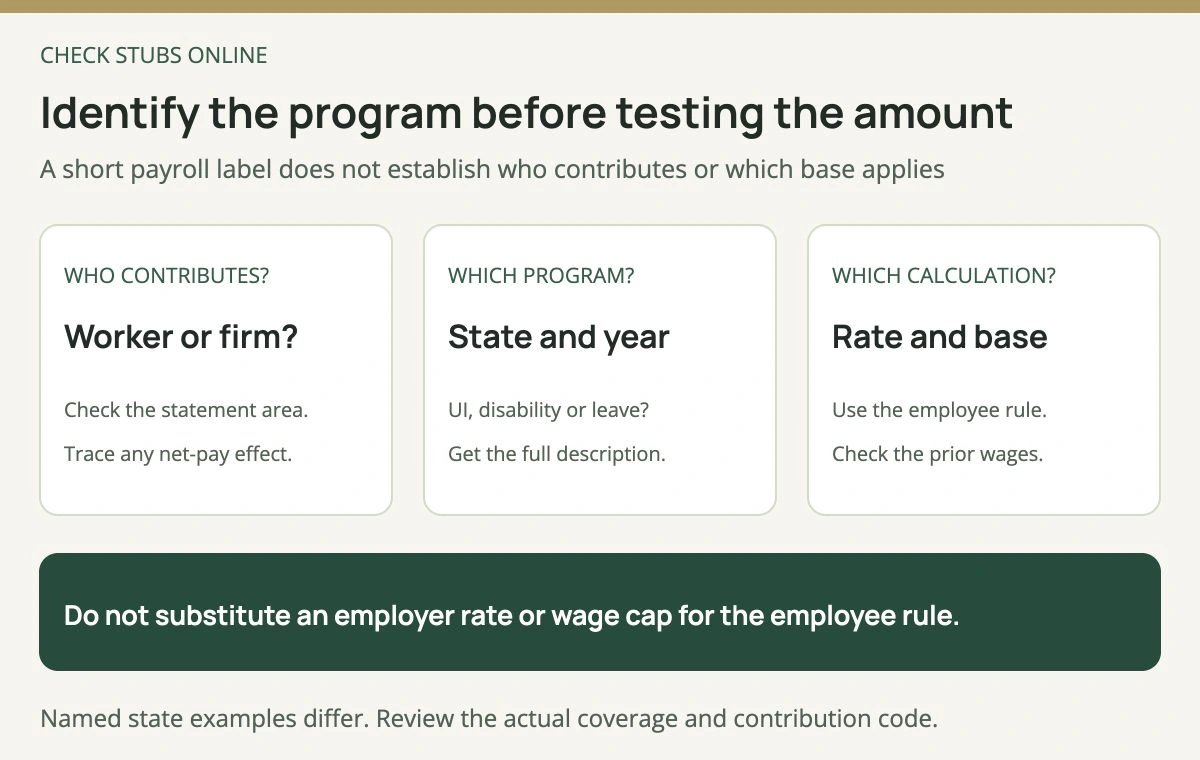
A payroll abbreviation is a starting clue. The full record and applicable program rules determine its meaning.
Copying the biggest percentage from a state employer tax notice can produce an incorrect employee calculation. A notice may show employer, employee and combined rates. The employee component needs to be identified separately.
## SUI, FUTA, SDI and income tax are different entries
State unemployment insurance and federal unemployment tax belong to related financing systems but do not have identical payroll treatment. The [IRS employment-tax reporting guidance](https://www.irs.gov/businesses/small-businesses-self-employed/depositing-and-reporting-employment-taxes) identifies FUTA as an employer obligation. This federal tax must not be taken from a worker’s wages. An employee SUI contribution in a state that requires one does not create an employee FUTA deduction.
Disability and paid-leave programs can also appear on a statement with their own rules. [California EDD’s payroll-tax overview](https://edd.ca.gov/en/payroll_taxes/what_are_state_payroll_taxes/), for example, distinguishes employer-funded UI from employee-withheld SDI and personal income tax. That California example does not mean every state uses those funding arrangements or labels.
If a worker moves or begins remote work, ask which state program payroll applied and why. A mailing address alone is not enough to explain every employment-tax result. Our [cross-state tax guide](https://blog.checkstubsonline.com/live-work-different-states-taxes) addresses related income-tax questions, but income-tax withholding and unemployment coverage must not be treated as one calculation.
## Current state examples show why one national rule does not work
The following official examples illustrate different checks. They are not a complete nationwide rate table and should not be carried into another year without review.
**Named 2026 program examples; verify your own coverage and payroll line**
| State example | What the official guidance establishes | Practical check |
| --- | --- | --- |
| Alaska | Employee UI rate of 0.50% and a $54,200 taxable wage base | Use the employee component and remaining covered wage base |
| Pennsylvania | Employee withholding rate of 0.07% on gross wages, without the employer’s wage-base cap | Do not stop the employee calculation at the employer’s $10,000 base |
| New Jersey | Separate reporting of worker UI, workforce, disability and family-leave contributions | Do not assume a combined line is UI alone |
| California | UI is an employer contribution; SDI is employee-withheld | Check whether an apparent employee UI charge is actually another program |
[Alaska’s 2026 rate page](https://labor.alaska.gov/estax/2026-experience-rates.html) separates employee and employer components. [Pennsylvania’s official contribution chart](https://www.pa.gov/content/dam/copapwp-pagov/en/dli/documents/uc/employer/uc-tax-rates/uc-749%20rev%2009-25.pdf) lists the 2026 employee withholding factor as .0007 and states that employee withholding has no gross-wage cap. Its separate employer wage-base row is not an employee limit.
[New Jersey’s 2026 wage-statement notice](https://www.nj.gov/treasury/taxation/pdf/other_forms/git-er/m6025-2026.pdf) identifies the different worker contributions that need reporting. Use the detailed program breakdown when reviewing a combined payroll label. A common agency or adjacent placement on a form does not make those contributions interchangeable.
## Original Alaska example: only $700 remains below the cap
Assume a fictional employee has $53,500 of covered wages already counted in one employer’s 2026 Alaska UI wage-base record. The next payment contains $2,000 of additional wages that would otherwise be covered. Assume no special exclusion, reversal, successor-employer issue or other adjustment.
The remaining room under the stated $54,200 base is $700. Only that $700 from this payment enters the employee UI calculation. At 0.50%, the employee contribution is $700 × 0.005 = $3.50. Applying the rate to all $2,000 instead would produce $10, which is $6.50 too much for this specific assumed history.
**Original 2026 Alaska wage-base ledger for one assumed employer record**
| Item | Covered or otherwise-covered wages | Wages newly subject to employee UI | Employee UI at 0.50% |
| --- | --- | --- | --- |
| Before the illustrated payment | $53,500 year to date | $53,500 accumulated | $267.50 accumulated |
| Illustrated payment | $2,000 | $700 | $3.50 |
| Next assumed payment after reaching the cap | $2,000 | $0 | $0.00 |
| Maximum base and employee total under these assumptions | $54,200 cap | $54,200 annual total | $271.00 annual total |
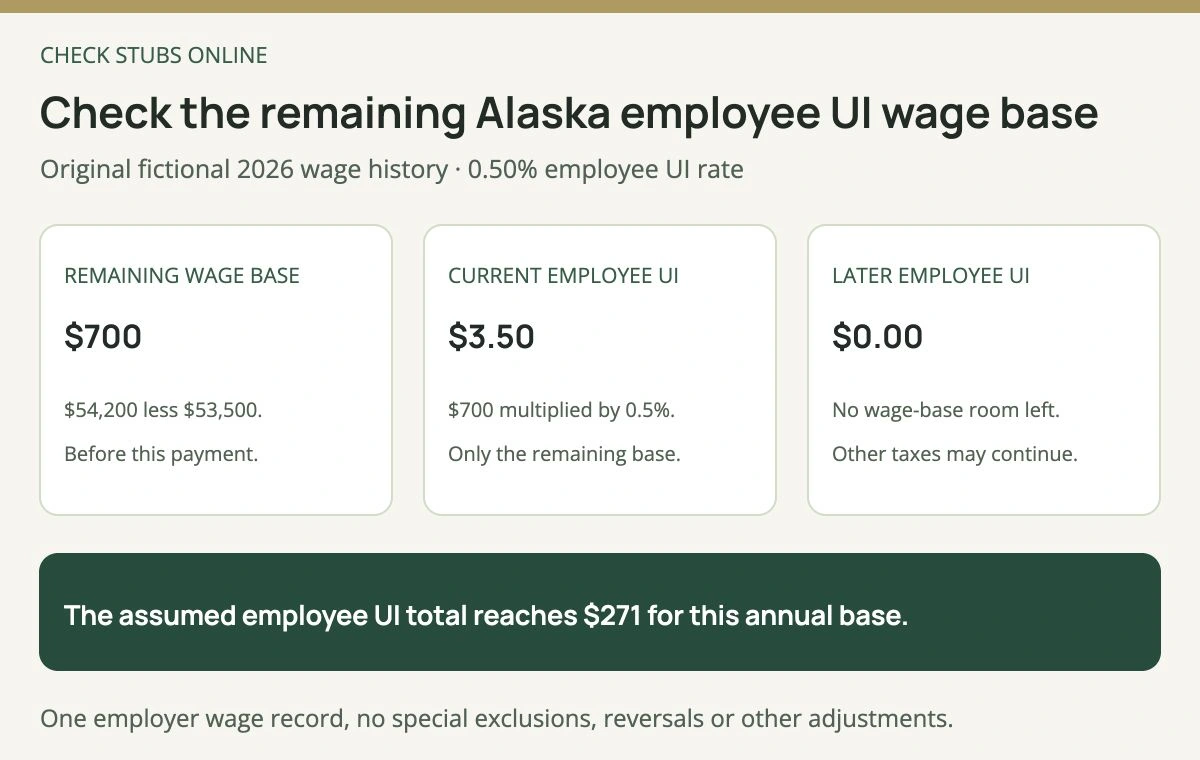
The example assumes one continuous covered-wage record with no adjustments. It does not calculate the whole paycheck.
[Alaska’s wages and deduction FAQ](https://dol.alaska.gov/estax/faq/WagesDeductions.htm) also lists the 2026 employee maximum of $271. The original ledger reconciles to it: $267.50 already contributed plus $3.50 equals $271. Do not mistake the employer’s separate contribution for another employee deduction.
Reaching the UI base does not mean every payroll tax stops. Other taxes use their own rules and bases. The [Alaska calculator guide](https://blog.checkstubsonline.com/alaska-paycheck-calculator-guide) reviews supported take-home-pay calculations, including components beyond this single contribution.
## Why Pennsylvania’s employee calculation needs a different check
For a separate fictional Pennsylvania payment in 2026, assume $2,000 of gross wages subject to the employee contribution. The employee factor .0007 corresponds to 0.07%, producing $1.40. This is not a 7% deduction and not the employer’s assigned contribution rate.
Suppose the employee has already received more than $10,000 during the year. That fact alone does not remove employee withholding in this named example, because the official chart’s no-cap note applies to the employee contribution. Transplanting Alaska’s capped-employee method or Pennsylvania’s employer cap would answer the wrong question.
Read the [Pennsylvania calculator guide](https://blog.checkstubsonline.com/pennsylvania-paycheck-calculator-guide) for the separate state income-tax and paycheck context. The $1.40 example is just one contribution line; it is not total state withholding or the complete difference between gross and net pay.
## What could explain a new, smaller or missing SUI amount?
- **A different section of the statement:** an employer contribution may be displayed without reducing net pay.
- **Reaching a program’s annual base:** a capped employee contribution can decrease or stop under that program’s rules.
- **A new calendar year:** verify the new year’s base, rate and payroll records rather than carrying a prior cap forward.
- **A coverage or location change:** request the state-program determination used by payroll.
- **A correction or renamed code:** match the original entry, reversal and replacement so an adjustment is not counted twice.
Where more than one employer, a business transfer or an interstate arrangement is involved, ask which rules govern the wage-base history or any excess-contribution procedure. Do not combine every employer’s totals and invent a refund or exemption on your own.
## Ask payroll for a calculation you can reproduce
A useful question identifies the payment date, complete contribution label, current deduction, prior covered wages and rate used. For the fictional Alaska example, ask payroll to reconcile the $2,000 payment against $700 of remaining UI wage base and identify the employee rate used.
Request the actual calculation basis, not merely confirmation that the software ran. Keep the statement, explanation and any correction together. Our [payroll contact guide](https://blog.checkstubsonline.com/who-handles-payroll-in-a-company) helps route questions among payroll, human resources and an external processor.
If a discrepancy remains, check the administering state agency’s current guidance and ask about the appropriate correction channel. A payroll label alone cannot establish a refund amount. Preserve your original documents instead of changing the reported deduction yourself.
## A contribution line is not a payment of unemployment benefits
A deduction helps explain a paycheck. It does not establish an unemployment claim, benefit amount or eligibility. Benefits paid by an agency have their own payment history and reporting documents. Our [unemployment payment-record guide](https://blog.checkstubsonline.com/unemployment-pay-stubs-payment-records) explains how those records differ from an employer’s wage statement.
The [Check Stubs Online paycheck calculators](https://www.checkstubsonline.com/paycheck-calculator/) can help examine supported wage scenarios after you identify the correct state and year. Check each tool’s coverage and exclusions. An estimate does not resolve contribution coverage, verify an employer’s filings or determine unemployment benefits.
## SUI questions
### Does every employee pay SUI?
No. Identify the applicable state program and whether the amount is employee-funded or employer-funded.
### Is SUI another name for FUTA?
No. Federal unemployment tax is an employer tax; state contribution rules must be examined separately.
### Does a $10,000 employer wage base always cap employee deductions?
No. Pennsylvania’s named 2026 example explicitly uses a different employee rule.
### Can a missing deduction prove my unemployment coverage ended?
No. A cap or payroll presentation may explain the line. Ask for the underlying coverage and calculation records.
The Check Stubs Online Editorial Team checked current primary state contribution references and independently recalculated the two original state-specific wage examples.
## Relevant document tool
Explore a paycheck estimate with the right inputs
Identify the payroll contribution first, then choose the relevant state calculator and review its supported components and wage units.
[Explore paycheck calculators](https://www.checkstubsonline.com/paycheck-calculator/)
An estimate does not determine state coverage, validate contributions or establish benefit eligibility.
## Related guides
- [Gross vs. Net Pay: Reconcile Your Paycheck](https://blog.checkstubsonline.com/gross-vs-net-pay)
- [Mandatory Paycheck Deductions: What Is Required and How to Check It](https://blog.checkstubsonline.com/mandatory-paycheck-deductions)
- [Who Handles Payroll in a Company? A Guide to the Right Contact](https://blog.checkstubsonline.com/who-handles-payroll-in-a-company)