---
title: "Third-Party Sick Pay: W-2 Forms, Withholding and Record Checks"
description: "Reconcile insurer sick-pay statements and W-2 forms, check for duplicate amounts, understand withholding and follow a six-calendar-month payroll-tax example."
url: "https://blog.checkstubsonline.com/third-party-sick-pay-w2"
datePublished: "2026-11-24"
---
# Third-Party Sick Pay: W-2 Forms, Withholding and Record Checks
Reconcile insurer sick-pay statements and W-2 forms, check for duplicate amounts, understand withholding and follow a six-calendar-month payroll-tax example.
Published: 2026-11-24
By [Check Stubs Online Editorial Team](https://blog.checkstubsonline.com/editorial-policy#editorial-team)
**Third-party sick pay can be reported on an employer’s W-2, a separate payer’s W-2 or coordinated records, depending on the reporting arrangement.** Match the payments and taxable amounts before adding statements together. Who issued the check, who reports the benefit and which taxes apply are separate questions. An insurer summary can describe money already included on the employer’s annual form.
Reviewed November 24, 2026 · Ordinary U.S. employer-plan sick-pay records and 2026 federal reporting. Examples are fictional and use supplied taxable amounts. This is not a determination of disability eligibility, a medical recommendation or a complete analysis of state benefits, retirement or railroad rules.
After a period away from work, an employee may receive a regular payroll statement, insurer benefit notices and annual tax forms bearing different payer names. The task is to map the actual payments to the correct form rather than treating every document as a new source of income.
For the broader difference between SSI, SSDI and disability insurance, see [our disability-income tax guide](https://blog.checkstubsonline.com/is-disability-income-taxable). This article concentrates on employer-related third-party sick-pay reporting and reconciliation.
## In this guide
1. [Identify the payment and payer](#sick-pay-scope)
2. [Find who will report the benefit](#sick-pay-forms)
3. [Reconcile annual wages without duplicates](#sick-pay-example)
4. [Read the W-2 fields separately](#sick-pay-boxes)
5. [Check the six-calendar-month rule](#sick-pay-clock)
6. [Ask about withholding and Form W-4S](#sick-pay-withholding)
7. [Resolve missing or overlapping records](#sick-pay-correction)
8. [Third-party sick-pay questions](#sick-pay-faq)
## Identify what was paid and which organization paid it
Ordinary sick pay replaces wages during a temporary absence due to illness or injury under an employer-related plan. The current [IRS Publication 505](https://www.irs.gov/publications/p505) distinguishes payments by the employer, its agent and a third party that is not acting as its agent. An insurance-company name alone does not resolve every part of the reporting arrangement.
**Start by classifying the record rather than the word disability**
| Payment or record | What to identify | Why the distinction matters |
| --- | --- | --- |
| Employer sick-leave wages | Pay period, employer and payroll calculation | Ordinary paid leave is not automatically a separate insurer benefit |
| Insurer wage-replacement benefit | Plan, payment dates and payer’s tax classification | The cash payer and annual reporting party can differ |
| Benefit-payment summary | Whether it is a supporting summary or an actual W-2 | A summary may repeat amounts reported elsewhere |
| Social Security, workers’ compensation or retirement payment | The actual program and annual form | Other benefit and tax rules may apply |
Ask for the plan’s benefit-payment ledger and taxable/excluded breakdown. The [IRS disability-insurance FAQ](https://www.irs.gov/faqs/interest-dividends-other-types-of-income/life-insurance-disability-insurance-proceeds/life-insurance-disability-insurance-proceeds-1) explains why premium funding and after-tax versus pre-tax employee payments can matter. A deduction on a pay stub does not automatically mean the employee funded the coverage with after-tax dollars.
For a group policy, ask which premium periods and allocation method the payer used; do not calculate taxable benefits from one recent premium deduction alone. Use the payer’s supported classification, while seeking correction if its funding facts are wrong. The annual illustration below deliberately supplies the taxable benefit amount instead of pretending to perform that eligibility analysis.
## Who issues the W-2 when an insurer made the payments?
[Publication 15-A for 2026, section 6](https://www.irs.gov/publications/p15a) describes the arrangements between an employer and a sick-pay payer. Depending on responsibility, notification and any applicable agreement, the employer may report the benefit or the third party may issue its own W-2. The employee cannot choose the reporting party merely to obtain the preferred tax result.
Ask both contacts one concrete question: “Who will include these dated benefit payments on my W-2, and will the employer’s regular wage form already include them?” Save the response and the period covered. A separate W-2 is not automatically a duplicate; two payers may legitimately report different payments.
Likewise, a year-end benefit summary is not necessarily another tax form. Check its heading and instructions. A summary may explain insurer payments that the employer reports on a combined W-2. Keep the summary as support, while reconciling the amount included on the annual form.
## Original example: $32,800 of taxable amounts, reported two possible ways
Assume a fictional employee has $28,600 of federal taxable regular wages and $4,200 of federal taxable sick pay for 2026. These are supplied taxable figures after any relevant classification; they are not gross bank deposits. Assume no other wage adjustments, benefits, employers or tax forms.
The combined amount is $28,600 + $4,200 = $32,800. Two different, expressly assumed reporting arrangements can explain that same total:
**Fictional alternatives: identify the actual reporting arrangement**
| Supplied arrangement | Employer’s Box 1 | Other record | Combined amount in this illustration |
| --- | --- | --- | --- |
| Employer reports both components | $32,800.00 | Insurer summary describes the same $4,200 already included | $32,800.00 |
| Separate nonoverlapping W-2s | $28,600.00 | Insurer W-2 Box 1 reports the separate $4,200 | $32,800.00 |
In the first arrangement, adding $4,200 again would produce $37,000 and duplicate the benefit. In the second, ignoring the insurer’s distinct W-2 would omit $4,200. The correct action follows the actual forms and payer confirmation, not a rule that every employee should combine or discard a second statement.
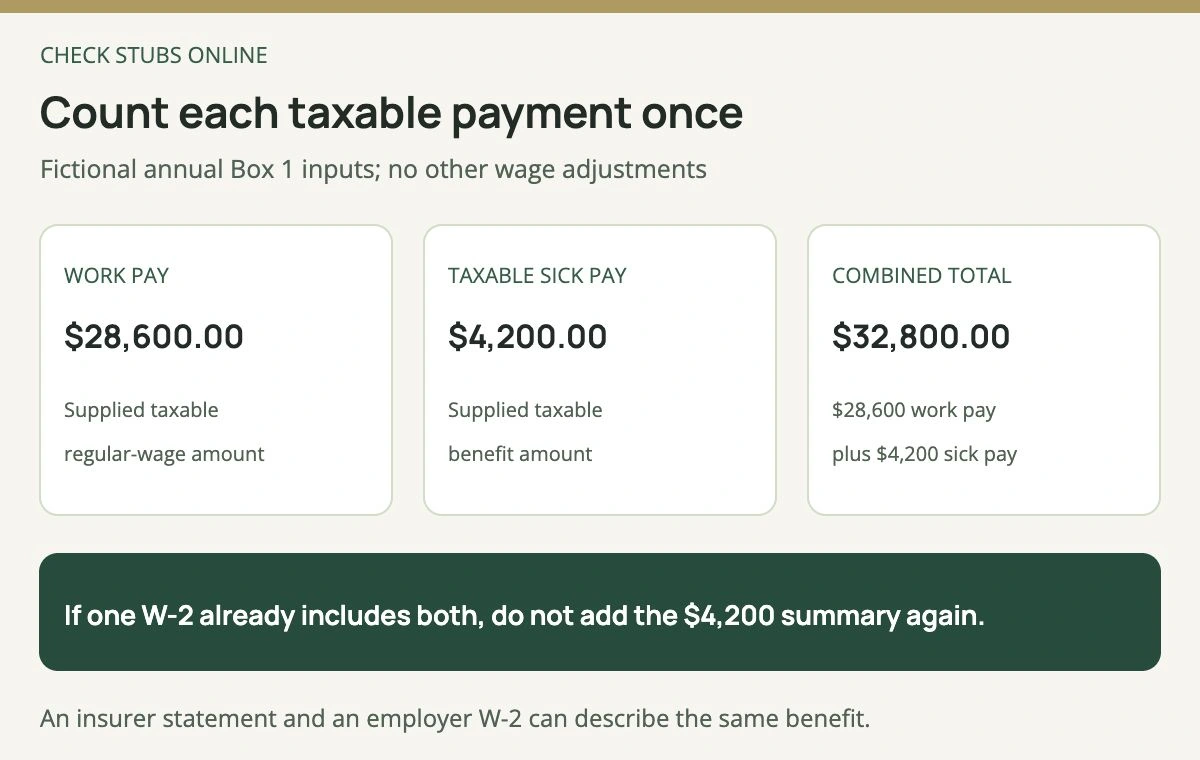
Compare the covered payment list with the annual forms. The illustration uses already-established taxable amounts, not a premium-funding calculation.
If two actual W-2s appear to include the same benefit, contact both issuers and request a payment-by-payment reconciliation. Do not privately alter one form or simply decide that it need not be reported. A corrected issuer form may be required. Our [reissued W-2 versus W-2c guide](https://blog.checkstubsonline.com/reissued-w2-vs-w2c) explains the difference between another copy and a correction.
## Read wage bases, code J and the checkbox separately
The [2026 W-2 instructions](https://www.irs.gov/instructions/iw2w3) identify a third-party sick-pay checkbox in Box 13. It describes a reporting situation; it is not an extra amount to add to wages or a declaration that the whole payment is tax-free.
**W-2 fields that can matter for sick-pay reconciliation**
| Field | Question to resolve | Avoid this shortcut |
| --- | --- | --- |
| Box 1 | Which federally taxable wages and benefits are included? | Replacing taxable income with the sum of net deposits |
| Boxes 3 and 5 | Which amounts are Social Security or Medicare wages? | Assuming every income-taxable benefit has identical payroll-tax treatment |
| Box 2 and the other tax fields | What tax was actually withheld and reported? | Treating missing withholding as proof of an excluded payment |
| Box 12 code J | Does it identify nontaxable third-party sick pay attributable to employee plan contributions? | Adding that informational excluded amount to taxable wages automatically |
| Box 13 sick-pay checkbox | Which reporting situation does the issuer identify? | Using the checkbox alone to calculate tax or identify a duplicate |
Code J has a specific definition in those instructions, including a distinction from nontaxable disability paid directly by a state. Do not use it as a catch-all label for every benefit you consider exempt. For other wage-base differences, read [why W-2 Boxes 1, 3 and 5 can differ](https://blog.checkstubsonline.com/w2-boxes-1-3-5-different).
## Count six full calendar months after the last month worked
Under the ordinary rule in Publication 15-A, sick-pay payments made after the six-calendar-month period following the last calendar month worked are no longer subject to Social Security, Medicare or FUTA tax. That does not itself exclude them from federal taxable income. The [Social Security wage rule in section 404.1051](https://www.ssa.gov/OP_Home/cfr20/404/404-1051.htm) also describes the calendar-month exclusion and its application to a third-party payment.
For an original 2026 example, assume the employee last works on January 16 and performs no further work for that employer. The six full following months are February, March, April, May, June and July. The later-payment period begins August 1. Do not substitute 180 days from January 16, the insurer’s approval date or the first deposit date.
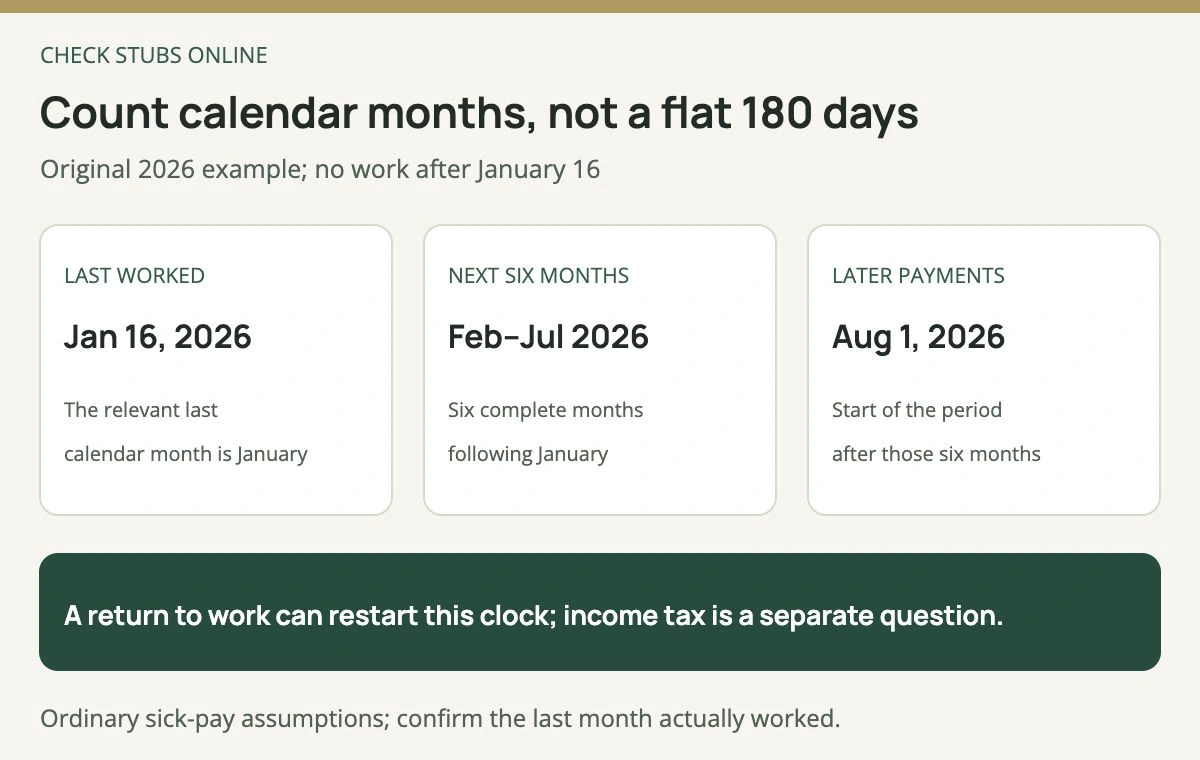
The example counts full months following the last month worked. It does not calculate an individual benefit’s income-tax result.
Now change one fact: the employee works a day on April 8, 2026, then performs no further work. The relevant following months become May through October, and November 1 starts the later-payment period in this variation. Publication 15-A’s return-to-work example explains why even one worked day can change the clock.
Confirm actual work dates with the employer and payer. These examples assume ordinary sick pay and no earlier special exclusion; state programs, disability retirement, workers’ compensation and other payment categories need their own rules. FUTA is an employer tax, not an extra employee deduction to remove from a benefit check.
## Ask whether Form W-4S applies to this payer
Publication 505’s sick-pay section distinguishes the payer roles. Employers and their agents generally withhold federal income tax. When an independent third-party provider is not the employer’s agent, the employee generally requests that withholding. Confirm the actual arrangement instead of assuming the W-4 on file with regular payroll controls the insurer’s payments.
The official [Form W-4S page](https://www.irs.gov/forms-pubs/about-form-w-4-s) describes requesting federal income-tax withholding from sick pay. Use the form and current instructions if appropriate for the actual payer. It is not an application for disability benefits, an instruction to the Social Security Administration or a substitute for the ordinary employer W-4.
Compare any requested withholding with the actual benefit statements. Withholding is a payment toward eventual tax, not the final liability calculation. An employee may need to review the wider annual tax picture or estimated-payment process if too little is being withheld; this guide does not recommend a personal withholding amount.
## Build a reconciliation packet before requesting a correction
1. **List each payment once.** Record payer, payment date, gross benefit, taxable/excluded classification, deductions and net amount.
2. **Identify each annual document.** Distinguish a benefit summary, W-2, reissued copy and corrected form.
3. **Map payments to reporting.** Obtain confirmation of which benefits the employer or insurer included and which year they cover.
4. **Check timing and wage bases.** Verify the last month worked and ask the payer to explain differing income-tax, Social Security and Medicare amounts.
5. **Send a focused discrepancy.** Identify the same payment appearing twice, a missing period or a specific incorrect field. Request the responsible issuer’s explanation and correction.
6. **Retain the resolution.** Keep the replacement or correction with the original record and a note explaining which document supersedes what.
For example: “Your summary lists $4,200 of taxable benefits. Please confirm whether those exact payments are included in the employer W-2’s $32,800 Box 1 amount or will appear on a separate W-2. If both forms include them, please coordinate the reporting correction and tell me which records to use.” Substitute verified facts; do not send a diagnosis or unrelated medical history merely to explain the arithmetic.
Use authenticated employer and insurer channels, with the minimum identifying information needed for the request. The [payroll contact guide](https://blog.checkstubsonline.com/who-handles-payroll-in-a-company) helps locate the employer records team. If an actual W-2 remains unavailable, follow the [missing-form process](https://blog.checkstubsonline.com/missing-w2-form-4852) rather than inventing an insurer form.
A prepared paycheck or privately revised PDF does not change the payer’s reporting, settle benefit eligibility or file a tax return. Confirm receipt and the final form’s contents. If a tax-filing deadline approaches while an overlap remains unresolved, seek qualified help using the actual documents.
## Third-party sick-pay questions
### Does an insurer payment always produce a separate W-2?
No. The actual reporting arrangement may place the benefit on the employer’s form. Ask who reports the specific payments and distinguish a supporting summary from another W-2.
### Are two W-2s automatically duplicates?
No. In the supplied separate-reporting case, $28,600 employer wages and $4,200 insurer wages are distinct. Investigate the payment coverage before adding or challenging forms.
### Does the six-month payroll-tax rule make sick pay income-tax-free?
No. It concerns specified employment taxes under the stated assumptions. The benefit’s federal income-tax classification and withholding are separate checks.
### Does my own premium deduction prove the benefit is excluded?
No. After-tax versus pre-tax funding and the applicable allocation method matter. Ask for the supported taxable/excluded breakdown instead of using one recent pay-stub line as the whole calculation.
### Does the Box 13 checkbox add another amount to my income?
No. It is an indicator, not a dollar amount. Reconcile the actual wage and tax fields and the payments they include.
The Check Stubs Online Editorial Team reviewed the linked IRS and Social Security guidance. Annual reporting alternatives, payment-mapping steps and 2026 calendar variations are original educational examples with independently checked totals and dates.
## Relevant document tool
Match the payer’s records with the correct annual form
The IRS employer supplement explains ordinary sick-pay reporting arrangements and the distinction between payroll taxes and income-tax withholding.
[Review IRS sick-pay reporting](https://www.irs.gov/publications/p15a)
Your employer and payer must confirm the actual arrangement. A summary or prepared document does not establish benefit eligibility or replace issuer reporting.
## Related guides
- [Reissued W-2 vs. W-2c: Duplicate Copies and Corrected Amounts](https://blog.checkstubsonline.com/reissued-w2-vs-w2c)
- [Why W-2 Boxes 1, 3 and 5 Are Different: Wage Examples](https://blog.checkstubsonline.com/w2-boxes-1-3-5-different)
- [Is Disability Income Taxable? SSI, SSDI, and Employer Benefits](https://blog.checkstubsonline.com/is-disability-income-taxable)