---
title: "Time Clock Rounding: Check Minutes on Your Paycheck"
description: "Audit original punches, rounded paid time and decimal-hour inputs. Follow checked examples and learn what records to request before claiming a payroll error."
url: "https://blog.checkstubsonline.com/time-clock-rounding-paycheck"
datePublished: "2026-11-25"
---
# Time Clock Rounding: Check Minutes on Your Paycheck
Audit original punches, rounded paid time and decimal-hour inputs. Follow checked examples and learn what records to request before claiming a payroll error.
Published: 2026-11-25
By [Check Stubs Online Editorial Team](https://blog.checkstubsonline.com/editorial-policy#editorial-team)
**To check time-clock rounding, compare the original punches with paid minutes and review how the policy actually operates over time.** Federal enforcement guidance describes conditional acceptance of certain rounding practices only when employees are properly compensated for their work. Converting minutes to decimal hours is a separate calculation. Preserve the raw records, check each rule and keep state requirements and actual duties in view.
Reviewed November 26, 2026 · U.S. timekeeping and paycheck records. The fictional punch pair assumes exact-minute entries, all intervening time worked except an actual uninterrupted unpaid 30-minute meal, the same rate and one workweek. It is a calculation demonstration, not approval of a real policy or a state-law conclusion.
An eight-hour-and-fifteen-minute shift can appear as 8.25 in a payroll field. That alone is not evidence that a quarter hour disappeared. Another statement may really omit recorded minutes. Start by identifying whether the difference comes from a time unit, a rounding setting, a meal deduction or an unrecorded duty.
Our [YTD-hours guide](https://blog.checkstubsonline.com/ytd-hours-on-pay-stub) follows cumulative counters. This article starts earlier, with the individual punch and the paid time that feeds the statement.
## In this guide
1. [Preserve the original punches](#round-source)
2. [Understand the limited federal rule](#round-rule)
3. [Check an original punch pair](#round-example)
4. [Convert minutes to decimal hours](#round-decimal)
5. [Review the pattern beyond one pair](#round-pattern)
6. [Separate meals, duties and missed entries](#round-other)
7. [Send a focused correction request](#round-request)
8. [Time-rounding questions](#round-faq)
## Keep raw time and the payroll result side by side
Save the available original clock entries before an edit or approval replaces them. Obtain the rounded start/end values, any deducted breaks, manual corrections, approver and the statement using those hours. Record which time zone or overnight date applies when that could explain the comparison.
**Trace a paid-time difference to its input**
| Input | What to retain | What it can explain |
| --- | --- | --- |
| Original punches | Dates and exact available times | The starting clock record |
| Rounding configuration | Increment, direction and where it is applied | Why the displayed start/end changed |
| Break entry | Actual duration and duty status | A separate time deduction |
| Manual adjustment | Reason, approval and old/new entries | A change that is not ordinary rounding |
| Payroll output | Paid units, unit format, workweek and rate | The resulting earning calculation |
The [DOL recordkeeping summary](https://www.dol.gov/agencies/whd/fact-sheets/21-flsa-recordkeeping) emphasizes accurate work-hour and wage records. A rounded report can be one output of a system; it should not make the source and explanation impossible to trace. Ask for the relevant available records through the employer’s approved process.
## What does the federal rounding guidance actually say?
[29 CFR 785.48(b)](https://www.ecfr.gov/current/title-29/section-785.48) gives examples of nearest-interval rounding at five minutes, six minutes (0.1 hour), or fifteen minutes (0.25 hour). Its enforcement acceptance depends on operation over time without a failure to compensate employees properly for their actual work. The listed intervals do not make a particular system automatically acceptable.
Review both the written rule and what it does. A setting that always moves arrivals later and departures earlier raises a different question from genuinely nearest-increment rounding. A policy name or a supervisor’s statement that “seven minutes never count” does not establish the federal conditions. State rules, agreements or the actual circumstances may require a different approach.
The same section distinguishes an early or late punch with no work from actual duties. Meanwhile, [29 CFR 785.47](https://www.ecfr.gov/current/title-29/section-785.47) limits the treatment of uncertain, practically unrecordable small periods and rejects arbitrary omission of fixed, regular or practically ascertainable required work. Do not use a casual “de minimis” label to erase routine duties that can be identified.
## Original example: two nearest-quarter-hour calculations
Assume the fictional system rounds each exact-minute arrival and departure to the nearest quarter hour. There are no seconds or midpoint ties in these entries. Each day includes an actual 30-minute unpaid meal, unchanged by the rounding. All remaining time in the supplied record is work; there are no other work hours in this two-day illustration.
**Original punch comparison with a separate 30-minute meal**
| Day | Original span | Rounded span | Actual paid-work minutes | Rounded minutes | Change |
| --- | --- | --- | --- | --- | --- |
| First | 08:07–16:53 | 08:00–17:00 | 496 | 510 | +14 |
| Second | 08:08–16:52 | 08:15–16:45 | 494 | 480 | −14 |
| Pair total | Meals remain 30 minutes each | Same limited scope | 990 | 990 | 0 |
For day one, the original span is 526 minutes; subtracting 30 leaves 496. The rounded nine-hour span is 540 minutes; less the same meal gives 510. Day two has 524 original span minutes and 510 rounded span minutes. After the meal, those become 494 and 480.
The first difference is +14 and the second is −14. Both two-day totals equal 990 minutes, or 16.5 hours. That result demonstrates the arithmetic of this chosen pair. It does not establish how a real policy behaves over a representative period, whether other work was omitted or whether a particular jurisdiction permits it.
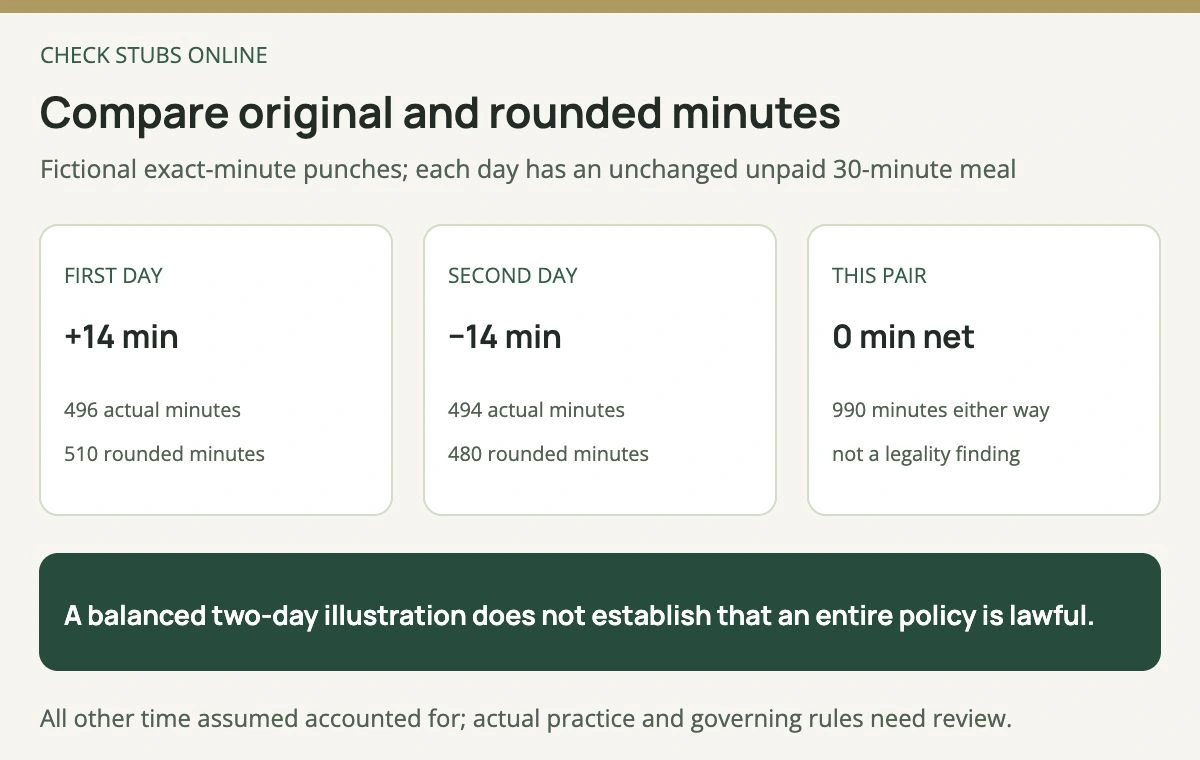
A small example can explain an increment. It cannot certify a timekeeping practice, even when its displayed totals balance.
## 8 hours 15 minutes is 8.25 hours, not 8.15
A minutes field uses sixty units per hour; a decimal-hour field uses hundredths or other decimal fractions. Convert the minutes before adding the full hours: 15 ÷ 60 = 0.25, so 8 hours 15 minutes becomes 8.25 hours. Entering 8.15 hours instead represents 8 hours plus 0.15 × 60 = 9 minutes.
For a separate fictional shift paid at an assumed $27 straight-time rate with no overtime or other earning component, 8.25 hours produces $222.75. The 8.15 input produces $220.05. The $2.70 gross difference is six minutes at that rate. This does not predict the change in a bank deposit or determine a real wage claim.
**Original decimal-unit check before any deduction calculation**
| Entry | Time represented | Gross at supplied $27 rate |
| --- | --- | --- |
| 8 h 15 min | 495 minutes | $222.75 |
| 8.25 decimal hours | 495 minutes | $222.75 |
| 8.15 decimal hours | 489 minutes | $220.05 |
| Input difference | 6 minutes | $2.70 |
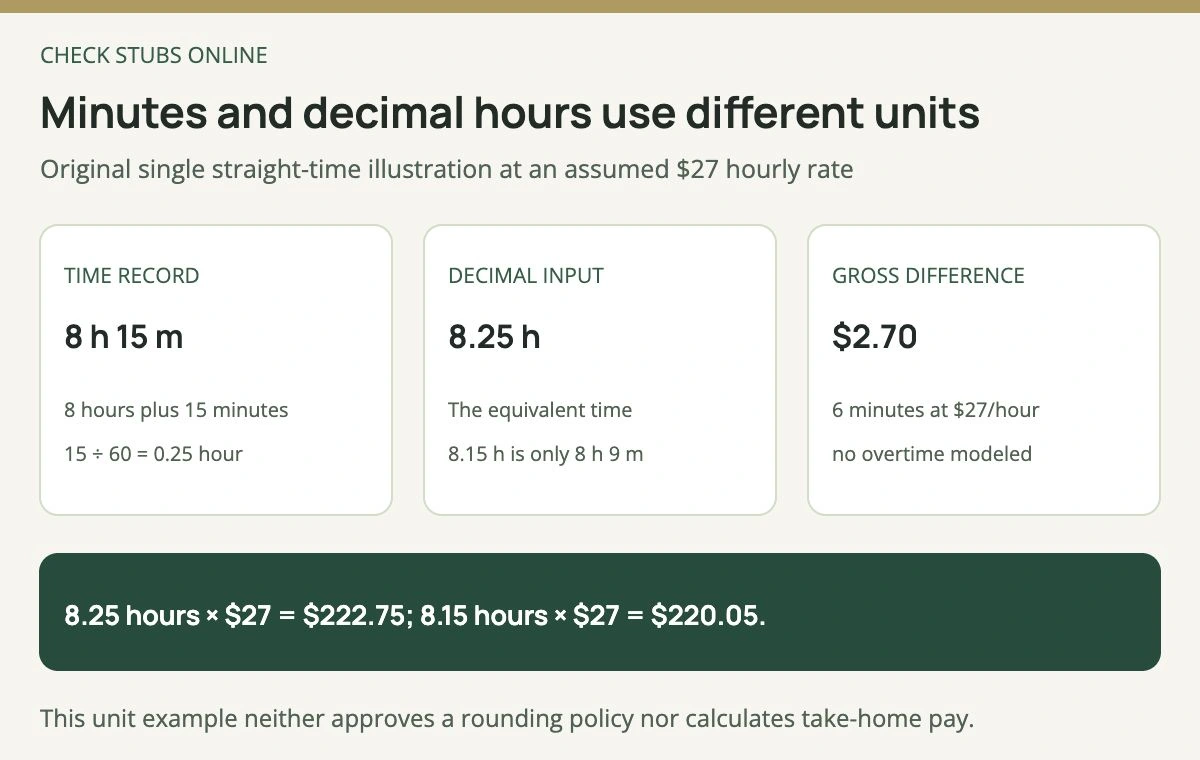
Resolve the field’s unit before calling an unfamiliar decimal a rounding loss.
If you are preparing an ordinary statement from authorized payroll records, enter the approved time in the format required by the [Regular earnings worksheet](https://www.checkstubsonline.com/regular-pay-stub) and compare the preview with the register. A worksheet’s numeric field does not determine whether the underlying rounding, break or work-time decision is valid.
Ask how much precision the system retains. Converting minutes, rounding a display and rounding currency are different steps. A two-decimal screen may hide a more precise calculation; obtain the underlying result before repeatedly rounding each intermediate number yourself.
## Review the operating pattern, not just a favorable day
Request enough original and processed entries to examine the actual practice. Track additions and removals by worker and work period, including manual changes. Review how often time is reduced, where the rule is applied and whether the apparently neutral configuration matches its output.
A simple counterexample is a practice that changes each 08:01 start to 08:15 while leaving the actual work before 08:15 unexplained. Across five such starts, 14 × 5 gives 70 minutes requiring investigation. That is a time difference, not a complete wage-damages calculation. It does not show what duties occurred, whether another entry paid them or how overtime applies.
Also reconcile the weekly wage calculation. A month-wide minute total does not explain the treatment of overtime, changing rates or a correction assigned to another period. The [mixed-rate workweek guide](https://blog.checkstubsonline.com/two-hourly-rates-overtime) demonstrates why work hours and the applicable pay components must stay connected.
## Is it rounding, a meal entry or missing work?
Keep each possible cause separate. An automatic meal deduction may be a different setting from punch rounding. Ask which actual interval it represents and whether the employee was relieved from duties. Do not assume every scheduled break occurred uninterrupted merely because the timecard subtracts it.
Required setup, a short remote assignment or work performed after the scheduled finish can call for a work-time review rather than a rounding calculation. Our [callback records guide](https://blog.checkstubsonline.com/on-call-pay-callback-hours) explains why a call’s duration and its required duties can be different records. Preserve what was done and when, without including unrelated confidential client information.
A missed clock-out also needs an authorized factual correction. Keep the available work log and request the employer’s repair process. Avoid replacing an uncertain record with a preferred round number simply to complete the timesheet.
## Send payroll a comparison it can reproduce
Identify the dates, original entries, displayed rounded entries, actual break and pay unit. A focused message says: “For the identified shift, the record shows 08:08–16:52 with a 30-minute meal, or 494 work minutes under the supplied facts. The processed entry is 480 minutes. Please explain the rounding rule, any separate adjustment and the actual paid units.” Replace this fictional comparison with your evidence.
Ask for the policy version, the relevant original/processed records and the explanation of a correction. Retain the response beside both statements. Our [payroll error checklist](https://blog.checkstubsonline.com/pay-stub-errors-correction) helps trace an hours correction through gross pay and its later payment instead of editing the issuer’s document yourself.
## Time-clock rounding questions
### Is the seven-minute rule a universal right to unpaid work?
No. The federal guidance has conditions about actual operation and compensation, and other rules may be stricter. Actual duties and the available records still matter.
### Does a balanced two-day example prove a policy is lawful?
No. It is too limited to establish the complete practice or resolve the governing jurisdiction. Preserve a representative record and the underlying work facts.
### Why does payroll show 8.25 when my record says 8:15?
If the first field is decimal hours and the second is hours and minutes, those figures represent the same time. Confirm the labels.
### Should I multiply missing minutes by the hourly rate and call that my net loss?
No. First resolve compensable time, rates, overtime and any other adjustment. Gross wages and take-home payment require different calculations.
Editorial review by the Check Stubs Online Editorial Team included current official timekeeping provisions, their November 23, 2026 eCFR issue and the original punch/conversion calculations. The limited examples explain an audit method without approving a real rounding arrangement.
## Relevant document tool
Keep the time record connected to the paycheck
Review official federal recordkeeping guidance, then obtain the actual clock entries and the explanation of any processed adjustment.
[Review DOL recordkeeping](https://www.dol.gov/agencies/whd/fact-sheets/21-flsa-recordkeeping)
A recordkeeping summary does not approve an employer’s rounding policy, resolve state law or calculate a particular wage claim.
## Related guides
- [On-Call Pay and Callback Hours: Check Your Pay Stub](https://blog.checkstubsonline.com/on-call-pay-callback-hours)
- [Overtime With Two Hourly Rates: Paycheck Checks](https://blog.checkstubsonline.com/two-hourly-rates-overtime)
- [Pay Stub Errors: How to Request and Track a Correction](https://blog.checkstubsonline.com/pay-stub-errors-correction)