---
title: "Travel Time Pay: Which Hours Belong on Your Paycheck?"
description: "Check paid travel time, ordinary commuting, same-day assignments and overnight trips. Follow a worked-hours example and reconcile weekly overtime."
url: "https://blog.checkstubsonline.com/travel-time-paycheck"
datePublished: "2026-11-26"
---
# Travel Time Pay: Which Hours Belong on Your Paycheck?
Check paid travel time, ordinary commuting, same-day assignments and overnight trips. Follow a worked-hours example and reconcile weekly overtime.
Published: 2026-11-26
By [Check Stubs Online Editorial Team](https://blog.checkstubsonline.com/editorial-policy#editorial-team)
**Travel time can count as paid work when it is part of an employee’s workday, such as moving between job sites.** Ordinary home-to-work commuting is generally treated differently under federal guidance. A special same-day assignment or overnight trip needs its own review. For covered nonexempt employees, compensable travel also enters the workweek’s overtime calculation; a mileage payment does not answer the hours question.
Reviewed November 26, 2026 · U.S. employee time and pay records under the ordinary federal framework. The fictional calculations assume covered nonexempt hourly work for one employer, a known workweek and the stated rate. They exclude state daily overtime, special industry rules, collective agreements and disputed classification. The examples do not decide a particular trip’s legal treatment.
A paycheck might show travel as a separate earning code, combine it with regular hours or omit the underlying trip detail from the summary. Start with what happened during the trip and which workweek contains it. Then connect the approved time record to the wage calculation. The name of an expense claim, a payroll code or a vehicle-tracking entry cannot settle that sequence by itself.
Use this guide for employee work time. Our [expense-reimbursement guide](https://blog.checkstubsonline.com/expense-reimbursements-pay-stub) addresses the separate question of paying back an employee’s costs. A business-mileage record and a wage-hours record can describe the same journey while serving different purposes.
## In this guide
1. [Identify the kind of trip](#travel-types)
2. [Keep a useful travel-time record](#travel-records)
3. [Check a 42-hour workweek](#travel-week)
4. [Understand the overtime rows](#travel-rows)
5. [Review a special same-day assignment](#travel-day-trip)
6. [Separate overnight travel cases](#travel-overnight)
7. [Keep expenses and wages distinct](#travel-costs)
8. [Ask payroll a precise question](#travel-request)
9. [Prepare a supported statement](#travel-preparation)
10. [Travel-pay questions](#travel-faq)
## Which kind of travel are you checking?
The [Department of Labor’s hours-worked fact sheet](https://www.dol.gov/agencies/whd/fact-sheets/22-flsa-hours-worked) distinguishes several travel situations. Its ordinary commute rule does not mean that all driving is unpaid, and its workday-travel rule does not mean that every journey from home is automatically work. Identify the facts before assigning a payroll category.
**Federal travel categories to identify before checking a paycheck**
| Situation | Ordinary federal guidance | Facts to establish |
| --- | --- | --- |
| Normal trip between home and work | Ordinary commuting generally is not work time. | Regular destination, duties and whether the trip actually fits the ordinary commute case. |
| Travel between work locations during the day | Travel within the principal work activity counts as work. | Departure, arrival, worksite sequence and any genuinely off-duty interval. |
| Special one-day assignment in another city | Travel counts, with the ordinary commuting allowance described by DOL. | Usual fixed worksite, same-day return, normal commute and actual assignment. |
| Trip requiring an overnight stay | Normal working hours and the passenger-travel distinction matter. | Usual daily schedule, nonworking days, passenger/driver status and work performed. |
These are starting categories, not a complete ruling on emergency calls, required equipment collection, a job beginning at home or a special transportation arrangement. Record those facts and request the rule being applied. A state rule or an agreement can require different or more generous treatment than the ordinary federal illustration.
## Keep a record that explains the trip
Preserve the assignment, work dates, departure and arrival times, locations and the employer’s established workweek. Distinguish a normal commute, movement between job sites, an overnight passenger segment and time actually spent performing duties. Record off-duty periods separately rather than removing a guessed allowance from every trip.
Use one consistent time unit. Forty-five minutes equals 0.75 hour, not 0.45 hour. Keep the original timestamps alongside any converted totals, especially if payroll rounds time. Our [time-clock rounding guide](https://blog.checkstubsonline.com/time-clock-rounding-paycheck) explains why decimal notation and an employer’s rounding policy are different questions.
Save the notice establishing any travel-pay rate and its effective date. This article’s main example uses the same hourly rate for on-site duties and travel. If different genuine rates apply, the [two-rate overtime guide](https://blog.checkstubsonline.com/two-hourly-rates-overtime) explains the ordinary weighted-rate method and why an unweighted average can misstate the calculation.
## Original example: 38 on-site hours plus four between-site hours
Assume an hourly employee performs 38 hours of on-site duties and spends four additional hours traveling between job sites during the same established workweek. The employer and employee have already confirmed that all four travel hours are compensable. Every worked hour has a $24 straight-time rate. There is no bonus, paid leave, differential, second employer or other includable compensation to classify.
Also assume the employee has 2.5 hours of ordinary commuting during the week that involve no work and fall within the ordinary federal commute rule. Those commute hours are not included in this example’s 42-hour total. That supplied classification is not permission to subtract 2.5 hours from some other employee’s record.
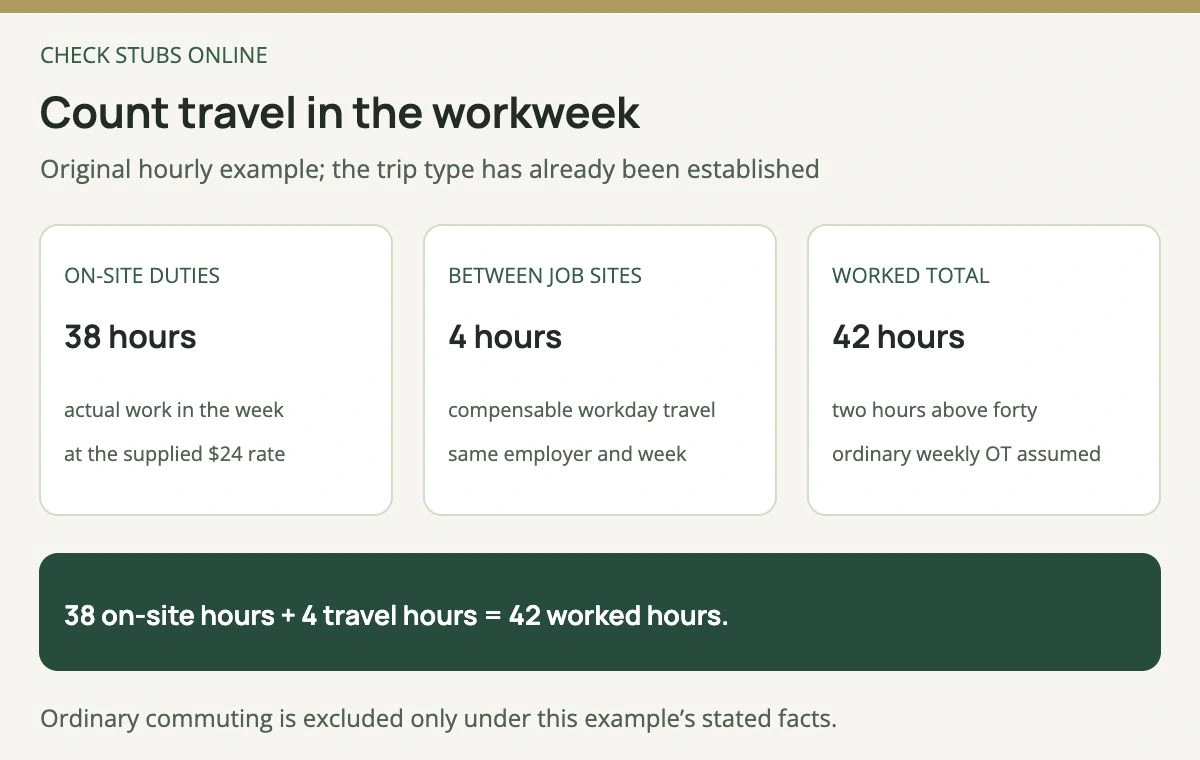
The trip classification is an explicit assumption. Once the four hours count as work, they remain part of the weekly hours even if payroll uses a separate travel code.
DOL’s [federal overtime fact sheet](https://www.dol.gov/agencies/whd/fact-sheets/23-flsa-overtime-pay) describes the ordinary over-40 workweek method and prohibits averaging separate weeks. Under the stated facts, 38 plus four gives 42 worked hours, of which two generate the additional overtime premium.
**Original same-rate workweek with compensable travel**
| Component | Calculation | Amount |
| --- | --- | --- |
| On-site straight time | 38 × $24 | $912.00 |
| Travel straight time | 4 × $24 | $96.00 |
| Straight time for all work | 42 × $24 | $1,008.00 |
| Additional weekly overtime premium | 2 × $24 × 0.5 | $24.00 |
| Weekly gross before deductions | $1,008 + $24 | $1,032.00 |
A comparison that pays only the 38 on-site hours would show $912 gross under these assumptions. The $120 gap comprises $96 travel straight time and $24 additional overtime premium. Adding just $96 would include the missing hours at straight time but still leave this illustration’s premium unresolved.
## A travel row and an overtime row can refer to the same hours
There are two equivalent presentations of this simple calculation. One pays all 42 hours at straight time and adds the $24 half-time premium. Another shows 40 hours at $24 and two hours at the full $36 overtime rate. Both produce $1,032 gross. Payroll’s row labels should make clear which presentation it uses.
Do not add two more worked hours merely because a premium-only row references two hours already counted in the 42. Equally, do not add another full $72 overtime payment on top of all 42 straight-time hours; their straight-time portion is already included there. Compare the complete ledger rather than declaring one particular row layout mandatory.
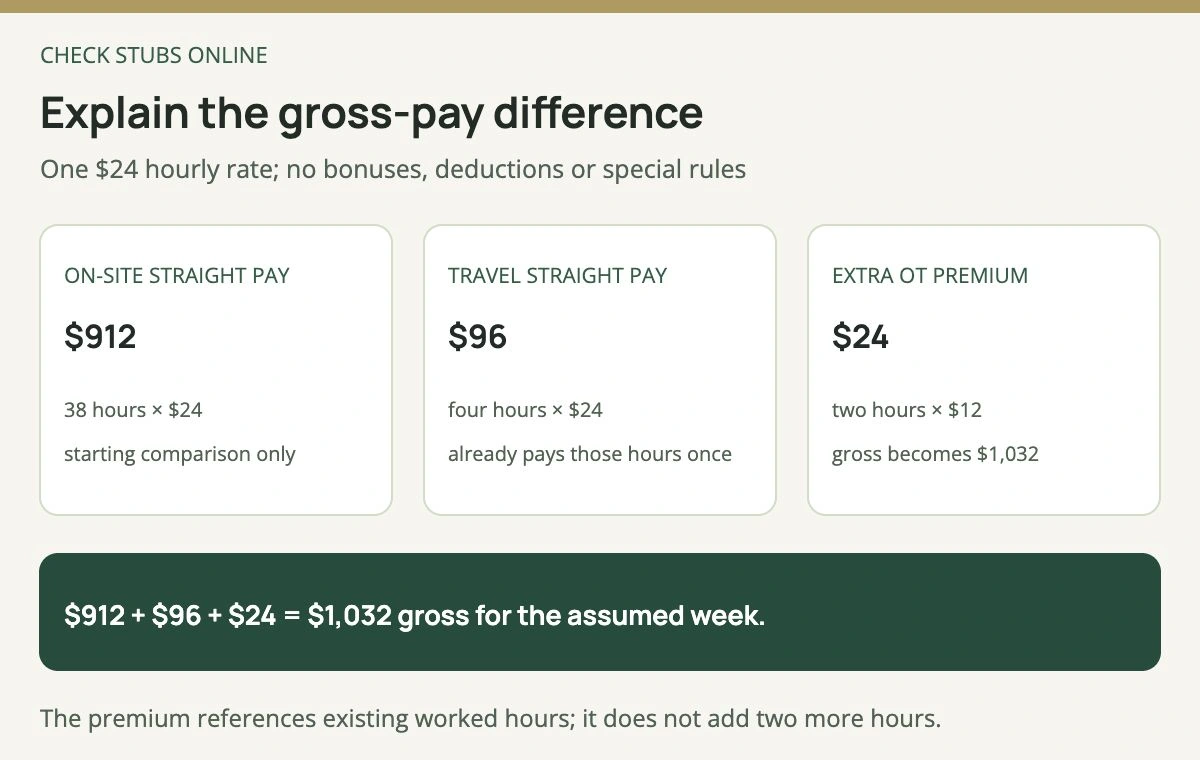
The $1,032 is the checked gross-pay result for the supplied week. Actual tax bases, deductions and net payment require separate records.
If a paycheck covers two weeks, complete this check for each established workweek. A later week with fewer hours leaves the completed 42-hour calculation above intact. The [pay-period versus payday guide](https://blog.checkstubsonline.com/pay-period-vs-pay-date) helps separate work coverage from the date a payment arrives.
## A special one-day assignment has a different commute comparison
DOL describes an employee with a regular fixed worksite who makes a special one-day assignment in another city and returns home that day. Its guidance treats that travel as work while allowing the time normally spent on the ordinary commute to be excluded. Establish that this is the relevant case before applying the comparison.
For a separate fictional time-only illustration, assume four hours of total round-trip travel for that assignment and one hour of normal round-trip commuting. Under the stated DOL treatment, the travel contribution is three hours. If the assignment also involves six actual on-site work hours, the day contributes nine worked hours. Assume the supplied trip totals already separate any genuinely off-duty meal interval.
Nine hours in that day does not alone establish the week’s ordinary federal overtime. Review the full workweek and any applicable daily-overtime rule separately. Avoid subtracting the one-hour normal commute twice, once for each direction, when the supplied hour already covers the round trip.
## Overnight travel requires the normal schedule and actual activities
For overnight travel, DOL includes travel occurring during the employee’s regular work hours, including corresponding hours on a day the employee ordinarily does not work. The fact sheet also describes an enforcement policy for passenger travel outside those regular hours. It should not be shortened into a blanket statement that weekends or airplane journeys never count.
Suppose a fictional employee’s normal hours are 9 a.m. to 5 p.m. A Sunday passenger trip runs from 2 p.m. to 7 p.m., entirely in the same time zone. Under the stated ordinary overnight-travel treatment, three hours overlap the normal daily schedule. The remaining two hours require the separate outside-hours passenger analysis. Assume no work is performed during those two hours; driving, assigned duties or other facts require their own review.
Retain the usual schedule, itinerary and actual activity record. Do not use the scheduled flight duration alone if it omits relevant work, changes in itinerary or the facts needed to apply the rule. This illustration does not resolve every driver, waiting-time or special-industry arrangement.
## Travel expenses and travel wages answer separate questions
A mileage allowance, hotel reimbursement or per-diem payment does not identify how many hours were worked. Keep the expense policy, supporting receipt or mileage detail and payment record apart from the work-time calculation. A correctly reimbursed cost does not, by itself, establish that compensable work hours were paid correctly.
Likewise, a travel earning label does not settle the tax treatment of a reimbursement. Our [per-diem guide](https://blog.checkstubsonline.com/per-diem-job-offer) separates a job’s paid unit from a travel allowance. Once the wage calculation is established, use the [gross-to-net guide](https://blog.checkstubsonline.com/gross-vs-net-pay) to trace actual deductions and the payment; the $120 gross difference above is not a promised $120 increase in the bank deposit.
## Ask payroll about the specific missing segment
Identify the date, trip purpose, departure and arrival times, the normal work schedule and the employer’s workweek. Explain whether the disputed difference concerns the trip classification, the number of hours, the hourly rate, the overtime calculation or the net payment. These are separate questions and may need different records.
A focused fictional request could say: “For this workweek, I have 38 on-site hours and four confirmed between-site travel hours at $24. My comparison gives $1,008 straight time plus $24 weekly overtime premium. Please confirm the time included, any other compensation affecting the rate, and how the statement displays the calculation.” Use supported actual facts in your own inquiry.
Keep the response and any authorized revision with the original statement. Our [correction-request guide](https://blog.checkstubsonline.com/pay-stub-errors-correction) covers following a change through to its actual payment. Employees seeking an issuer correction should not create a replacement that appears to amend the employer’s ledger.
## Prepare the statement after the time and rates are resolved
For authorized preparation from completed payroll records, the [Enhanced earnings worksheet](https://www.checkstubsonline.com/enhanced-pay-stub) separates regular pay, overtime and supported extra earnings. Review whether its fields can represent the approved breakdown, keep the supporting travel detail and check the full preview before ordering. A separate travel-specific custom field is not assumed here.
The worksheet does not determine which journeys are compensable, set a lawful rate, pay wages or verify the employer’s records. Resolve those matters first. Accurate hours and the meaning of each earnings row should lead the document preparation.
## Questions about travel time on a paycheck
### Is every drive to the first job site paid work?
Not automatically. Ordinary commuting and travel within the principal workday have different treatment. Required duties, the trip arrangement and applicable rules matter more than the destination’s label.
### Can mileage reimbursement replace the hours check?
No. Reimbursement addresses a cost. Review compensable time and wages separately before concluding that the records are complete.
### Do travel hours count toward weekly overtime?
Compensable work hours enter the ordinary covered nonexempt workweek calculation. The trip’s treatment, applicable exemptions and any special rules must first be established.
### Does being paid a salary make the question disappear?
No. A salary label alone does not establish an overtime exemption or settle travel-time treatment. Our [salary and hourly comparison](https://blog.checkstubsonline.com/salary-vs-hourly-pay) explains the distinction between pay basis and classification.
### Will a corrected gross amount equal the added deposit?
Not necessarily. Actual withholding and other supported deductions can affect the net change. Obtain the corrected wage calculation and trace the payment separately.
The Check Stubs Online Editorial Team read the currently served DOL hours-worked and overtime fact sheets, visibly revised July 2008 and October 2019. The weekly pay, round-trip and overnight time illustrations were constructed and checked independently; the review date does not imply a new federal rule.
## Relevant document tool
Review regular pay and overtime together
Use completed payroll records and the confirmed travel-time calculation before preparing the earnings statement.
[Review the Enhanced worksheet](https://www.checkstubsonline.com/enhanced-pay-stub)
The worksheet does not decide compensable travel, establish wage compliance or issue an employer correction.
## Related guides
- [Time Clock Rounding: Check Minutes on Your Paycheck](https://blog.checkstubsonline.com/time-clock-rounding-paycheck)
- [Salary vs. Hourly Pay: Compare Hours, Overtime and Job Terms](https://blog.checkstubsonline.com/salary-vs-hourly-pay)
- [Paid Training Time: Meetings, Online Courses and Overtime](https://blog.checkstubsonline.com/paid-training-time-paycheck)