---
title: "Overtime With Two Hourly Rates: Paycheck Checks"
description: "Check overtime when one employer pays two hourly rates. Follow a weighted-rate example, read premium-only rows and keep each workweek separate."
url: "https://blog.checkstubsonline.com/two-hourly-rates-overtime"
datePublished: "2026-11-25"
---
# Overtime With Two Hourly Rates: Paycheck Checks
Check overtime when one employer pays two hourly rates. Follow a weighted-rate example, read premium-only rows and keep each workweek separate.
Published: 2026-11-25
By [Check Stubs Online Editorial Team](https://blog.checkstubsonline.com/editorial-policy#editorial-team)
**When a covered nonexempt employee works different hourly-rate jobs for one employer in the same workweek, the ordinary federal approach uses a weighted regular rate.** Add the includable straight-time earnings, divide by the actual work hours and calculate the required overtime premium. Keep each workweek separate. A conditional alternative method or a more protective state rule can change the analysis, so ask which method payroll used before declaring a difference an error.
Reviewed November 26, 2026 · U.S. employee wage records and ordinary federal weekly overtime. The invented examples assume one employer, covered nonexempt work, genuine hourly job rates, no other includable compensation, no special agreement-based method and no state daily overtime. They do not determine anyone’s classification or actual entitlement.
You may see two ordinary earning lines and one unfamiliar overtime rate on the same statement. That third rate can be meaningful: it may come from the week’s combined earnings rather than either job’s posted hourly rate. A useful check connects the hours, earning codes and premium before looking at net pay.
This guide follows a different question from [weekend differential pay](https://blog.checkstubsonline.com/weekend-differential-pay) or a [bonus-related overtime adjustment](https://blog.checkstubsonline.com/bonus-overtime-regular-rate): two distinct hourly job rates already apply to actual work in one week. Those other earnings require additional review if they occur too.
## In this guide
1. [Confirm the employer and workweek](#rates-scope)
2. [Collect hours and rate records](#rates-records)
3. [Reconcile an original 45-hour week](#rates-example)
4. [Read a premium-only overtime row](#rates-premium)
5. [Keep a second week separate](#rates-two-weeks)
6. [Ask about an alternative method](#rates-alternatives)
7. [Send a precise payroll question](#rates-review)
8. [Two-rate overtime questions](#rates-faq)
## Start with one employer and one established workweek
A department transfer does not automatically start a second overtime clock. Identify the legal employer, the established seven-day workweek and the actual work assigned to each rate. A two-week pay period can contain two separate weekly calculations; see our [pay-period and payday guide](https://blog.checkstubsonline.com/pay-period-vs-pay-date) for the calendar distinction.
The [Department of Labor’s overtime overview](https://www.dol.gov/agencies/whd/overtime) describes the usual federal over-40 framework for covered nonexempt employees. Its [overtime fact sheet](https://www.dol.gov/agencies/whd/fact-sheets/23-flsa-overtime-pay) explains weighted averaging when different straight-time rates apply and identifies conditional alternative methods. Coverage, exemptions and special arrangements must be resolved before applying this illustration.
Do not combine unrelated employers just because both pay on Friday. Conversely, different locations, cost centers or brand names do not by themselves establish independent employment. If the relationship is disputed, obtain the employer and governing-rule explanation rather than deciding it from the PDF’s appearance. This article assumes the single employer is already identified.
## Gather the hours behind each rate
Collect the daily time detail, job or earning code, rate notice, effective dates and the payroll register. Check whether a higher figure represents a separate job rate, a differential added to another rate, or a row that already includes overtime. Similar-looking numbers can require different calculations.
**Records needed before checking a mixed-rate workweek**
| Record | Question it answers | Common mismatch |
| --- | --- | --- |
| Daily time by job | Which work received each hourly rate? | A transfer is recorded under the old code. |
| Rate and effective-date notice | Which rate applied on each work date? | An approved change starts midway through the record. |
| Workweek definition | Which hours belong together? | The pay-period cutoff is used instead. |
| Full earning detail | What pay belongs in the regular-rate review? | A bonus or differential is omitted. |
| Overtime-method explanation | Is this weighted averaging or a qualified alternative? | The reviewer assumes every overtime line uses the same method. |
[DOL’s employer-recordkeeping summary](https://www.dol.gov/agencies/whd/fact-sheets/21-flsa-recordkeeping) calls for accurate daily and weekly hours and pay information. A payroll statement may summarize that detail; it need not display every task change. Request the supporting calculation when its earning codes do not explain the result.
Keep worked time distinct from paid absence. A vacation payment can appear in gross pay without becoming an hour worked for ordinary federal weekly overtime. Our [worked-time and paid-leave guide](https://blog.checkstubsonline.com/holiday-pay-count-toward-overtime) explains that separate issue. The following example has no paid leave.
## Original example: 30 hours at $24 and 15 hours at $36
Assume a fictional employee works 30 warehouse hours at $24 and 15 dispatch hours at $36 during the same established workweek for the same employer. All 45 hours are actual work. Both rates are genuine agreed straight-time rates. There are no bonuses, differentials, noncash wages or other payments to classify. The weighted-average approach applies under the stated assumptions.
[29 CFR 778.115](https://www.ecfr.gov/current/title-29/subtitle-B/chapter-V/subchapter-B/part-778/subpart-B/section-778.115) describes combining compensation from the different rates and dividing by total work hours. It also points to statutory exceptions; it does not authorize choosing whichever result is cheapest after the work is complete.
**Original mixed-rate weekly earnings and extra overtime premium**
| Step | Independent calculation | Amount |
| --- | --- | --- |
| Warehouse straight time | 30 × $24 | $720.00 |
| Dispatch straight time | 15 × $36 | $540.00 |
| Straight time for every worked hour | $720 + $540 | $1,260.00 |
| Weekly regular rate | $1,260 ÷ 45 | $28.00 per hour |
| Overtime work hours | 45 − 40 | 5 hours |
| Extra half-time premium | 5 × $28 × 0.5 | $70.00 |
| Weekly gross before deductions | $1,260 + $70 | $1,330.00 |
The ordinary hourly rates average to $30 if you simply add $24 and $36 and divide by two. That ignores how much work occurred at each rate. The weighted result is $28 because more hours were worked at the lower rate. Check the hours as carefully as the rates.
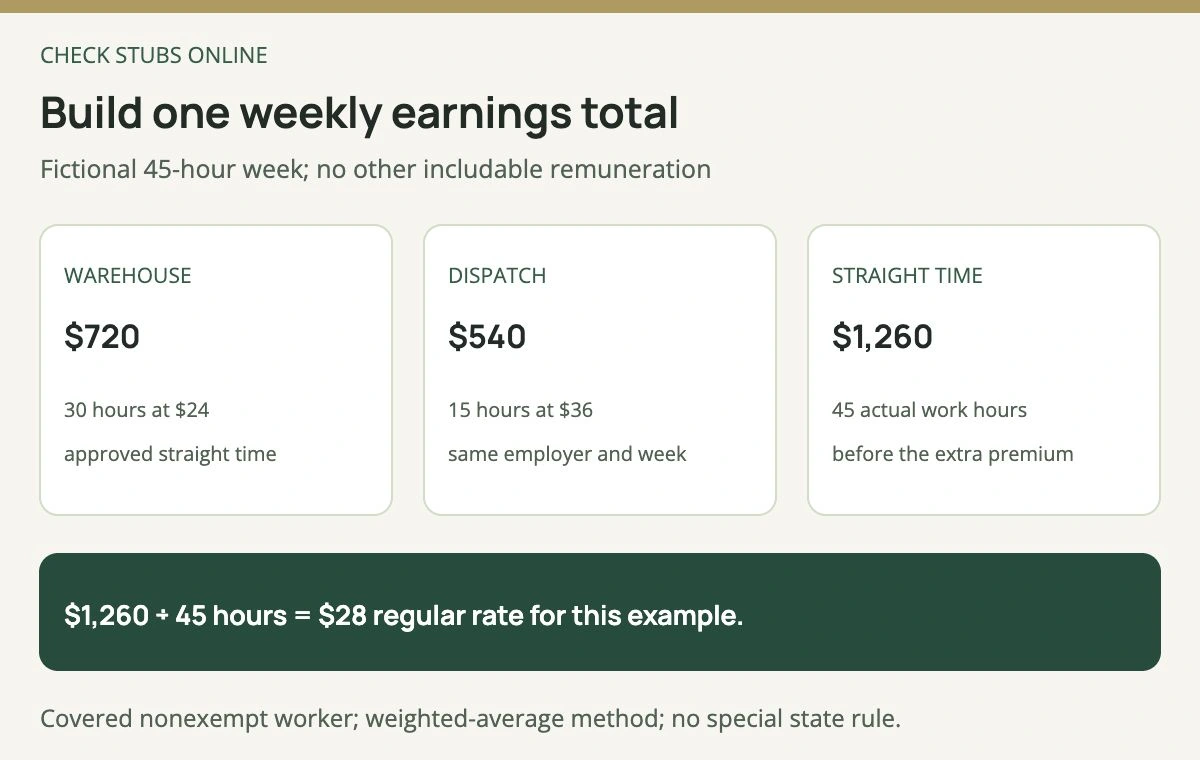
The denominator is the 45 actual work hours in this assumed week, including the five that also generate an extra overtime premium.
## Why is the extra premium $70 rather than another full overtime payment?
The $1,260 straight-time total already pays all 45 hours once. Under these assumptions, another half of the $28 regular rate is due for each of the five overtime hours. Five × $14 gives the $70 addition. Adding five × $42 on top of all 45 straight-time hours would count their straight-time component again.
A statement may show a premium-only row, or it may allocate straight-time and premium portions among job lines. Ask which representation is being used before comparing one row with an expected full overtime rate. The complete hours and gross total matter more than a universal label.
Using half of the $24 job rate would produce only $60 of extra premium here, $10 below the illustrated $70. Using half of $36 would give $90. A higher contractual payment can be permitted; a different result also may reflect a qualified method. Neither shortcut establishes the ordinary weighted calculation under this example’s facts.
## An 80-hour paycheck can still include weekly overtime
Continue the illustration with a separate second workweek of 35 hours, all at $24. It produces $840 straight time and no ordinary federal weekly overtime under these assumptions. The first week still contains 45 hours and its $70 extra premium. The pay-period hours total 80, but averaging the two weeks to 40 each would erase a real part of the stated calculation.
**Two-week statement with separate workweek checks**
| Workweek | Worked hours | Gross pay |
| --- | --- | --- |
| Mixed-rate first week | 45 | $1,330.00 |
| Second week at $24 | 35 | $840.00 |
| Pay period total | 80 | $2,170.00 |
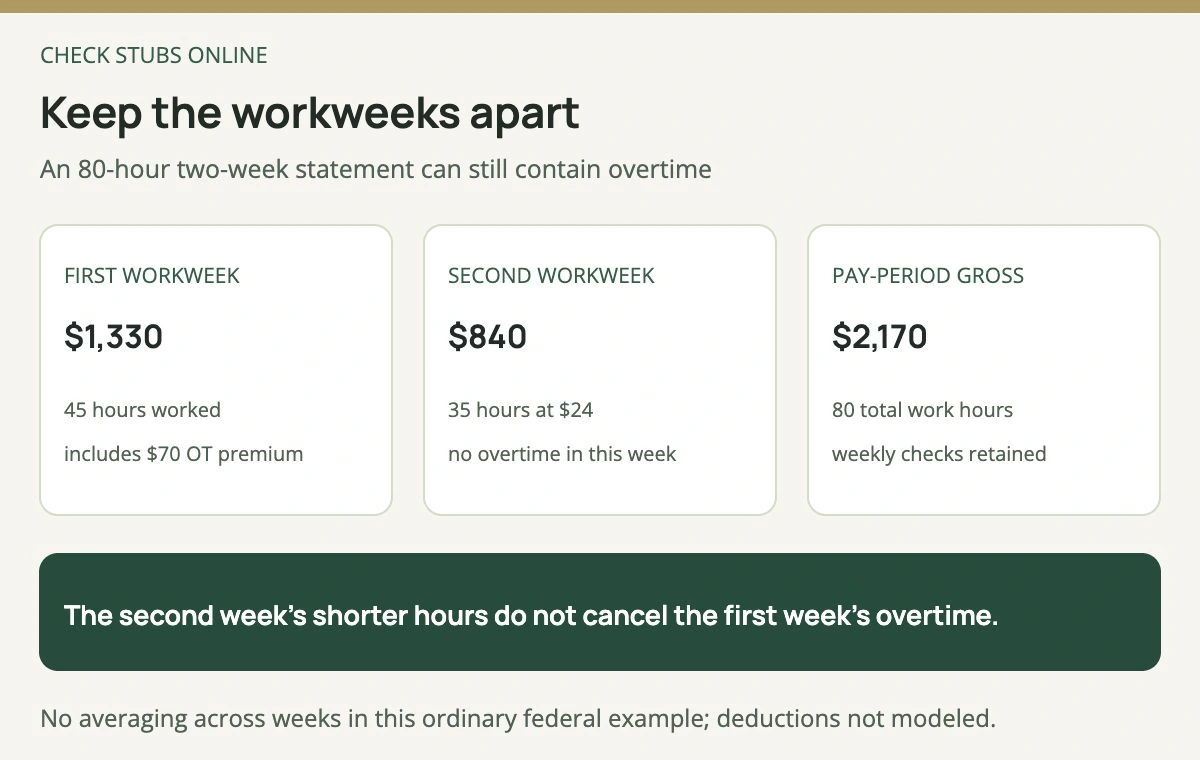
The example adds already checked weekly gross amounts. It does not calculate taxes or predict the bank deposit.
The displayed $2,170 is compensation before employee deductions. Federal withholding, FICA and other entries need their own supported wage bases and elections. Use our [gross-to-net reconciliation guide](https://blog.checkstubsonline.com/gross-vs-net-pay) after the earning calculation is resolved; do not change a wage rate to force a preferred net figure.
## What if payroll says it uses the rate for the overtime job?
Ask for the method and its conditions. [29 CFR 778.419](https://www.ecfr.gov/current/title-29/subtitle-B/chapter-V/subchapter-B/part-778/subpart-E/section-778.419) describes a conditional federal arrangement involving different kinds of work, genuine rates and an agreement reached before performance of the work, together with other requirements. A payroll screen that selects a job rate does not establish those conditions by itself.
Do not assume the example settles a collective agreement, prevailing-wage job, special public-safety schedule, exempt position or a state daily-overtime requirement. Ask which rule applies and have the actual calculation reviewed when the explanation depends on one of those cases. This article demonstrates the stated ordinary method, not every permitted arrangement.
## Ask payroll about one complete workweek
A focused inquiry identifies the employer, week, job codes and source hours: “For the identified workweek, my time record shows 30 hours at $24 and 15 at $36. Under the weighted method, I calculate $1,260 straight time, a $28 regular rate and $70 extra premium. Please confirm the actual method, any other included earnings and how the statement presents the premium.” These are fictional figures; replace them with your own supported details.
Keep the response, original statement and any authorized correction together. Our [pay-stub correction checklist](https://blog.checkstubsonline.com/pay-stub-errors-correction) helps connect a revised wage amount with its payment. An extra gross amount need not equal the extra deposit after actual deductions.
If you are authorized to prepare the resulting statement, compare the [pay stub maker’s supported fields](https://www.checkstubsonline.com/pay-stub-maker) with the approved mixed-rate register before choosing a layout. Preserve each rate and the meaning of the premium. Where a workflow cannot represent the actual case, use an appropriate process rather than combining unlike earnings into a misleading row.
## Two-rate overtime questions
### Does each department get its own 40-hour allowance?
Not under this ordinary single-employer example. Combine the relevant worked hours within the established workweek before checking the overtime threshold.
### Should I always use the higher hourly rate?
The illustrated weighted method uses total includable earnings divided by work hours. A more generous policy or qualified alternative requires its own explanation.
### Does a premium-only row need to show five more worked hours?
It can reference the same five hours already paid at straight time. Do not count a premium reference as five additional hours actually worked.
### Can a single-rate estimate prove the mixed-rate calculation is correct?
No. Check the week’s full remuneration, hours and actual method. A calculator setting does not establish legal coverage or validate source records.
The Check Stubs Online Editorial Team reviewed current official federal guidance and the latest available eCFR title-29 issue, dated November 23, 2026. The job-rate, premium-only and separate-workweek ledgers are original fictional examples checked independently.
## Relevant document tool
Start with the official federal overtime guidance
Review the covered-employee workweek framework, then request the employer’s actual hours, rates and calculation method.
[Review DOL overtime guidance](https://www.dol.gov/agencies/whd/overtime)
Federal information does not classify a particular worker or replace a state-law, agreement or payroll review.
## Related guides
- [Weekend Differential Pay: Rates, Hours and Overtime](https://blog.checkstubsonline.com/weekend-differential-pay)
- [Nondiscretionary Bonuses and Overtime: Check Your Regular Rate](https://blog.checkstubsonline.com/bonus-overtime-regular-rate)
- [Does Holiday Pay Count Toward Overtime? Worked vs. Paid Hours](https://blog.checkstubsonline.com/holiday-pay-count-toward-overtime)