---
title: "Unemployment Pay Stubs: How to Get Official Payment Records"
description: "Download or print official unemployment payment history. Review state examples, PDF checks, missing copies and the difference between benefit records and Form 1099-G."
url: "https://blog.checkstubsonline.com/unemployment-pay-stubs-payment-records"
datePublished: "2026-10-09"
dateModified: "2026-11-04T23:50:08Z"
---
# Unemployment Pay Stubs: How to Get Official Payment Records
Download or print official unemployment payment history. Review state examples, PDF checks, missing copies and the difference between benefit records and Form 1099-G.
Published: 2026-10-09 · Updated: 2026-11-04T23:50:08Z
By [Check Stubs Online Editorial Team](https://blog.checkstubsonline.com/editorial-policy#editorial-team)
**To get unemployment pay stubs, download or print official payment history from the state agency that paid your benefits.** Select the required dates and review the payment details and identification before sharing. Unemployment benefits do not produce an employer wage stub; the annual tax record is generally Form 1099-G. The requesting organization decides which records it needs.
U.S. unemployment insurance records · Reviewed October 10, 2026. Portal labels and document requirements vary by state and recipient.
## In this guide
1. [Download, print or request payment-history copies](#unemployment-print-download)
2. [What is an unemployment pay stub?](#what-is-an-unemployment-pay-stub)
3. [Choose the right record](#choose-the-right-record)
4. [Get your payment history](#get-your-payment-history)
5. [Read the payment details](#read-the-payment-details)
6. [Example: benefits versus the deposit](#benefit-to-deposit-example)
7. [Payment history versus Form 1099-G](#payment-history-and-1099-g)
8. [Missing or incorrect records](#missing-or-incorrect-records)
9. [Prepare proof of unemployment income](#prepare-proof-of-income)
10. [Frequently asked questions](#frequently-asked-questions)
## How do I download or print unemployment pay stubs?
What people call an unemployment “pay stub” is usually the paying agency's payment history or benefit statement. Start in that agency's official claimant account. Choose the period the recipient needs, open the payment details and use the available download or printable view. Do not substitute a recreated wage statement for agency records.
1. **Choose the right record.** Recent payment history answers a different question from an annual tax statement or a notice showing a possible weekly award.
2. **Select the required dates.** Include each relevant paid week and any displayed withholding or offset. A pending week is not a completed payment.
3. **Open the printable or download view.** If the agency provides a printable page, use the browser's Print command. A Save as PDF option may be available on your device; it is not a feature every agency labels the same way.
4. **Review every page before sharing.** Check the name or account identification available on the record, agency, period, amounts and payment status. If identification is absent, ask the recipient which additional official record it accepts.
5. **Request missing copies from the agency.** If account access or an older period is unavailable, ask for the specific date range and type of record. A bank deposit alone may not explain the benefits paid.
[Minnesota's official printing instructions](https://mn.gov/uimn/applicants/getpaid/print-payment-history/) provide a concrete example: select View and Maintain My Account, then Payment Information, enter the date range, open the printable version and use the browser's print function. These labels describe Minnesota's service, not a universal national portal.
**Looking for an unemployment W-2?** For unemployment compensation, the annual federal tax record is generally [Form 1099-G](https://www.irs.gov/individuals/employees/unemployment-compensation), rather than an employer's W-2. Request payment history for individual payments and the 1099-G for the applicable tax year. Our [guide to obtaining a copy of a 1099](https://blog.checkstubsonline.com/get-copy-of-1099-online) covers that separate retrieval task.
## What is an unemployment pay stub?
An unemployment pay stub is a common informal name for a record of unemployment benefits. Your state may call the actual document a payment history, payment detail, benefit statement, or benefits letter. The important question is what the record shows and who issued it, rather than whether its heading says “pay stub.”
An employer’s pay stub records compensation for work. An unemployment payment record comes from the benefits agency and records payments on your claim. A former employer can help with old wage records, but the paying agency is the source for your unemployment payment history.
For example, California’s Employment Development Department (EDD) lets claimants review the issue date, amount paid, and payment status in UI Online. New York’s Department of Labor directs claimants to a separate payment-history page in its unemployment services account. These are agency records of benefits, rather than new payroll statements from a previous job. See [EDD’s payment-status guide](https://edd.ca.gov/en/unemployment/ui_payment_information/) and [New York’s payment-history instructions](https://dol.ny.gov/unemployment-insurance-top-frequently-asked-questions).
## Which unemployment record do you need?
Start with the request you are trying to satisfy. “Show the last month’s payments” and “show the annual amount reported for taxes” call for different records. Keep the original agency documents, even when you also prepare a short explanation of the figures.
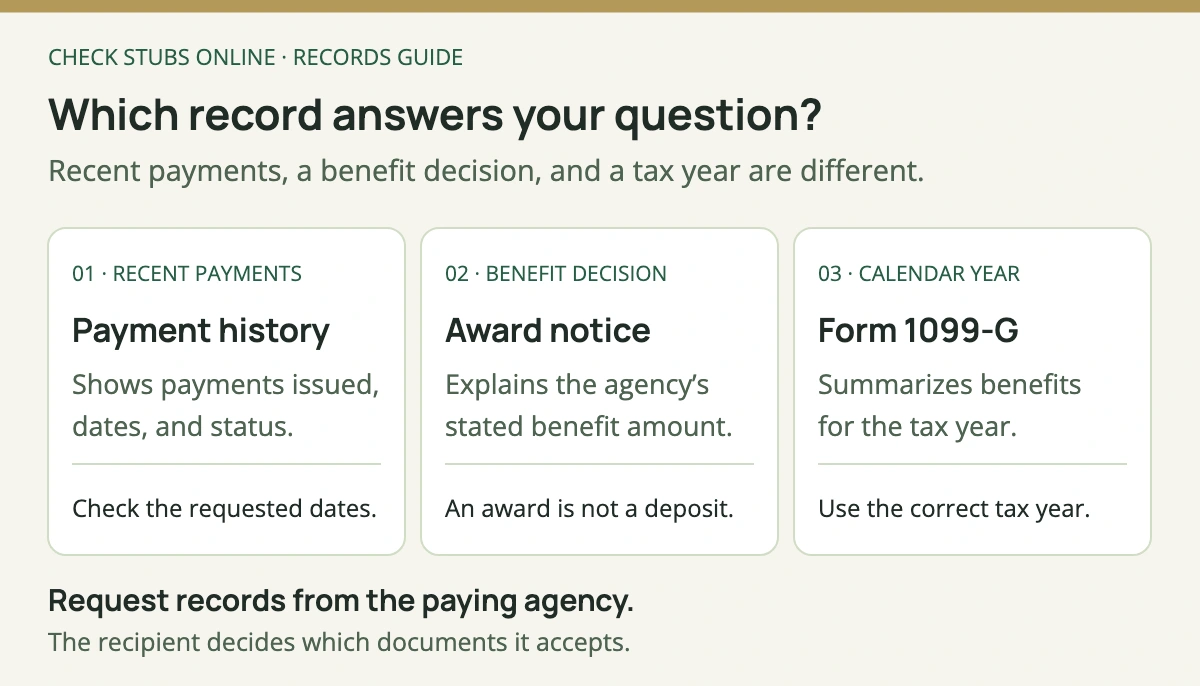
Match the document to the question. An award amount, an issued payment, and an annual tax total describe different things.
**What each record can help explain**
| Record | Useful for | What to check |
| --- | --- | --- |
| Agency payment history | Benefits issued over a selected period | Dates, amounts, adjustments, and status. Confirm whether amounts are before or after withholding. |
| Award or determination notice | The agency’s decision and stated benefit amount | A stated weekly amount alone does not establish that every week was paid or that future payments are guaranteed. |
| Agency benefits letter | A recipient’s request for a named, agency-issued explanation | The letter’s date, amount, coverage period, and any duration information the recipient requires. |
| Bank or benefit-card statement | Matching an issued payment to money received | Deposits may be net of withholding or adjustments. The statement alone may not explain the gross benefit. |
| Form 1099-G | Unemployment compensation reported for a calendar year | The tax year and relevant boxes. It is not a week-by-week record of current benefits. |
| Pay stub from a job | Employment earnings for that job’s pay period | Keep wage income separate from unemployment benefits, including when both occur during the same month. |
Acceptance depends on the organization reviewing your documents. As one specific example, [HealthCare.gov’s income-document guidance](https://www.healthcare.gov/help/how-do-i-resolve-an-inconsistency/) lists an unemployment benefits letter containing your name, the agency, the benefit amount, and duration, including start and end dates if applicable. That Marketplace requirement does not establish what a landlord, lender, or another program will accept.
## How to get your unemployment payment history
1. **Identify the agency paying your claim.** Use the agency named on your official claim correspondence. If you need to locate it, start with the [U.S. Department of Labor’s unemployment insurance resources](https://www.dol.gov/general/topic/unemployment-insurance). Follow the official agency’s account link rather than a link in an unexpected message.
2. **Sign in to your benefits account.** Open the payment history, payments, or payment activity area. A claims or certifications screen may show weeks you requested, including weeks that have not been paid.
3. **Select the requested period.** If the portal offers a date filter, set it to the dates the recipient asked for. Open individual payment details when the overview does not explain withholding or adjustments.
4. **Save the agency’s record.** Use its download or print option if available. If you use your browser’s Print → Save as PDF, check the preview: your name, agency, relevant dates, amounts, and status should be readable. A saved portal page is not automatically a certified benefits letter.
5. **Request a letter when necessary.** If the recipient requires an agency-issued letter, a signature, or information the portal does not show, contact the agency through its official support channel and describe the exact requirement.
### California: UI Online
Sign in through myEDD and open UI Online. EDD’s payment-status help describes **Payment Activity** and the **Details** link for a particular week. Its tax-information help describes **Payments**, followed by a date range for payment history. Labels can differ as screens change; follow the agency’s current instructions for the screen you see. Use payment details for the calculation and claim history for certification status. See [Get Payment Status](https://edd.ca.gov/en/unemployment/ui_payment_information/) and [EDD’s payment-history and tax-record instructions](https://edd.ca.gov/en/unemployment/Get_Tax_Information_Form_1099G/).
### New York: View Payment History
Sign in with your NY.gov ID. On **My Online Services**, select **Unemployment Services**, then **View Payment History**. New York’s official FAQ describes this as the place to find the complete record of unemployment insurance benefit payments. If you need a replacement agency letter, the same FAQ explains how to request one through a secure account message. See [New York’s unemployment FAQ](https://dol.ny.gov/unemployment-insurance-top-frequently-asked-questions).
### If you cannot access the account
Use the agency’s account-recovery or contact instructions. Specify whether you need recent payment history, older records, a benefits letter, or a replacement 1099-G; these requests are not interchangeable. Give the requested date range through the agency’s secure channel. Do not give another person your password or one-time verification code to retrieve the record for you.
## How to read an unemployment payment record
Check these fields together before adding the amounts:
- **Benefit week:** The week the payment relates to. This is different from the day the agency issues it.
- **Payment or issue date:** When the agency issued the benefit. Your bank may show a different posting date.
- **Benefit amount before adjustments:** The gross amount for the paid period, when shown. Do not assume the largest number on the account is the payment; it may be an award amount or remaining claim balance.
- **Withholding and other adjustments:** Amounts deducted or applied elsewhere. Read the detail labels rather than treating every difference as income tax.
- **Amount paid and status:** What was issued and whether the entry is paid, pending, cancelled, or another status. A certification receipt does not by itself confirm a payment.
Not every portal presents these fields in the same way. If its summary says “amount paid,” use the details or ask the agency whether that figure is gross or net. EDD’s [UI Online FAQ](https://edd.ca.gov/en/unemployment/FAQ_-_UI_Online/) explains that detailed payment information can include reported wages, overpayments, and voluntary federal tax withholding.
A zero deposit needs context. For example, EDD distinguishes a pending certification from a payment applied entirely or partly to an overpayment. Neither should be described as an ordinary cash deposit. Match the status to its agency explanation and preserve any related notice. See [EDD’s payment-status definitions](https://edd.ca.gov/en/unemployment/ui_payment_information/).
## Example: why $840 in benefits can become a $756 deposit
**Fictional example:** A claimant has two paid weeks of unemployment benefits at $420.00 per week. They elected 10% voluntary federal income tax withholding, effective for both payments. Assume no state withholding, support deductions, overpayment offsets, or other adjustments. This is a reconciliation example, not an estimate of anyone’s benefit entitlement.
**Two paid weeks with 10% federal withholding**
| Paid period | Gross benefit | Federal tax withheld | Net payment |
| --- | --- | --- | --- |
| Week A | $420.00 | $42.00 | $378.00 |
| Week B | $420.00 | $42.00 | $378.00 |
| Two-week total | $840.00 | $84.00 | $756.00 |
For each week, $420.00 × 10% = $42.00 withheld, leaving $378.00. If the two net payments arrive together, the bank shows $756.00. That deposit does not mean the gross benefits were only $756.00. Keep the two weekly detail entries and the matching deposit record; do not count the combined deposit as another benefit payment.
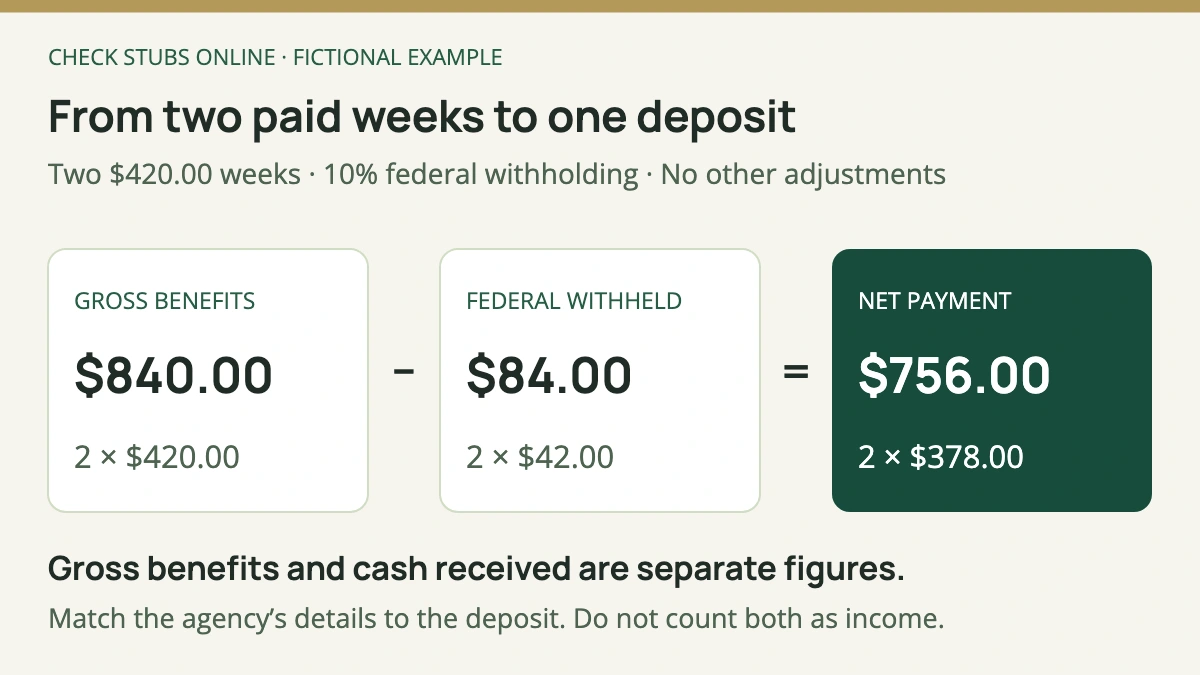
Two weekly payments can reconcile to one deposit. Use the agency’s actual payment details, rather than assuming every deposit covers one week.
The [IRS’s Form W-4V, revised January 2026](https://www.irs.gov/pub/irs-pdf/fw4v.pdf), specifies a 10% voluntary federal withholding rate for unemployment compensation. The form’s other percentage choices apply to other listed payments, not unemployment compensation. Give a withholding request to the payer, using its own form when it provides one, and confirm when withholding will start. The amount withheld is a tax payment; it does not establish your final tax liability.
## Payment history versus Form 1099-G
**Payment history explains individual payments; Form 1099-G reports unemployment compensation for a calendar year.** Under the [IRS’s unemployment compensation guidance](https://www.irs.gov/individuals/employees/unemployment-compensation), Box 1 reports unemployment compensation and Box 4 reports federal income tax withheld. Unemployment compensation is generally included in federal taxable income; this guide is about obtaining records, not calculating a tax return.
Extend the fictional example to exactly eight paid weeks, all paid within the same calendar year at $420.00 per week, each with 10% federal withholding and no other benefits or adjustments:
**Eight-week example: gross, tax, and cash are separate totals**
| Calculation | Amount | Record to compare |
| --- | --- | --- |
| 8 × $420.00 gross benefits | $3,360.00 | Form 1099-G, Box 1 |
| 8 × $42.00 federal withholding | $336.00 | Form 1099-G, Box 4 |
| 8 × $378.00 net payments | $3,024.00 | Matching deposits, assuming all were received |
Those figures would describe the entire year only if these were the claimant’s only unemployment payments that year. Include other payments and review adjustments before comparing your real records. A bank-deposit total by itself is not the Box 1 total.
For proof of benefits paid during 2026, retrieve current payment history. A completed 2026 annual tax statement follows the end of the year; a prior-year 1099-G does not document new 2026 payments. New York’s after-filing FAQ explains that its annual 1099-G can be viewed in January for benefits received during the previous calendar year. Check the issuing agency’s guidance for that year’s access and delivery details. See [New York’s tax-record FAQ](https://dol.ny.gov/postappFAQ).
If benefit weeks, issue dates, and bank posting dates cross December and January, do not assign a tax year from the benefit-week label alone. Review the paying agency’s annual statement and reporting instructions. EDD specifically explains that its benefits are taxed according to the payment’s issue date.
## What if records are missing or incorrect?
### The PDF has amounts but no name
Return to the agency’s print or statement view and check whether it includes identifying information. If it still does not meet the recipient’s request, ask the agency for a benefits letter. Keep the original history as supporting detail. Do not type your name onto the agency’s statement and present the altered file as its original document.
### A week is pending or unpaid
Show the actual status when relevant to the request. Do not add a pending amount to paid income just because the weekly award lists that amount. For a current payment question, follow the state agency’s status and support instructions; a tax form cannot resolve a pending claim.
### A payment does not match the deposit
First compare the same date range. Check whether one deposit combines several weeks, whether withholding or an offset explains the difference, and whether a payment was reissued. Make a list of the agency’s issue dates, amounts, statuses, and the corresponding bank entries. Send any unresolved discrepancy to the agency through its official contact channel.
### The 1099-G appears wrong, or benefits were claimed in your name
The [IRS directs recipients to contact the state agency](https://www.irs.gov/individuals/employees/unemployment-compensation) about an incorrect unemployment amount. If the form lists benefits you did not receive because of identity theft, report the problem to the issuing state and request a corrected 1099-G. Follow the [IRS’s specific unemployment identity-theft instructions](https://www.irs.gov/identity-theft-fraud-scams/identity-theft-and-unemployment-benefits), rather than treating a fraudulent amount as your income or editing the form yourself.
### You repaid benefits or had an overpayment offset
Keep the overpayment notice, repayment confirmation, payment details, and any corrected annual statement together. A cash repayment and a benefit withheld to repay a debt are different transactions. Follow the agency’s annual reporting guidance and applicable IRS instructions; do not assume subtracting a repayment from bank deposits produces the correct tax figure. EDD’s [tax-information page](https://edd.ca.gov/en/unemployment/Get_Tax_Information_Form_1099G/) addresses repayments and offsets separately.
## How to prepare proof of unemployment income
Before sending documents, ask the recipient:
- Which records are acceptable: payment history, a benefits letter, an annual tax form, or a combination?
- What date range is required, and does it mean benefit weeks or payment dates?
- Should the amount be gross benefits or cash received after deductions?
- Must the record show benefit duration or a current claim decision?
- Which identifying details must remain visible, and where should the files be uploaded securely?
Then collect the requested agency records. Add matching bank entries only if requested or needed to explain the payment. If you also earned wages, provide those employment records separately and label each income source. Avoid treating an award amount as recurring income for a full year without evidence about the paid weeks and benefit duration.
Keep an unaltered original for your records. Where the recipient permits redaction, hide unrelated transactions, full account numbers, or unnecessary identifiers on a separate sharing copy. Preserve the name, agency, dates, and amounts needed for verification. Check that redaction actually removes sensitive text rather than covering it with a removable shape.
An optional cover note can explain an otherwise confusing deposit:
> “The attached agency history shows two paid weeks of $420.00 each. Federal withholding was $42.00 per week. The combined net payment was $756.00, which matches the attached deposit. These are fictional figures used to illustrate the explanation.”
For your own note, replace that example with the exact figures and dates in your records and remove the fictional-example sentence. The note explains the documents; it does not replace them or guarantee acceptance.
## Frequently asked questions
### Can I use a pay stub generator for unemployment benefits?
A generated employment pay stub is not an agency-issued unemployment record. Request official benefit payment history or a benefits letter from the state paying your claim. If you also have employment earnings, document those separately using the actual wage records.
### Is a bank statement enough to prove unemployment income?
Ask the recipient. A statement can show a deposit, but it may not explain the gross benefit, covered weeks, withholding, or current benefit duration. Agency payment history or a benefits letter can supply information the bank record lacks.
### Can my former employer issue my unemployment payment statement?
Request unemployment payment records from the paying agency. Your former employer’s payroll records document that job’s earnings, which can be useful for a separate wage-history request but do not replace the agency’s benefit history.
### Where do I find an old unemployment 1099-G?
Check the paying agency’s tax-document section, using the correct year. If the form is unavailable online, follow its replacement-copy instructions. Online access periods vary, so request older records directly if the year you need is missing.
### What if I receive unemployment and part-time wages?
Keep the employer’s wage statement and agency benefit history as separate records. Do not combine them into a single employment pay stub. Follow your state’s instructions for reporting work and wages; the benefit amount actually paid may differ from the original weekly award.
**About this guide:** Prepared by the Check Stubs Online Editorial Team using the linked agency and IRS sources. Examples and diagrams are original and fictional. State-specific eligibility decisions and document acceptance remain with the responsible agency or recipient. Read our [editorial policy](https://blog.checkstubsonline.com/editorial-policy).
## Related guides
- [How to Get a Copy of Your 1099 Online: Payer and IRS Options](https://blog.checkstubsonline.com/get-copy-of-1099-online)
- [1099-G Online: Review Government Payments and Refund Years](https://blog.checkstubsonline.com/1099-g-online-government-payment-guide)
- [Do Part-Time Employees Get Benefits? A Pay Stub Guide](https://blog.checkstubsonline.com/part-time-employee-benefits-pay-stub)