---
title: "Uniform Deductions on a Paycheck: Minimum Wage and Overtime Checks"
description: "Check required uniform and equipment deductions using original workweek examples, federal wage protections, cash-purchase rules and a practical correction checklist."
url: "https://blog.checkstubsonline.com/uniform-deductions-paycheck"
datePublished: "2026-11-27"
---
# Uniform Deductions on a Paycheck: Minimum Wage and Overtime Checks
Check required uniform and equipment deductions using original workweek examples, federal wage protections, cash-purchase rules and a practical correction checklist.
Published: 2026-11-27
By [Check Stubs Online Editorial Team](https://blog.checkstubsonline.com/editorial-policy#editorial-team)
**An employer-required uniform or equipment cost cannot reduce a covered employee’s pay below the applicable FLSA minimum or take away required overtime compensation.** Paying the employer in cash instead of using a payroll deduction does not avoid those protections. State law, agreements and other deduction rules can be more protective, so a federal arithmetic check is only a starting point.
Reviewed November 27, 2026 · Federal wage-hour review for covered, nonexempt employees. Examples assume the ordinary $7.25 federal minimum, no tips or credits, no special subminimum arrangement and no additional earnings. They do not approve a deduction under state law or an employment agreement.
“Uniform” can mean an actual purchase, cleaning cost, deposit, rental charge or repayment for missing property. Identify the charge and the workweek it affects before dividing the bank deposit by hours. Payroll taxes and required job costs are different kinds of reduction and should not be tested as though they were interchangeable.
## In this guide
1. [Identify the charge and requirement](#uniform-type)
2. [Check an original federal floor example](#uniform-floor)
3. [Protect overtime in a separate example](#uniform-overtime)
4. [Check cash purchases and installment charges](#uniform-cash)
5. [Review stronger rules and other deductions](#uniform-state)
6. [Request records and a correction](#uniform-request)
7. [Prepare the statement after the decision](#uniform-preparer)
8. [Uniform deduction questions](#uniform-faq)
## Which costs are you actually being asked to pay?
[DOL Fact Sheet 16](https://www.dol.gov/agencies/whd/fact-sheets/16-flsa-wage-deductions) treats a required uniform’s cost and maintenance as an employer business expense for these wage protections. It also addresses other items primarily benefiting the employer, including work tools and specified business losses. A charge can raise the same federal issue whether the employer requires the uniform by policy, the work’s nature requires it, or another law requires it.
The currently served fact sheet is labeled revised July 2009. It remains the DOL’s published explanation, reviewed here alongside its current minimum-wage page and overtime guidance; this article does not imply a new 2026 revision of the fact sheet.
**Records to identify behind a uniform or equipment charge**
| Possible entry | Information to request | Why it matters |
| --- | --- | --- |
| Uniform purchase or rental | Required items, invoice, ownership and amount. | An ordinary clothing purchase and an employer-required uniform need their actual facts. |
| Cleaning or maintenance | Required care, actual cost and reimbursement arrangement. | Maintenance can impose a required job cost even without a uniform purchase deduction. |
| Equipment or tools | Work requirement, item, price and who retains it. | A work-related expense cannot be ignored merely because it is called equipment. |
| Deposit or missing-property charge | Written terms, actual recovery and any later refund. | A deduction label does not establish a lawful debt or refund. |
Do not assume that signing a policy settles the wage test. Nor does an allegation of negligence remove the minimum-wage and overtime restrictions described by DOL. If the item is disputed, keep that issue separate from whether payroll properly protected the required wages.
## Original 35-hour example: combine required job costs before testing the floor
Assume a covered employee works 35 hours at $8 an hour in one workweek. There is no overtime, tip credit, bonus or special pay arrangement. For this deliberately limited federal example, use the ordinary $7.25 minimum shown on the [DOL minimum-wage page](https://www.dol.gov/agencies/whd/minimum-wage).
The employer requires $42 for a uniform, $12 for work tools and $8 for specified uniform maintenance in that week. Assume all three are employer-benefit costs covered by this analysis. Their combined amount is $62; testing each item separately would miss the total effect.
**Original one-workweek federal minimum-wage comparison**
| Measure | Calculation | Amount |
| --- | --- | --- |
| Gross straight-time wages | 35 × $8.00 | $280.00 |
| Ordinary federal floor | 35 × $7.25 | $253.75 |
| Difference before required costs | $280 − $253.75 | $26.25 |
| Required job costs | $42 + $12 + $8 | $62.00 |
| Wages after those costs | $280 − $62 | $218.00 |
| Shortfall against this floor | $253.75 − $218 | $35.75 |
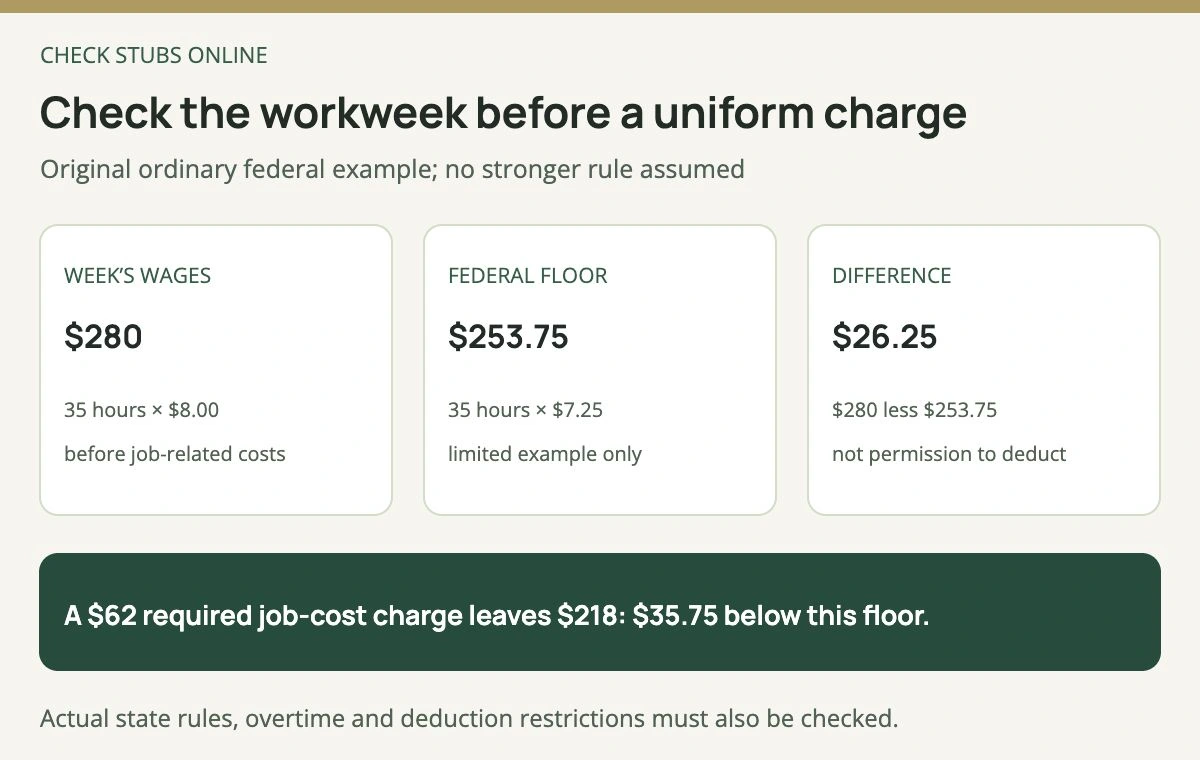
The $26.25 difference is not a legal authorization. This example omits potentially stronger state and other requirements.
The $62 charge fails this limited federal floor check. Requiring the employee to buy the same items personally would not solve that problem. The calculation compares wages and required costs before ordinary tax withholding; it is not a prediction of the bank deposit or the employee’s taxable wage base.
If a more protective minimum or reimbursement rule applies, the employer must evaluate that as well. Even a smaller charge fitting inside the $26.25 difference is not automatically permissible. Identify applicable law and any required deduction authorization before calling it allowed.
## A separate 44-hour example: do not test only straight-time minimum wages
[DOL Fact Sheet 23](https://www.dol.gov/agencies/whd/fact-sheets/23-flsa-overtime-pay) describes the ordinary federal overtime rule for covered nonexempt workers and the workweek basis. Hours from different workweeks cannot be averaged to avoid overtime. Actual regular-rate adjustments can matter; this simple illustration has none.
Assume another employee works 44 hours in one workweek at a $7.25 regular rate. Straight-time compensation for every hour is 44 × $7.25 = $319. Four overtime hours require an additional half-rate premium: 4 × $3.625 = $14.50. Total required compensation is $333.50 before the ordinary payroll tax lines.
**Separate original overtime week at the ordinary federal minimum**
| Step | Calculation | Amount |
| --- | --- | --- |
| All-hours straight time | 44 × $7.25 | $319.00 |
| Extra overtime premium | 4 × 0.5 × $7.25 | $14.50 |
| Total required wages | $319 + $14.50 | $333.50 |
| Proposed required uniform charge | Employer-benefit cost | −$20.00 |
| After that charge | $333.50 − $20 | $313.50 |
| Shortfall against required wages | $333.50 − $313.50 | $20.00 |
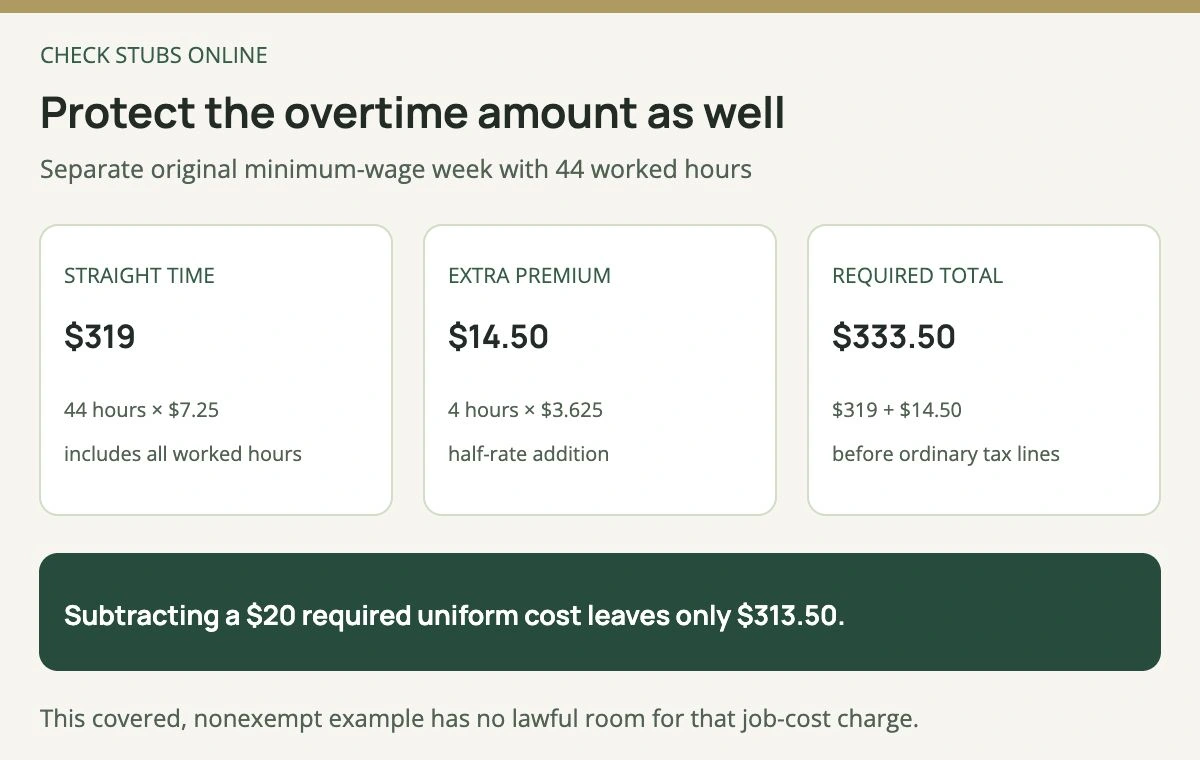
The half-rate method starts with straight time for all 44 hours. Do not add another full 1.5-rate payment on top of that starting amount.
This employee has no room for the $20 required charge in the stated case. The employer cannot justify it by pointing to a separate, better-paid week or a signed consent. A different job’s regular rate, overtime exclusions and applicable state rules need their own calculation; this example is not a universal maximum-deduction formula.
Use the [multiple-rate overtime guide](https://blog.checkstubsonline.com/two-hourly-rates-overtime) if a worker has more than one established hourly rate. Do not substitute a simple rate from this illustration when the real regular-rate calculation includes other compensation.
## Cash purchases and installment deductions still affect the review
Fact Sheet 16 says an employer cannot sidestep the protections by demanding a cash payment rather than a wage deduction. Keep receipts for a required purchase from a store or supplier as well as any amount paid directly to the employer.
DOL allows uniform costs to be spread across paydays only when the resulting treatment protects required minimum wages and overtime in every workweek. That is not permission to divide a bill into any convenient installment. Workweeks with fewer hours, a different wage floor or overtime may require a different review.
For a biweekly paycheck, obtain the two separate workweek calculations. A combined pay-period gross total can hide a shortfall in one week. A later reimbursement should also be recorded with its dates and purpose; do not assume that calling an earlier charge a deposit resolves a wage deficiency automatically.
## Federal compliance is not the whole deduction decision
The DOL minimum-wage page explains that employers must comply with applicable federal and state requirements, and state law can offer greater protection. The $7.25 examples here do not establish the rate or reimbursement obligation for a particular location. Confirm the relevant state and local rules, worker category and industry before authorizing a charge.
Contracts, collective bargaining terms and employer promises may create additional questions. A uniform charge, tax withholding, garnishment and voluntary benefit contribution also have different rules. Read the [paycheck deduction overview](https://blog.checkstubsonline.com/mandatory-paycheck-deductions) to organize the categories without treating one category’s authority as permission for another.
The employee’s final paycheck deserves the same careful review. A missing item or unreturned uniform does not by itself decide whether a final-wage deduction is permitted. The [final-paycheck guide](https://blog.checkstubsonline.com/final-paycheck-after-quitting) explains why timing, amounts owed and contested recovery should be checked separately.
## How to ask payroll for an explanation or correction
1. **Identify the exact charge.** Ask what was required, who benefited and which invoice or policy supports it.
2. **Collect all payments.** Include paycheck deductions, cash paid and required outside purchases for the relevant week.
3. **Obtain the workweek records.** Match hours, ordinary wages, overtime and other regular-rate components.
4. **Request the legal basis.** Ask which applicable wage and deduction rules were used, including stronger state protections.
5. **Keep the correction record.** Retain any explanation, refund, revised statement and the period it corrects.
A focused request could say: “My 35-hour week shows $280 gross and $62 of required job costs. Please explain how those costs were reviewed against the applicable wage floor and provide any correction.” Replace the example with supported records. Do not send unrelated identity or bank details when a redacted statement and receipt will answer the question.
If the issuer agrees the record is wrong, follow the [payroll correction checklist](https://blog.checkstubsonline.com/pay-stub-errors-correction). If it remains unresolved, the DOL fact sheet provides Wage and Hour Division contact information; the appropriate state agency may also be relevant. An educational calculation is not an agency determination or a guarantee of recovery.
## Record the decided payroll treatment clearly
An authorized preparer should preserve actual hours and gross earnings, identify each supported deduction, distinguish a refund from new wages, and show the resulting net amount accurately. Make the legal and accounting decision before entering a charge into a template. A calculation tool cannot supply missing authorization, decide an employment dispute or replace the employer’s correction.
Keep any deductions and reimbursements tied to the genuine transaction and corrected records. Do not lower recorded hours or an agreed pay rate merely to make a uniform charge disappear from the statement.
## Uniform and equipment deduction questions
### Can a signed uniform agreement override minimum wage?
It does not remove the FLSA protections described here. Other authorization and state-law issues remain separate.
### What if I buy the required uniform myself?
A required outside purchase can still impose the employer-benefit cost. DOL says using a cash payment instead of a payroll deduction does not avoid the wage protections.
### Should I divide my bank deposit by hours to test compliance?
No. Separate ordinary withholding, job costs and the applicable workweek wage calculation. The deposit alone does not establish that analysis.
### Can the employer charge everything in a better-paid week?
Do not assume so. Each relevant workweek, overtime protection, applicable wage floor and other deduction or reimbursement rules must be satisfied.
Current DOL pages were used to review the federal scope and workweek protections. The 35-hour combined-cost example and separate 44-hour overtime ledger are original illustrations, with state and specialized arrangements expressly left for their applicable rules.
## Relevant document tool
Review the federal deduction protections
Identify required uniform, maintenance and equipment costs, then check the applicable workweek wage and overtime rules before recording a charge.
[Read DOL deduction guidance](https://www.dol.gov/agencies/whd/fact-sheets/16-flsa-wage-deductions)
Federal illustrations do not approve a charge under state law, a contract or a particular payroll arrangement.
## Related guides
- [Overtime With Two Hourly Rates: Paycheck Checks](https://blog.checkstubsonline.com/two-hourly-rates-overtime)
- [Mandatory Paycheck Deductions: What Is Required and How to Check It](https://blog.checkstubsonline.com/mandatory-paycheck-deductions)
- [Pay Stub Errors: How to Request and Track a Correction](https://blog.checkstubsonline.com/pay-stub-errors-correction)