---
title: "Wage Garnishment on a Pay Stub: Why the Amount Changes"
description: "Understand ordinary wage-garnishment entries, disposable earnings and federal ceilings. Follow checked weekly examples and reconcile orders, deductions and net pay."
url: "https://blog.checkstubsonline.com/wage-garnishment-pay-stub"
datePublished: "2026-11-22"
---
# Wage Garnishment on a Pay Stub: Why the Amount Changes
Understand ordinary wage-garnishment entries, disposable earnings and federal ceilings. Follow checked weekly examples and reconcile orders, deductions and net pay.
Published: 2026-11-22
By [Check Stubs Online Editorial Team](https://blog.checkstubsonline.com/editorial-policy#editorial-team)
**A wage-garnishment line records earnings withheld under a legal collection process; it is separate from taxes and voluntary deductions.** For ordinary consumer debts, compare two federal weekly limits: one-quarter of disposable earnings and the remainder after protecting 30 federal-minimum-wage hours. Use the smaller result. A more protective applicable state rule can reduce the amount. Identify the order type, pay period and legally required deductions before checking the statement.
Reviewed November 22, 2026 · Ordinary employee wage-garnishment records under the federal CCPA. Fictional examples assume the stated weekly earnings and deductions. Support, taxes, bankruptcy, government administrative orders, bank levies and state-specific exemptions require separate analysis.
A changed garnishment does not necessarily mean the debt increased. Earnings for the period, the protected-floor test or order instructions can produce a different deduction. A smaller paycheck alone does not reveal whether it was calculated correctly. The useful record trail begins with the actual notice or order, then connects it to payroll’s earnings base and the amount withheld. A percentage inferred from the final deposit can mix together several unrelated deductions.
Our [mandatory-deduction guide](https://blog.checkstubsonline.com/mandatory-paycheck-deductions) explains the broader statement categories. This guide concentrates on an ordinary debt order and the reconciliation needed to understand its payroll entry.
## In this guide
1. [Identify the order and collection type](#garnishment-order)
2. [Find disposable earnings](#garnishment-base)
3. [Check an original weekly example](#garnishment-example)
4. [Test a lower-earnings week](#garnishment-low-pay)
5. [Match the pay period and other orders](#garnishment-period)
6. [Build a payment and order log](#garnishment-records)
7. [Resolve a calculation or legal question](#garnishment-action)
8. [Common garnishment questions](#garnishment-faq)
## Identify what the deduction is collecting
The [CFPB’s garnishment overview](https://www.consumerfinance.gov/ask-cfpb/can-a-debt-collector-take-or-garnish-my-wages-or-benefits-en-1439/) distinguishes ordinary court-authorized collection from government processes that can operate without that kind of court order. Do not infer the procedure or applicable limit from an abbreviated payroll code.
Ask for the issuing court or agency, the case or order reference, the covered debt, the effective dates and the withholding instructions. Keep private identifiers secure. A collector’s email, a voluntary wage assignment and an actual garnishment order are different records.
The calculation below is deliberately limited to ordinary consumer debt. It is not an IRS levy calculation, a support-withholding worksheet, a bankruptcy instruction or a federal student-loan example. If the document belongs to one of those categories, locate that process’s current rules before applying any percentage here.
## Disposable earnings are different from final take-home pay
[DOL Fact Sheet 30](https://www.dol.gov/agencies/whd/fact-sheets/30-cppa) explains that disposable earnings subtract legally required deductions from covered earnings. Taxes and required employee payroll contributions are examples. Voluntary insurance or retirement deductions generally do not reduce this base, although a contribution actually required by law has different treatment.
A field marked “net” can already subtract both kinds of deductions and the garnishment itself. It is therefore not automatically the correct starting point. Ask payroll to show which components it classified as legally required for this calculation.
**Keep four payroll amounts distinct**
| Amount | Meaning in this review | Common mistake |
| --- | --- | --- |
| Covered earnings | Compensation included before the relevant deductions | Starting with only the bank deposit |
| Legally required deductions | Amounts qualifying to reduce the disposable-earnings base | Treating every payroll deduction as legally required |
| Disposable earnings | Covered earnings minus qualifying required deductions | Subtracting the garnishment from its own base |
| Net payment | Cash remaining after all actual payroll deductions | Assuming it equals disposable earnings |
## Original weekly example: a $155 ordinary federal ceiling
Assume a fictional employee has $760 of covered weekly earnings and $140 of correctly identified legally required deductions. A separate $65 employee benefit deduction is voluntary. Assume one ordinary consumer-debt order, no competing support or other order, no extra fees, and no applicable state rule or exemption producing a lower amount.
Disposable earnings are $760 − $140 = $620. The $65 benefit still reduces the employee’s cash, but it is not deducted from that $620 base in this example.
The current [29 CFR 870.10](https://www.ecfr.gov/current/title-29/subtitle-B/chapter-V/subchapter-D/part-870) sets the ordinary federal comparison. With the current $7.25 federal minimum wage, the weekly protected-floor calculation uses 30 × $7.25 = $217.50. Compare the two limits rather than automatically taking 25%.
**Original ordinary-debt example: calculate the federal weekly ceiling**
| Check | Calculation | Amount |
| --- | --- | --- |
| Disposable earnings | $760 − $140 | $620.00 |
| Percentage test | $620 × 25% | $155.00 |
| Weekly protected floor | 30 × $7.25 | $217.50 |
| Amount above that floor | $620 − $217.50 | $402.50 |
| Lower federal ceiling | Lower of $155 and $402.50 | $155.00 |
This is a ceiling, not an instruction to withhold the maximum from every employee. The actual order, balance, applicable exemptions and state protection still need review. For the cash illustration only, assume a valid order requires the full permitted $155 and all the stated conditions are satisfied.
Then $760 − $140 − $65 − $155 = $400 net. An independent check is $140 + $65 + $155 + $400 = $760. Disposable earnings remain $620; the final $400 payment is a different figure. The example does not calculate the employee’s actual tax liability, benefit eligibility or underlying debt.
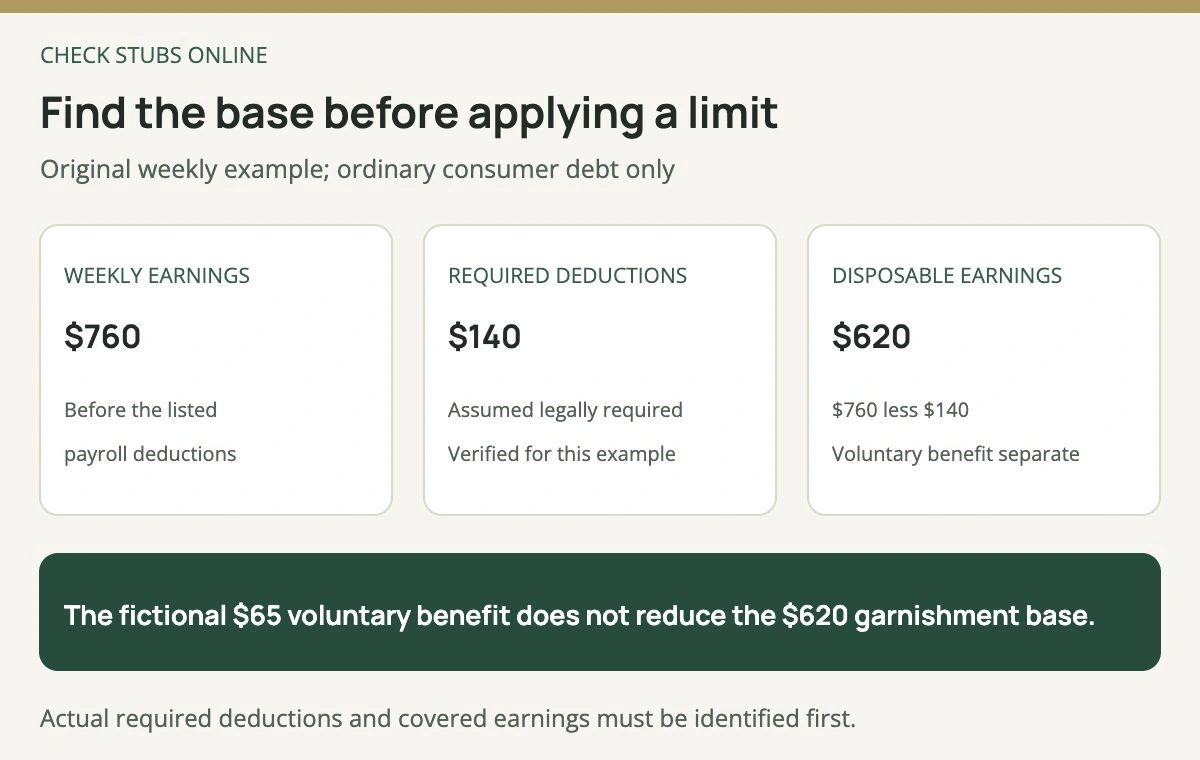
Identify legally required deductions before applying a garnishment limit. The voluntary benefit belongs to a separate cash reconciliation.
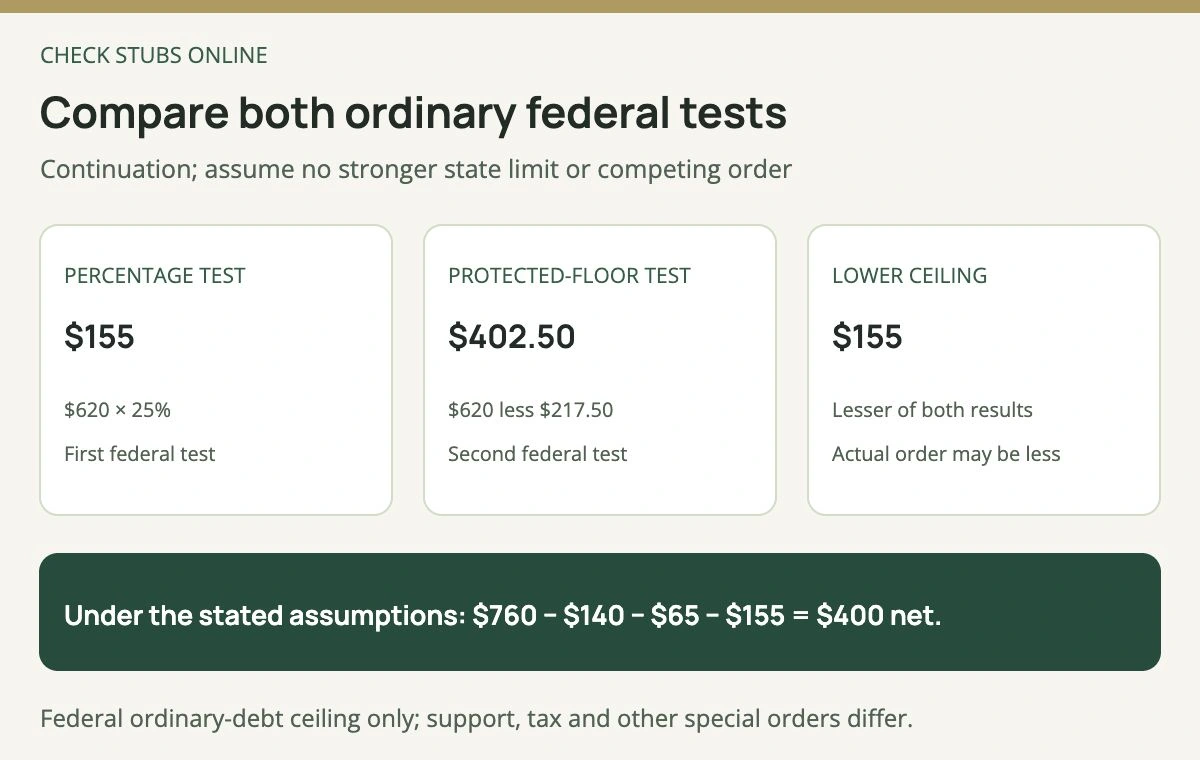
Both federal tests are compared for the same weekly disposable earnings. The actual deduction must also satisfy the order and applicable protections.
## A lower-earnings week can produce less than 25%
Use a separate fictional week with $260 disposable earnings. The percentage test gives $65, while the amount over the $217.50 floor is only $42.50. The lower ordinary federal ceiling is therefore $42.50 under the same limited assumptions. Withholding $65 solely because it is 25% would miss the other test.
If weekly disposable earnings are at or below the protected floor, the ordinary federal formula leaves no amount available for that garnishment. That statement does not resolve a support, tax or other special order, and a state rule can provide more protection for the ordinary debt case.
**Two fictional weeks: the same ordinary framework gives different ceilings**
| Week | Disposable earnings | 25% test | Above-floor test | Lower federal ceiling |
| --- | --- | --- | --- | --- |
| First example | $620.00 | $155.00 | $402.50 | $155.00 |
| Lower-earnings example | $260.00 | $65.00 | $42.50 | $42.50 |
The examples differ by $360 in disposable earnings and $112.50 in the federal ceiling. That change does not indicate a new debt or a higher claim. The second week switches which federal test is more protective. No change in the debt is needed to explain the different ceiling under these assumptions.
Recalculate from the actual period’s records when pay changes. Do not copy last week’s deduction just because the case number is the same. A smaller earnings base and a smaller remaining order balance are different reasons for the amount to change.
## Match the pay frequency and account for other orders
Section 870.10 provides period adjustments; its weekly dollar floor is not reused unchanged for a biweekly or monthly paycheck. Confirm the payroll frequency and use the correct period calculation. [Biweekly and semimonthly payrolls](https://blog.checkstubsonline.com/biweekly-vs-semimonthly-pay) cover different intervals even when both produce roughly two checks in a month.
The ordinary ceiling is not a fresh 25% allowance for each creditor. Multiple orders and priority rules must be reviewed together. The CCPA limitation does not itself establish the order of priority. Ask payroll to identify other active withholding orders and the rule used before evaluating a newly added entry.
Applicable state law resulting in less ordinary garnishment must be respected. A federal example cannot establish what a specific state permits or what exemption a particular employee can claim. Obtain the relevant current state instructions through the court or a qualified adviser.
## Keep an order-to-payment log
Use a private log that connects each payroll entry to the right process. It can contain the statement date, pay period, covered earnings, qualifying deductions, calculated base, order reference, amount withheld and any remittance information provided. Keep the source documents rather than relying on a handwritten total alone.
For the fictional $760 week, one row would show $140 required deductions, $620 disposable earnings, a $155 ceiling, an assumed $155 actual withholding and $400 cash after the separate $65 voluntary benefit. If the creditor’s ledger has not yet credited the $155, record that as a remittance/crediting question rather than subtracting it again from the paycheck.
Payroll withholding and the creditor’s remaining balance are separate records. Interest, permitted costs, credits and processing timing can affect the latter. A total of past deductions does not alone establish that an order has ended. Request the appropriate payoff or release information and confirmation of how payroll will implement it.
## Separate a payroll error from a challenge to the order
For an apparent arithmetic error, give payroll the exact base and comparison. A useful request is: “For this weekly statement I calculate $620 disposable earnings after $140 required deductions. Please explain the $155 percentage test, the $402.50 protected-floor test and the actual withholding, including any state limit or competing order.” Use real records in place of the fictional figures.
For the validity of a debt, an exemption or an order dispute, review the notice and the relevant court/agency procedure promptly. Payroll can explain an entry, but a request to payroll is not automatically a filed objection or a court-ordered stop. The [FTC’s debt-collection guidance](https://consumer.ftc.gov/articles/debt-collection-faqs) warns against ignoring a lawsuit and explains that stopping collector contact does not make the debt disappear. Preserve response dates and seek appropriate legal help when needed.
The CFPB page links to legal-help options and explains the distinction between wage collection and protected money in a bank account. A bank freeze after payment is not simply another paycheck calculation. Keep its notice separately.
Use our [pay-stub correction process](https://blog.checkstubsonline.com/pay-stub-errors-correction) to track an issuer’s amended statement. If sharing records with an adviser or recipient, use an appropriate secure channel and review [permitted redaction and verification needs](https://blog.checkstubsonline.com/redact-pay-stub-before-sharing). Do not remove material deduction information from a record that needs to explain net pay.
## Wage-garnishment questions
### Is the limit always 25% of gross pay?
No. The ordinary federal test uses disposable earnings and compares two limits. The applicable order and stronger state protection can reduce the actual amount further.
### Does my voluntary insurance deduction reduce the garnishment base?
It generally does not under the stated CCPA definition, even though it reduces take-home cash. Check the legal character of the particular deduction.
### Can two creditors each take a separate 25%?
Do not stack that percentage for each order. Review aggregate limits, order types and priority rules together.
### Does the worked example apply to child support or an IRS levy?
No. Those processes have different rules. This article intentionally illustrates only an ordinary consumer-debt wage garnishment.
### Can a pay statement prove the remaining debt is paid?
It shows what payroll recorded as withheld. Match remittances, creditor credits and the appropriate release or order instructions before concluding that collection has ended.
Check Stubs Online constructed the two weekly scenarios independently and checked their arithmetic against the stated assumptions. The linked federal sources support the scoped explanation; no particular debt, exemption or order has been adjudicated here.
## Relevant document tool
Check the federal ordinary-debt limits
Review the DOL explanation, then match the order type, applicable state protection and your actual payroll records.
[Read DOL garnishment guidance](https://www.dol.gov/agencies/whd/fact-sheets/30-cppa)
The federal overview does not decide your debt, exemptions, order priority or state-specific procedure.
## Related guides
- [Biweekly vs. Semimonthly Pay: Paychecks, Dates and Salary](https://blog.checkstubsonline.com/biweekly-vs-semimonthly-pay)
- [Pay Stub Errors: How to Request and Track a Correction](https://blog.checkstubsonline.com/pay-stub-errors-correction)
- [Can You Redact a Pay Stub? Privacy and Verification Checks](https://blog.checkstubsonline.com/redact-pay-stub-before-sharing)