---
title: "What Is a 1099 Worker? Classification, Forms and Payment Records"
description: "Understand what a 1099 worker means, why a form does not decide employment status, and how to separate client receipts, expenses, profit and owner transfers."
url: "https://blog.checkstubsonline.com/what-is-a-1099-worker"
datePublished: "2026-11-10"
---
# What Is a 1099 Worker? Classification, Forms and Payment Records
Understand what a 1099 worker means, why a form does not decide employment status, and how to separate client receipts, expenses, profit and owner transfers.
Published: 2026-11-10
By [Check Stubs Online Editorial Team](https://blog.checkstubsonline.com/editorial-policy#editorial-team)
**“1099 worker” usually means someone being paid as an independent contractor, but receiving a 1099 or signing a contractor agreement does not decide the person’s legal status.** For federal employment taxes, review the actual control and working relationship. If the person is genuinely self-employed, keep payment and expense records and review the applicable tax obligations rather than treating every client deposit as employee take-home pay.
Reviewed November 10, 2026 · U.S. federal tax classification and original sole-proprietor recordkeeping example. Wage-and-hour, state and benefit-program tests need their own review. This guide does not classify a real worker or calculate an individual’s taxes. All example amounts and facts are fictional.
The phrase “1099 employee” mixes a payment-reporting label with employee status. That can hide the first question a worker or hiring business needs to answer: does the arrangement actually qualify as independent contracting? The paperwork follows that analysis; it should not replace it.
Use this guide to organize the facts, understand the different forms and keep an honest record of money received. For the specific document workflow, see [the contractor payment-statement guide](https://blog.checkstubsonline.com/contractor-pay-stub-maker-guide).
## In this guide
1. [Understand the 1099 label](#worker-meaning)
2. [Review the federal tax facts](#worker-control)
3. [Keep other legal tests separate](#worker-laws)
4. [Identify each form’s job](#worker-forms)
5. [Reconcile original business receipts](#worker-example)
6. [Keep useful supporting records](#worker-records)
7. [Handle uncertainty and tool limits](#worker-next)
8. [1099 worker questions](#worker-faq)
## A reporting form is not permission to classify a worker
Form 1099-NEC reports nonemployee compensation, as explained on the [IRS form page](https://www.irs.gov/forms-pubs/about-form-1099-nec). Its presence says that a payer reported a payment in that category. It does not establish that the payer’s underlying classification was correct.
Likewise, the absence of a form does not automatically make business receipts tax-free. Our [income without a 1099 guide](https://blog.checkstubsonline.com/report-self-employment-income-without-1099) explains the reporting task. Information-return requirements and the character of the underlying income are separate questions.
For the common-law federal tax analysis, the [IRS contractor-or-employee overview](https://www.irs.gov/businesses/small-businesses-self-employed/independent-contractor-self-employed-or-employee) directs businesses to consider control and independence across the full relationship. There is no fixed number of favorable facts that automatically produces contractor status.
## Review actual conduct and retained rights
Organize the federal tax facts into the IRS categories below. Keep evidence for each answer, including the agreement and how work is performed in practice. Treat the questions as a way to assemble the file, not a quiz that awards a legal classification after three boxes are checked.
**A federal tax fact organizer for a working relationship**
| Area | Questions to investigate | Useful evidence to retain |
| --- | --- | --- |
| Behavioral control | Who can direct methods, sequence, training and evaluation? | Instructions, training materials and evaluation criteria |
| Financial control | Who supplies investment, carries costs and has profit or loss opportunity? | Expense terms, equipment arrangements and business records |
| Type of relationship | What do the duration, benefits and actual terms show? | Agreement, renewal terms, benefit documents and working practice |
[IRS behavioral-control guidance](https://www.irs.gov/businesses/small-businesses-self-employed/behavioral-control) includes the right to direct how the work is done. A business does not have to exercise that right every day for it to matter. Working from home or being experienced enough to need little instruction does not settle the question.
The [financial-control guidance](https://www.irs.gov/businesses/small-businesses-self-employed/financial-control) looks beyond the payment label to investment, unreimbursed expenses, business opportunity and related facts. An hourly payment is not, on its own, proof that the recipient is an employee. Owning a laptop is not, on its own, proof of an independent business.
Under the [relationship guidance](https://www.irs.gov/businesses/small-businesses-self-employed/type-of-relationship), a written contractor designation is insufficient by itself. Lack of paid vacation or insurance also does not conclusively establish contractor status. Check the entire arrangement rather than selecting the one fact that supports a preferred result.
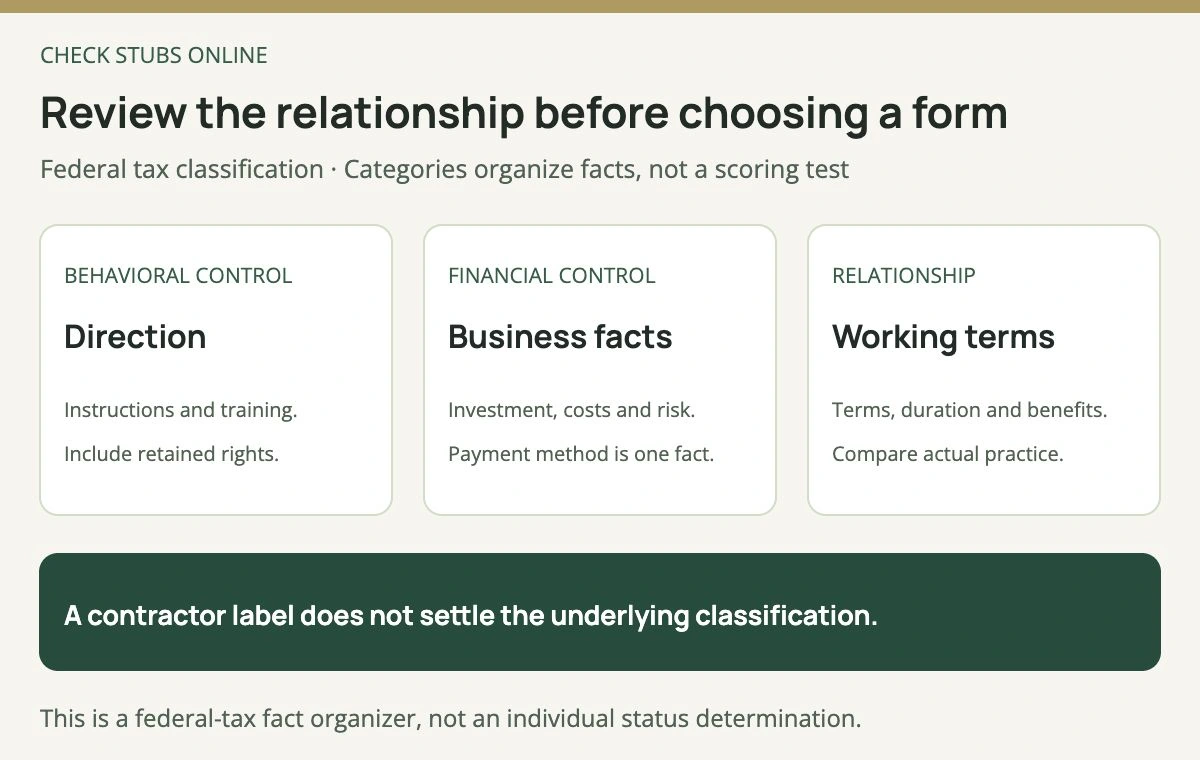
These categories organize a federal employment-tax review. The figure does not assign a status to a hypothetical or real individual.
## Federal tax status does not answer every legal question
Do not use a tax-form choice to decide minimum wage, overtime, unemployment insurance, workers’ compensation or state-law coverage. The relevant law and administering agency need their own analysis.
The [Department of Labor’s misclassification page](https://www.dol.gov/agencies/whd/flsa/misclassification) addresses the employment relationship and coverage for federal wage-and-hour protections. A person who is an employee under the applicable law cannot lose those protections merely because a business writes contractor on an agreement.
This article’s fact organizer focuses on IRS federal tax categories. It does not restate a particular wage-and-hour enforcement rule or replace state guidance. If the work location or legal issue changes, identify the relevant test before applying conclusions from another context.
## W-9, W-4, 1099-NEC and W-2 do different jobs
A request for tax information is not the same event as a year-end payment report. Our [W-9 versus W-4 comparison](https://blog.checkstubsonline.com/w9-vs-w4) explains why the forms are not interchangeable. A W-9 supplies payee tax-identification and related information; a W-4 provides employee federal withholding instructions.
A W-2 is an employer wage-and-tax report. A 1099-NEC reports nonemployee compensation in its applicable scope. A worker can have a wage job and separate genuine self-employment during the same year. Keep those activities and records distinct; a person is not required to have only one income category for every task they perform.
Do not substitute a 1099-MISC simply because it has a familiar number. The [NEC versus MISC guide](https://blog.checkstubsonline.com/1099-nec-vs-1099-misc) addresses their different reporting uses and year-specific rules. Neither form should be used to manufacture payments that did not occur.
## Original example: receipts, expenses and profit are different amounts
Assume a fictional service provider is correctly treated as a sole proprietor. In the selected month, the business receives $9,400 from customers and refunds $200. It pays $3,100 in business expenses that are expressly assumed allowable for this simplified example. There is no inventory, depreciation, loan receipt, contribution, sales tax or special timing item.
The net receipts are $9,200 and illustrative profit is $6,100. These figures are before the owner’s individual income-tax and self-employment-tax analysis. They are not an employee gross-to-net payroll calculation and not a statement of cash freely available after every business obligation.
**Original one-month sole-proprietor worksheet**
| Item | Amount | Treatment in this illustration |
| --- | --- | --- |
| Customer cash collected | $9,400 | Starting receipts |
| Customer refund | −$200 | Reduces those receipts |
| Net receipts | $9,200 | Cash collected less refund |
| Assumed allowable paid expenses | −$3,100 | Subtract once in this example |
| Illustrative profit | $6,100 | Before the individual tax analysis |
| Owner’s personal transfer | $2,500 | Separate draw; no reduction of this profit |
| Invoice still unpaid | $1,200 | Not received or constructively available here |
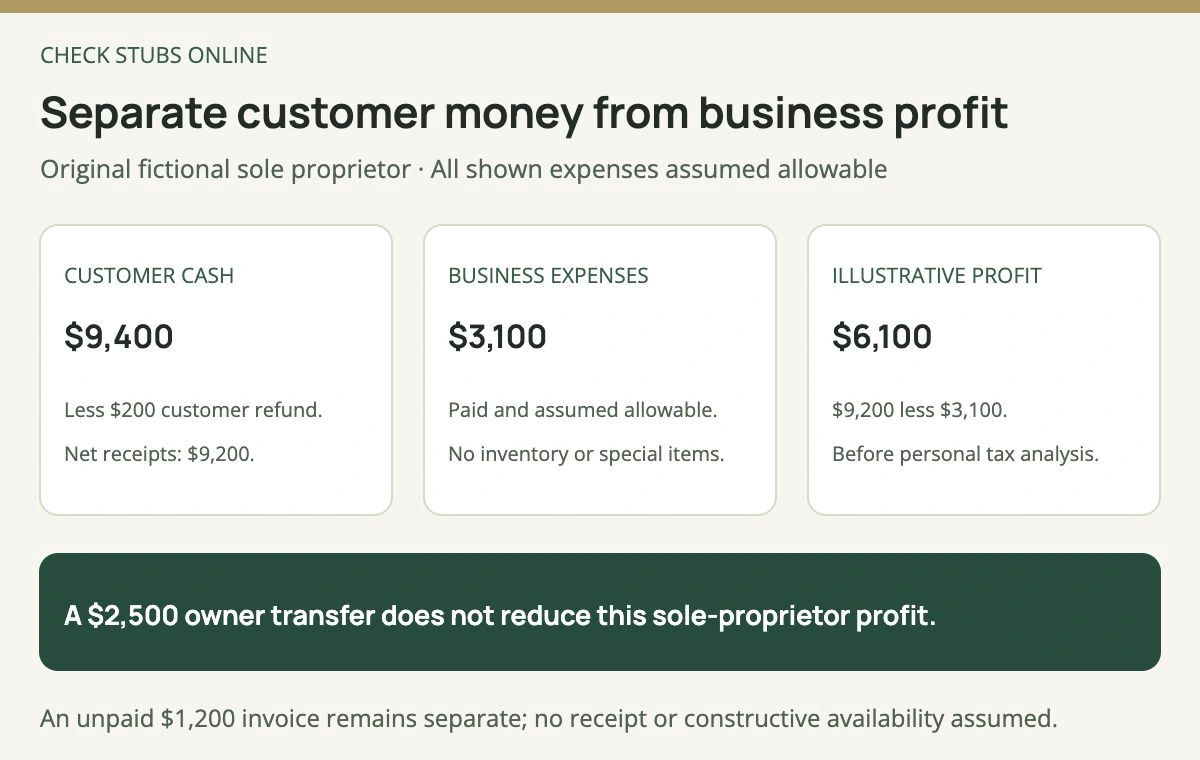
This limited worksheet separates business performance from the owner’s transfer and an outstanding invoice. It is not a complete tax return.
If the owner transfers $2,500 from the business account to a personal account, there is no second customer payment. For this sole proprietor, the draw is not a deductible salary payment to themselves. [IRS Publication 334](https://www.irs.gov/publications/p334) explains the treatment of personal withdrawals and accounting methods; its displayed edition is for 2025, and no annual tax rate from it is applied here.
The unpaid $1,200 invoice stays outside this cash illustration because no payment or unrestricted availability is assumed. Actual tax timing depends on the accounting method and receipt facts. A receivable can still be a useful business record without being cash already collected.
## Build a record trail that explains the money
Keep the agreement, invoices, payment confirmations, refund records, expense support and a ledger covering the same period. The [IRS recordkeeping guidance](https://www.irs.gov/businesses/small-businesses-self-employed/recordkeeping) explains the importance of support for income and deductions. A polished summary remains dependent on those source records.
Assign a reference to each invoice and match its payment without counting both documents as two receipts. Separate owner contributions, borrowed funds and transfers from customer revenue. If a payment processor deducts fees, retain the gross payment and fee information so a net bank credit can be explained.
The [IRS self-employed tax center](https://www.irs.gov/businesses/small-businesses-self-employed/self-employed-individuals-tax-center) distinguishes business profit and self-employment tax from income tax and describes estimated-tax planning. Use the actual year, business facts and household circumstances. A fixed percentage of every deposit is not an individualized tax calculation.
For an entity-choice question, see [the first LLC tax-return guide](https://blog.checkstubsonline.com/first-llc-tax-return). Do not carry the sole-proprietor draw treatment into a corporation’s payroll without reviewing its tax classification.
## What to do when the label or records are unclear
Ask the payer how it classified the relationship and identify which facts need clarification. Preserve the original terms and payment history. For a federal tax status determination, the [IRS Form SS-8 process](https://www.irs.gov/forms-pubs/about-form-ss-8) is available to firms and workers. A form-preparation website does not make that determination.
The [Check Stubs Online pay stub maker](https://www.checkstubsonline.com/pay-stub-maker) includes a Contractor option for arranging supported payment information. Choose the accurate mode and verify the parties, periods and actual amounts. It does not retrieve a payer’s records, establish worker status, issue a tax ruling or prove that a transfer occurred.
## 1099 worker questions
### Can a contract make anyone a 1099 worker?
No. The federal tax analysis considers the full working relationship, including actual control and retained rights.
### Does getting paid hourly prove employee status?
No. Payment method is one fact; it does not decide the entire classification.
### Is everything in a client deposit spendable take-home pay?
No. Business costs and the individual tax analysis remain separate. A client receipt is not the same calculation as an employee’s net paycheck.
### Can a self-prepared statement replace original payment evidence?
No. It can summarize supported entries, but the underlying invoices, payment records and other source documents remain important.
The Check Stubs Online Editorial Team reviewed primary IRS classification and business-record guidance, checked the original receipts-to-profit arithmetic, and kept wage-and-hour questions within their separate scope.
## Relevant document tool
Prepare a statement from supported payment records
The maker offers a Contractor option. Use the correct parties and periods, then compare every amount with the original payment trail.
[Open the pay stub maker](https://www.checkstubsonline.com/pay-stub-maker)
Preparing a statement does not determine worker status, retrieve payer records or verify payment.
## Related guides
- [W-9 vs. W-4: Key Differences and Which Form to Use](https://blog.checkstubsonline.com/w9-vs-w4)
- [First LLC Tax Return: Choose the Right Federal Filing Path](https://blog.checkstubsonline.com/first-llc-tax-return)
- [Contractor Pay Stub Maker: Document Actual Contract Payments](https://blog.checkstubsonline.com/contractor-pay-stub-maker-guide)